SK Group chairman speaks at Seoul National University
AI drawing astronomical investment, upending conventional market logic
AI agents can help resolve conflicts within organizations
Deregulation of large conglomerates needed to drive national economic growth
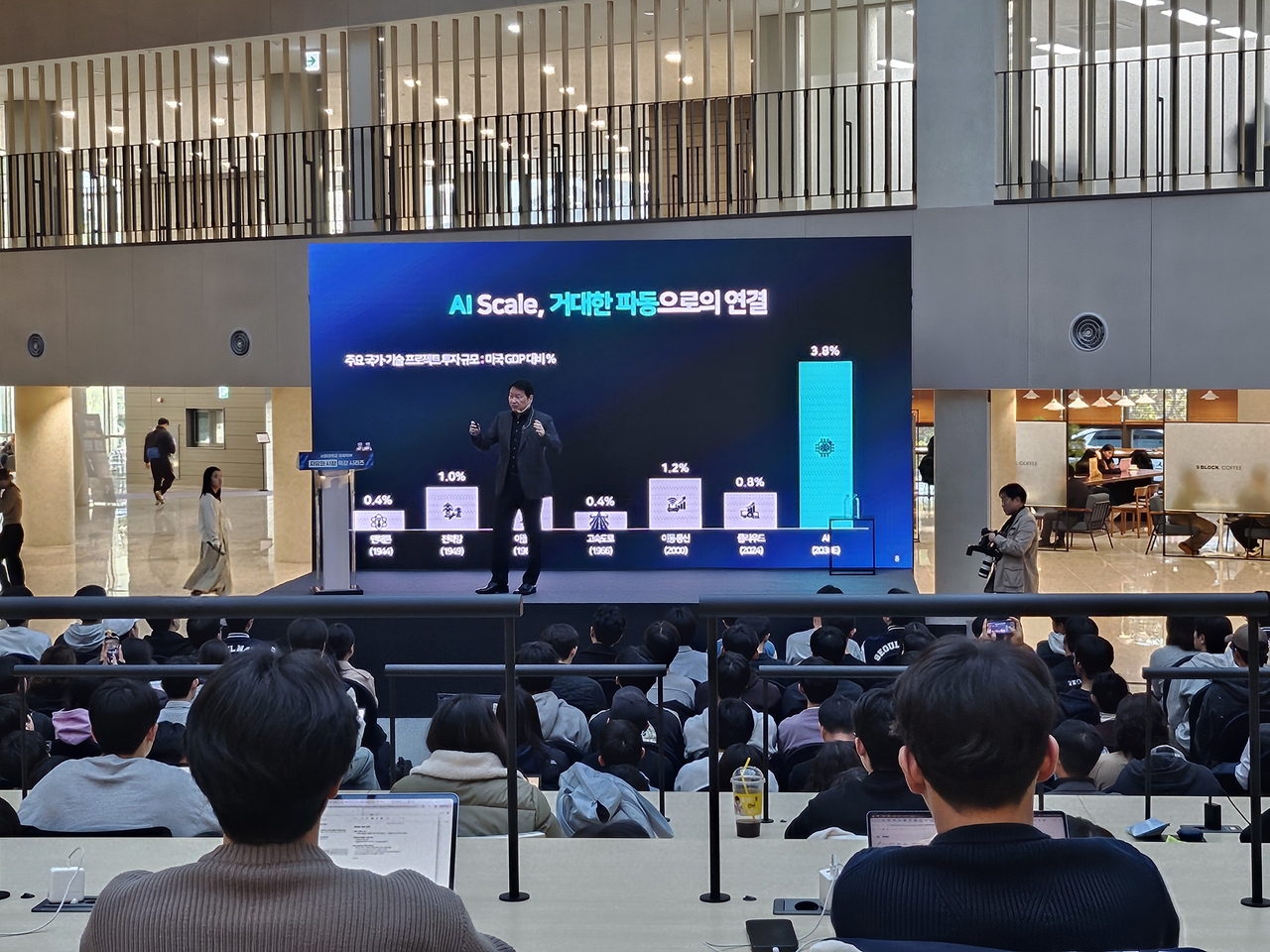
SK Group Chairman Chey Tae-won said the most essential skill in the AI era is the ability to design and build services. He also argued that South Korea must strengthen its industrial competitiveness through measures such as deregulating large conglomerates, as the world enters a period of sweeping transformation driven by astronomical investment in AI.
Chey made the remarks Thursday afternoon while speaking at a special session of Seoul National University's Department of Economics "Freedom and Markets Special Lecture Series," held at the university's College of Social Sciences. He was responding to an undergraduate student's question about what kind of education universities should provide in the AI age.
"The existing education system was built around imitating an already-designed framework, and South Korea itself developed by following the model of advanced economies rather than designing its own industries," Chey said. "But in this period of transition, where AI is reshaping markets, we need new capabilities."
He added that rather than asking universities to provide specific forms of education, individuals need to develop the ability to design and build things themselves. "What we should ask of universities is to give students the freedom to design something," he said.
Questions from Seoul National University undergraduates that day focused on the kind of talent needed in the AI era and the direction of industrial development.
Asked how individuals and organizations can reduce conflict in the AI age, Chey said that while competing interests inevitably clash within any organization, AI now makes it possible to navigate those tensions. "By using AI agents to analyze the information each member holds, we can accurately diagnose situations and reduce conflict," he said.
Chey also analyzed how economic growth itself is unfolding in fundamentally new ways amid the global AI investment boom. "The United States' national debt has reached 124 percent of GDP, and global investment in AI alone is approaching $6 trillion," he said. "We are seeing countries grow by rapidly accumulating debt in ways that conventional market logic simply cannot explain."
He added that the decades-long development model of focusing on exports within a single large global market under the World Trade Organization framework "is no longer valid."
As a way to strengthen South Korea's economic competitiveness in this environment, Chey pointed to the need for a better incentive system. His argument was that easing the regulatory burden concentrated on large conglomerates is essential to driving broader economic growth.
"During the high-growth era, regulations were imposed on large conglomerates on the grounds that their outsized share of the economy was bad for economic democratization," Chey said. "As a result, small and medium-sized enterprises have no desire to grow larger, and no one wants to enter regulated markets." He added that the government must send a clear message that companies will not lose welfare benefits and incentives if they grow into large conglomerates, saying that is the only way to grow the national economy as a whole.
Chey also put forward several broader solutions: a "New Capitalism" that rewards those who create social value; an "AI Native Nation" strategy that shifts South Korea's growth engine from semiconductors to AI services; and an "Expansion Option" built on deeper economic cooperation with Japan.
klee@heraldcorp.com