Chey cites semiconductor stock plunge at SNU lecture
'Excess liquidity amplifies even small shocks'
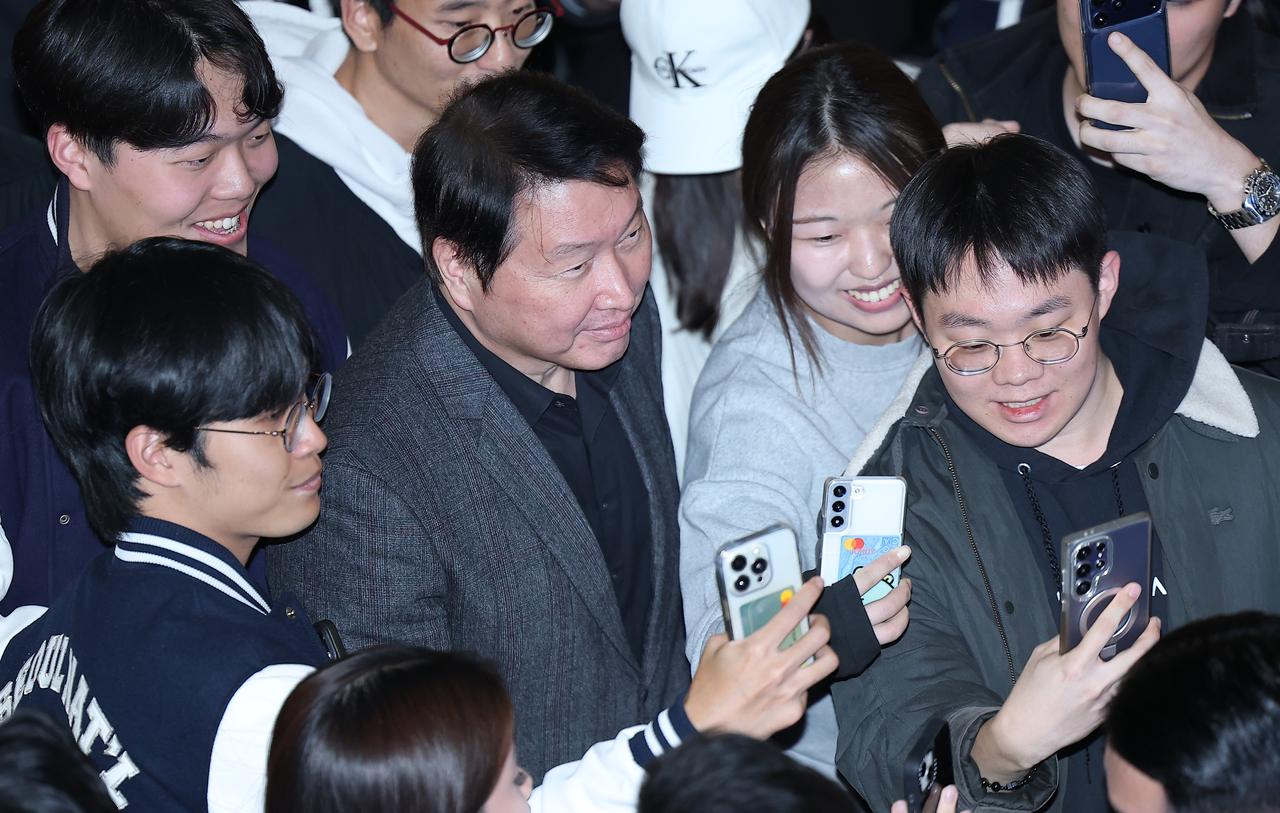
SK Group Chairman Chey Tae-won said Thursday that markets will keep swinging sharply in the wake of the US midterm elections, warning that investors must keep in mind that "the roller coaster will continue."
Chey made the remarks at a guest lecture titled "The AI Era: Changes in the Global Economic Paradigm and South Korea's Vision," held at Kim Jong-seop Hall at Seoul National University's College of Social Sciences in Gwanak-gu, Seoul. Chey was responding to a student's question about how the midterm results would affect SK hynix and other SK Group affiliates.
"I wish we could just say, 'Whatever happens in the midterms, what does it have to do with us?'" Chey said. "But judging by how much share prices fell today, it seems the market has decided the midterm outcome was not good for semiconductors."
Chey added that arguing about whether markets are rational "doesn't really mean much," saying the reaction showed that "a lot of people are expressing their anxiety this way."
Concerns have emerged that the Democratic Party's victories in gubernatorial races in Texas and Georgia — states with heavy concentrations of data centers — could lead to tighter regulation of AI infrastructure expansion. On Wednesday (local time), Nvidia's share price and the Philadelphia Semiconductor Index each fell about 3.1 percent.
Domestic semiconductor stocks also tumbled. Samsung Electronics closed regular trading down 7.57 percent at 201,500 won, while SK hynix fell 9.46 percent to finish at 1.264 million won.
Chey pointed to the excess liquidity that has built up since the global financial crisis as the reason even small signals can send markets lurching. He noted that major economies launched massive quantitative easing programs after the 2008 Lehman Brothers collapse, and that even more liquidity was pumped into the system during the COVID-19 pandemic.
"Too much money has already been unleashed," Chey said. "Because everyone said AI was where the money was, too much poured in — and here in Korea, because everyone said semiconductors were going up, people rushed in and bought all at once."
"When a correction comes, chaos follows, and things that went up too much come down just as hard," Chey added. "This kind of roller-coaster market is bound to continue."
Chey also noted that the intensifying global race for AI investment has pushed the scale of capital commitments to levels incomparable with the past.
Referring to the "three mega-projects" announced in June, Chey said he had wondered at the time whether it was even appropriate to make such an announcement. "The total investment pledged then was 2,100 trillion won ($1.57 trillion)," he said.
"In the past, an investment of 200 trillion won would have seemed enormous," he said. "Now we've gone past 10 times that. The nature of the game has completely changed, and so has the scale and concept of money."
"The whole world is in this game," he said. "Without betting like this, there is no way for us to keep up."
About 450 students from SNU's Department of Economics attended the lecture. It was Chey's first meeting with SNU economics students since a lecture in April 2022, roughly four and a half years ago.
In his remarks, Chey assessed that the US-China rivalry for global dominance is reshaping the existing international division of labor, and offered four prescriptions for the South Korean economy: "new capitalism," an "AI-native nation," an "expansion option" through South Korea-Japan economic solidarity, and an "incentive system" to drive economic growth.
hss@heraldcorp.com