Ruling comes about 11 months after first-instance verdict
Yoon delivers 80-minute final statement, repeats 'message martial law' claim
Criticizes current government, says 'the country is in crisis'
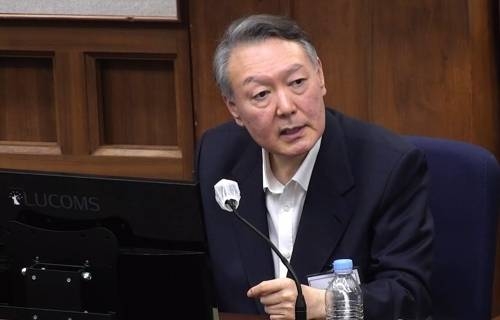
The appeals court verdict for former President Yoon Suk Yeol, who was indicted on charges of leading an insurrection in connection with the Dec. 3 emergency martial law declaration, will be handed down in late January.
The 12th Criminal Division of Seoul High Court announced Thursday that it will deliver its ruling at around 2:30 p.m. on Jan. 26 in the appeals trial of Yoon and former Defense Minister Kim Yong-hyun on insurrection charges. The second-instance judgment will come about 11 months after the first-instance verdict on Feb. 19 this year.
The closing arguments, which unfolded over three hearings beginning Friday, concluded Thursday. Earlier, the special prosecutor's team led by Cho Eun-seok sought the death penalty for Yoon — the same sentence it had requested at trial. Prosecutors sought life imprisonment for Kim and 30 years in prison for former Defense Intelligence Command chief Noh Sang-won.
In an 80-minute final statement Thursday, Yoon again argued that the emergency martial law declaration did not constitute insurrection because it was intended to alert the public to the opposition party's unilateral budget cuts, legislation and serial impeachments of government officials.
"The National Assembly, dominated by the large opposition party at the time, repeatedly carried out an unprecedented string of impeachments unseen in any modern state, unilaterally slashed budgets for core state functions including national security and public safety in a manner unprecedented in constitutional history, repeatedly introduced unconstitutional legislation that undermined the nation's future in terms of sound fiscal management, investment and jobs, and engaged in legislative abuses that paralyzed governance," Yoon said.
He added that he was "stunned" when the large opposition party moved to impeach the Board of Audit and Inspection chief — who had been auditing irregularities in National Election Commission hiring and the leak of classified military information on the THAAD deployment — and threatened to impeach the chief of the Seoul Central District Prosecutors' Office and key senior prosecutors, all while a series of impeachments continued. "And when I saw the budget for key surveillance, reconnaissance and data-link capabilities to counter North Korea's nuclear and missile threats being unilaterally cut, I concluded this was a national emergency that could no longer be left unaddressed," he said.
Yoon said he had considered declaring emergency martial law within the constitutional framework as a response. "I thought of it as an appeal-style martial law declaration to call for the public's awakening, and believed military deployment should be kept to a minimum," he said.
"There was no instance of neutralizing constitutional institutions such as the National Assembly or the National Election Commission, nor did the military or police use suppression or violence against citizens, lawmakers or civil servants," he said. "In short, a president's exercise of constitutional authority — accepted under the political oversight of the National Assembly — cannot constitute the crime of insurrection."
Yoon also repeated his claim that governance would have been restored had he not been impeached by the Constitutional Court.
"After martial law was lifted, the large opposition party launched impeachment proceedings and an insurrection campaign against me — yet after that, my approval rating and opposition to impeachment both surged well past 50 percent," he said. "Anti-impeachment rallies drew 10 to 20 times more participants than pro-impeachment ones, and countless high school students, university students and young people joined the anti-impeachment and pro-martial law movement, amplifying the anxiety of the large opposition party and forces seeking to subvert the system."
"Had I not been suspended from my duties by the impeachment motion and been able to explain to the public more frequently and in greater detail the anti-constitutional abuses of the large opposition party and the true nature of the system-subverting forces, I believe the collapsed constitutional order and paralyzed governance would have been restored to some degree," he said.
Yoon also strongly denied the special prosecutor's claim that a desire for long-term authoritarian rule had motivated the martial law declaration.
"If I had intended a coup — deploying large numbers of troops, maintaining martial law for an extended period and staging a political takeover — why would I have sent personnel to the National Election Commission for a security inspection immediately after the declaration?" he said. "Was it not to quickly check whether the basic security systems were functioning, given that martial law would soon be lifted by the large opposition party, and to seek systemic improvements if problems were found?"
"I have never even entertained the idea of long-term authoritarian rule, and the only power I held was authority granted by law — authority that was difficult to exercise fully even under those circumstances," he said.
Yoon also pushed back against the special prosecutor's claim that he had discussed emergency powers at dinner gatherings and drinking sessions, allegedly recruiting participants for the martial law plan. "If I was talking about emergency powers while intoxicated in front of others, that would actually prove I was not thinking about anything like martial law at the time," he said.
"Would I really have floated the idea over drinks, then met someone in a drunken state to ask their opinion and discuss it if they seemed receptive?" he said. "I have no memory whatsoever of anything I may have said while drunk — how could I have discussed martial law or recruited participants in that condition?"
Yoon also took issue with the first-instance court's finding — based on his public address vowing to "eradicate pro-North Korea forces" — that he had intended to neutralize the National Assembly. "The Democratic Party and the current government are now calling for the eradication of insurrection forces — do they mean to simply eliminate them without due process of law and trial, or are they saying to criticize, monitor and handle them according to the law?" he asked.
Yoon also directed criticism at the current government and ruling party. "The arrogance of power has reached its peak," he said. "There is no shortage of political figures claiming their own court cases are fabricated indictments."
"They say they will punish judges whose rulings they dislike, humiliate the head of the judiciary and impeach them," he said. "The judicial system of modern civilized nations, built up over many years, is also crumbling."
"Seeing all this, I think it is true that the country is in a state of crisis," he said. "I feel that we are all walking through the midst of tribulation."
Yoon's defense team, in its closing argument, invoked Alfred Dreyfus — the French Jewish army officer wrongly imprisoned on espionage charges in the late 19th century and later exonerated after a retrial — drawing a parallel and saying, "The guilt that inflamed public opinion was convinced of has collapsed before the truth."
"The truth is that there was no riot at the National Election Commission, the National Assembly or anywhere else, and where there is no riot, there is no insurrection," the defense said. "Yoon Suk Yeol declared emergency martial law to restore a free Republic of Korea in which the people are the true masters."
Kim, the former defense minister, said in his final statement that South Korea was "facing the greatest crisis in its history" due to what he described as a malignant force. "The three things I recognized as that malignant force while speaking with the president during the emergency martial law were: first, the legislative tyranny of the large opposition party; second, pro-North Korea and anti-state forces; and third, the collapse of the fairness and integrity of elections, which are the foundation of liberal democracy," he said.
"The president declared emergency martial law to inform the people of the crisis threatening national ruin and to uphold the constitutional order," Kim said. "His eyes, filled with tears, were full of deep anguish and desperation to protect liberal democracy — for the people and for the country."
Former Commander Noh said: "Regarding the Dec. 3 martial law, I tried my best to assist with Minister Kim's requests and have no regrets whatsoever. I am sorry that in the process, I inadvertently caused concern to many people."
After the hearing concluded, Yoon smiled and shook hands with his lawyers. He told one attorney, "Give me lots of good books to read. I like history books — you know, about wars and things like that."
He also said farewell to former Commander Noh, telling him, "We won't be seeing each other for a long time, but please take good care of your health."
Turning to supporters in the public gallery, Yoon expressed his gratitude. "Thank you so much for coming out in the cold," he said. "Your support has been a great source of strength for those of us standing trial."
He also asked supporters to "applaud the special prosecutors as well, as the Republic of Korea is a nation governed by the rule of law." The supporters responded with applause, calling out, "We love you, Mr. President" and "Stay strong."
Yoon and the other defendants were indicted on charges of inciting a riot with the intent to undermine the constitutional order through the Dec. 3 emergency martial law declaration.
In February, the first-instance court found that Yoon's act of dispatching troops to the National Assembly met the criteria for insurrection — namely "intent to undermine the constitutional order" and "riot" — and sentenced him to life imprisonment.
hss@heraldcorp.com