Index tumbles 6.02% on Friday, hitting 7-month low
Foreign investors dump 2.77 trillion won in shares
Nvidia, AMD and other US chip stocks bounce back
Analysts see bargain buying after oversized selloff
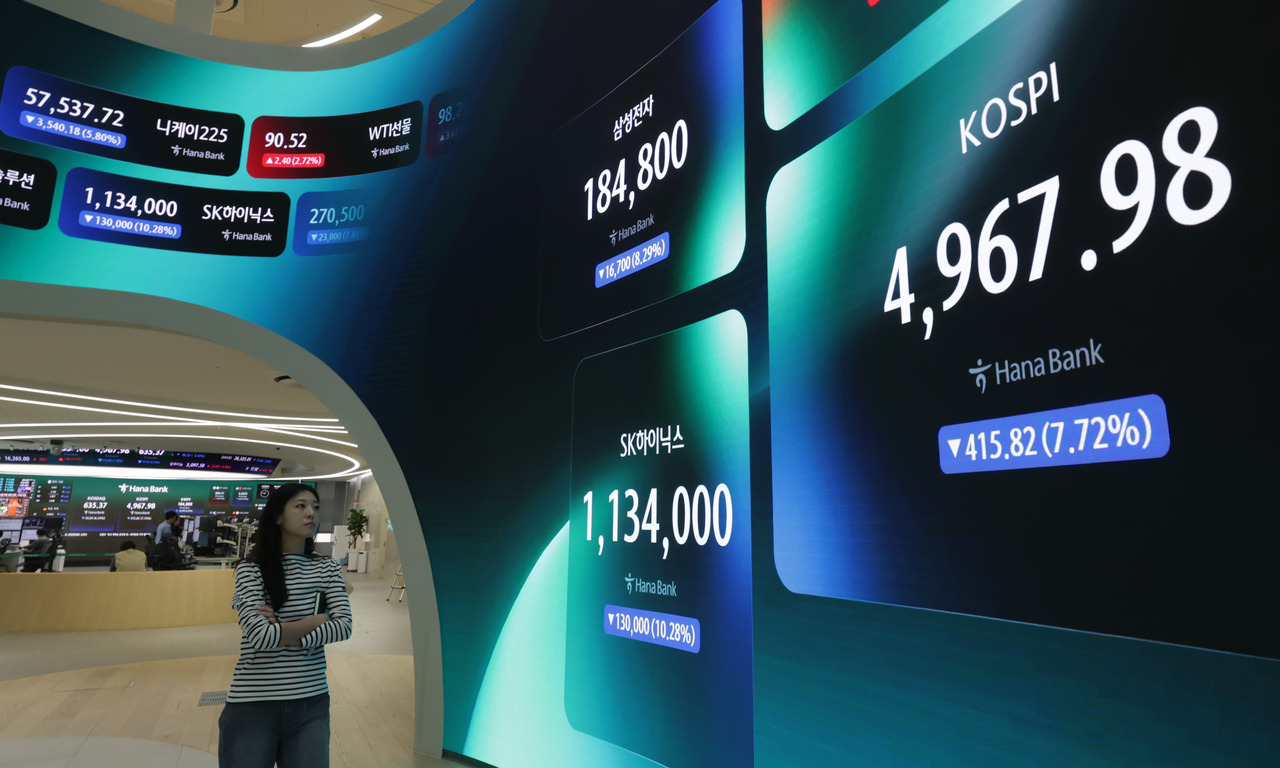
All eyes are on whether the Kospi can stage a rebound Monday after Friday's steep selloff, with investors watching for bargain buying to emerge following the previous session's sharp losses.
The Kospi closed Friday down 324.11 points, or 6.02%, at 5,059.69 — its lowest closing level in about seven months since it recorded 5,052.46 on March 31.
The index opened down 120.54 points, or 2.24%, at 5,263.26 before accelerating its decline, at one point falling as far as 4,911.28 — a drop of 8.78% — briefly breaking below the psychologically significant 5,000 level. It was the first time the index had dipped below 5,000 during intraday trading since Feb. 6, a gap of nine months.
The severity of the selloff triggered both a circuit breaker and a sell-side sidecar on the Kospi market during the morning session.
Foreign investors net sold 2.77 trillion won ($2.06 billion) worth of shares, while institutions and retail investors were net buyers of 1.07 trillion won and 601 billion won, respectively.
Analysts attributed the Kospi's plunge to a wave of panic selling in technology stocks — particularly semiconductors — on Wall Street, driven by concerns that a sweeping Democratic Party victory could lead to tighter regulation of AI data centers.
The Nasdaq Composite fell 5.52% and the Philadelphia Semiconductor Index plunged 12.25%. Domestically, Samsung Electronics and SK hynix — the two dominant semiconductor names on the Korean market — at one point tumbled 11.07% and 13.84%, respectively, adding heavy downward pressure on the index.
Samsung Electronics ended the regular session down 6.35% at 188,700 won, surrendering the 200,000-won threshold that investors had dubbed "200,000 Electronics." SK hynix closed down 10.44% at 1,132,000 won.
Authorities moved quickly to cushion the blow, announcing a three-month suspension of the requirement for securities firms to maintain a 140 percent collateral ratio on margin financing.
The Kospi is expected to open higher Monday, with bargain buyers likely to step in following Friday's steep decline. On Wall Street over the weekend, dip buyers returned to beaten-down technology stocks, lifting share prices and indexes broadly.
The Nasdaq Composite rose 1.09% and the S&P 500 gained 0.31%, though the Dow Jones Industrial Average slipped 0.46%.
Major chip stocks rebounded, with Nvidia up 2.78%, AMD up 11.04% and Micron up 5.12%, while the Philadelphia Semiconductor Index surged 4.2%. The MSCI Korea ETF rose 4.07% and the MSCI Emerging Markets ETF gained 2.20%. KOSPI 200 overnight futures also bounced 1.60%.
Seo Sang-young, a managing director at Mirae Asset Securities, said the Korean market would open higher Monday, supported by a rebound in US semiconductor stocks and bargain buying after the oversized decline. "Delays in new data center permits do not mean reduced demand for memory chips in existing servers," Seo said. "The core drivers of the memory chip cycle — a supply shortage and rising prices — have not been undermined in the short term, so buying interest will emerge given how far the market has fallen."
Seo added that this week's market direction would hinge on the actual impact of data center regulations, credit risks at CoreWeave and Nebius, inflation data and government bond auctions, and any interest rate signals from Federal Reserve officials.
Lee Je-won, a researcher at Yuanta Securities Korea, said the current selloff had run ahead of any confirmed fundamental deterioration. "The plunge reflects fears of future investment cuts and a supply-demand imbalance rather than actual damage to fundamentals," Lee said, noting that the intraday low in the 4,900s corresponded to roughly 1.2 times the trailing 12-month price-to-book ratio.
Lee said this was not the time to sell, but cautioned that any decision to add to positions should be made after monitoring 2028 earnings-per-share forecasts and whether credit risks among AI infrastructure companies stabilize.

yuni@heraldcorp.com