Ministry reviewing timing of levy on Banpo Hyundai complex
Banpo 3rd district, Sinbanpo 21st complex also face charges
Market warns double burden of construction costs and levy could chill rebuilding
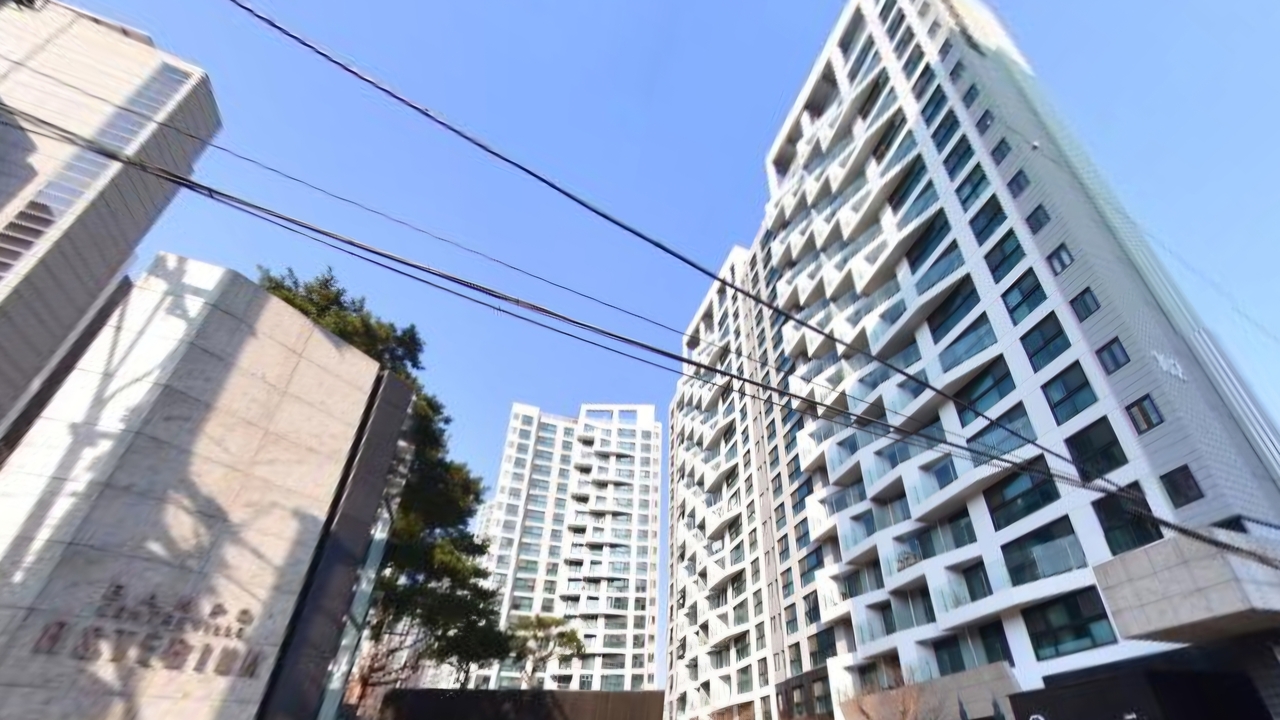
The government has reaffirmed its commitment to imposing levies under the reconstruction excess profit recapture regime. While the Ministry of Land, Infrastructure and Transport said it is reviewing the legal timing of the levy on the Banpo Hyundai complex in Seocho-gu, Seoul, it made clear the regime itself will continue. The ministry also pushed back against concerns that the levy could dampen reconstruction activity and constrain housing supply, saying the impact would be limited.
According to the reconstruction industry, Seocho-gu was set Monday to visit the Ministry of Land, Infrastructure and Transport to deliver its position on the reconstruction excess profit recapture system and submit a petition from residents. The district was also scheduled that day to send a levy notice to the Banpo Hyundai reconstruction complex — now known as Banpo Centreville Asterium — making it the first complex to receive such a charge under the regime.
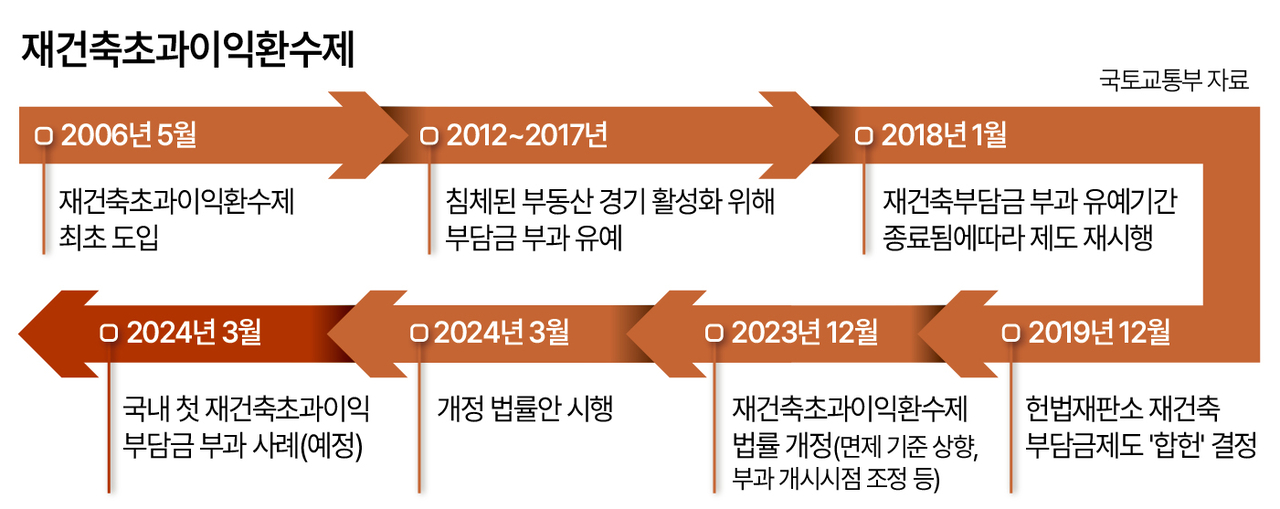
The reconstruction excess profit recapture system has alternated between enforcement and suspension with each change of government over the past two decades. Introduced in 2006 to recoup windfall gains from reconstruction projects, it calculates excess profit by subtracting the property value at the start of a project, normal price appreciation and development costs from the value at completion, then levies a charge on association members accordingly.
Actual imposition of the levy was suspended for an extended period depending on real estate market conditions. In particular, reconstruction projects that applied for management and disposal plan approval between Dec. 18, 2012, and Dec. 31, 2017, were exempt from the charge. Related legislation was then amended in December 2023, and a revised, more lenient regime took effect in 2024.
The disagreement between Seocho-gu and the ministry over the timing of the levy stems from this history. Seocho-gu has in principle called for the regime to be abolished outright. Under current law, however, the district argues that given the completion date of the Banpo Hyundai complex — July 30, 2021 — the levy must be imposed by Dec. 30 this year, taking into account the five-year statute of limitations and the five-month imposition window from the completion date.
"We plan to visit the ministry to convey our position on abolition and submit a residents' petition," a Seocho-gu official said. "If the ministry issues an official legal interpretation that the levy can be imposed up until 2029, we could defer the imposition schedule accordingly."
Separately from its legal review of the timing, the Ministry of Land, Infrastructure and Transport said it intends to proceed with imposing reconstruction levies as a matter of principle. If it does, the Banpo 3rd district complex (Raemian Trinione), the Sinbanpo 21st complex (Otiere Banpo) and the Sinbanpo 18th complex Building 337 (Otiere Sinbanpo) are all expected to receive levy notices in succession.
The ministry said the regime must continue because the 2023 legal amendments already introduced multiple relief measures, including revised exemption thresholds and a new calculation method for excess profits. "The law was amended so that various relief measures — including the 2024 exemption threshold and the revised start date for levy calculation — would apply," a ministry official said. "Because the law remains in force, levies must be imposed in sequence."
The ministry also drew a line against criticism that the levy could stifle reconstruction projects and obstruct housing supply, even as the government has been emphasizing an expansion of housing supply to stabilize the real estate market. "The reconstruction excess profit recapture system reclaims excess profits only when they actually arise from reconstruction," a ministry official said. "Its direct link to project viability is not significant." The ministry views the dampening effect on housing supply as limited.
The market, however, has pushed back, arguing that the levy erodes the financial viability of reconstruction projects and weakens the incentive for association members to participate. "In the case of Eunma Apartments, even assuming a move to a unit of the same size, the total cost including the reconstruction excess profit levy is expected to reach around 900 million won ($663,000)," said an official at a reconstruction association in Seocho-gu. "Other complexes are anticipating a similar level of additional costs." The official added that even accounting for changes in the value of money, such additional burdens could undermine reconstruction viability and suppress housing supply.
Song Seung-hyeon, head of Urban and Economy, said the levy could feel unfair to association members who continue to live in their homes without realizing any gains, since it effectively taxes unrealized profits. "In the current situation, where home prices in some areas such as Gangnam are undergoing a correction, there is also a risk that prices could fall after a levy has already been paid," Song said.
Song added that with additional contributions already rising sharply due to higher construction costs, the reconstruction excess profit levy could in effect bring reconstruction projects to a halt. "The lower an association member's financial capacity, the less incentive they have to participate in reconstruction," Song said.
hss@heraldcorp.com
quq@heraldcorp.com