Stablecoin opportunity lies in migrant remittances, tourist payments
Tether, Ripple discuss shifts in global payment networks and Korea use cases
Tether: 'Focus on cross-border links, not competing with domestic payment networks'
Ripple: 'Korean regulation is slow, but institutional infrastructure is being built'
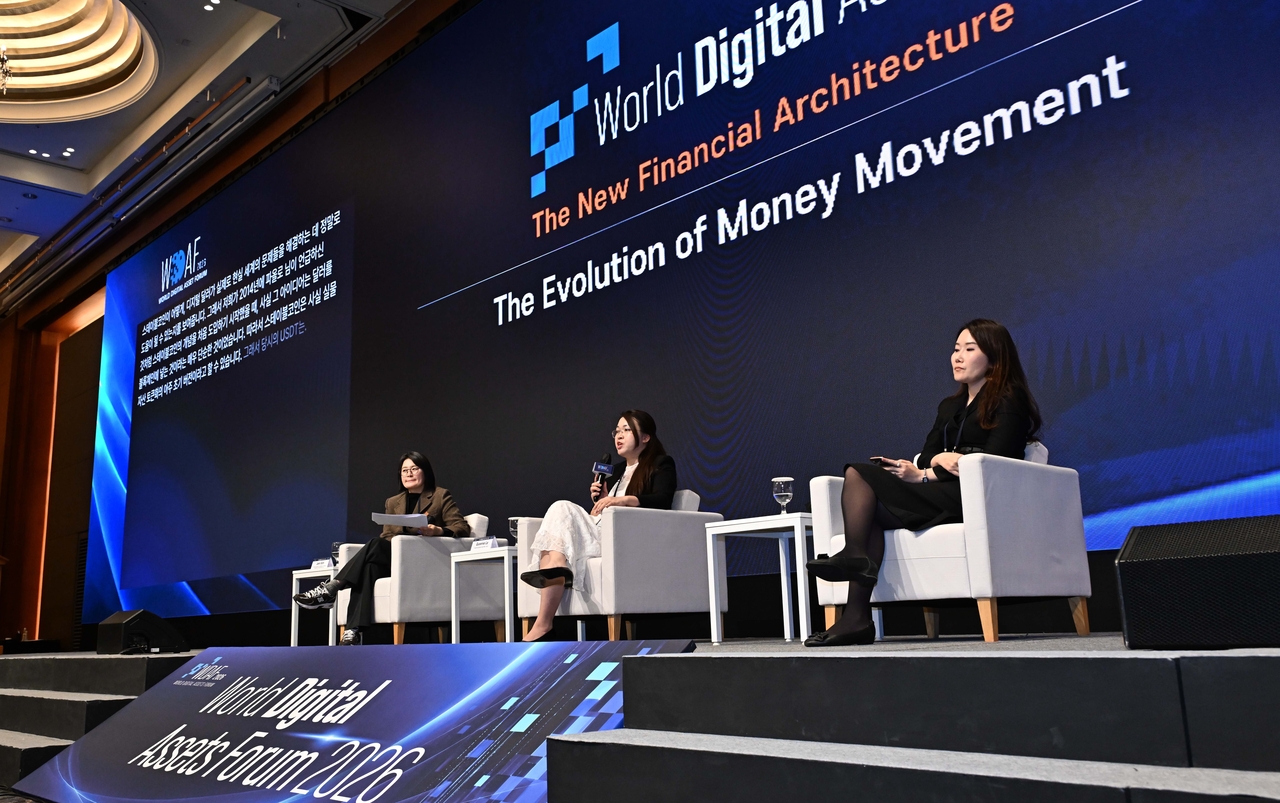
Cross-border remittances and payments by foreign tourists visiting South Korea are the most promising domestic use cases for stablecoins, analysts said Monday. Stablecoins and blockchain technology could broaden the scope of Korea's financial sector — not only in cross-border transfers and payments, but also in asset custody and management by financial institutions.
The inaugural World Digital Assets Forum (WDAF), hosted by The Herald Business and The Korea Herald at the Grand Lotte Seoul in Sogong-dong, Seoul, convened Monday under the theme "The New Financial Architecture," bringing together financial market and digital asset industry leaders to discuss the sector's transformation and the path forward.
The session titled "The Evolution of Money Movement" examined how the spread of stablecoins is reshaping global payment networks and the potential for their adoption in the Korean market. The discussion, moderated by Kim Ji-hyun, head of innovation strategy at Herald Media Group, featured Quinnie Le, head of Asia-Pacific expansion at Tether, and Jinny Lee, Asia-Pacific institutional sales director at Ripple.
Le said stablecoins' competitive edge in Korea lies in cross-border money movement. Given that domestic banking apps and payment methods are already well developed, the focus should be on connecting Korea to overseas markets rather than competing with existing domestic payment infrastructure. "The competitive advantage and added value that USDT can offer is cross-border payments," Le said.
Le particularly highlighted Korea's extensive business ties with emerging markets, saying stablecoins could serve as a link to countries such as Brazil, Argentina, Turkey, Vietnam and the Philippines. Specific use cases proposed included remittances sent home by foreign workers — particularly from Vietnam — payments by tourists visiting Korea, and a mechanism for exporters to receive proceeds in USDT before converting them into won or a won-based stablecoin.
Le said tourist payments would be the easiest case for regulators to consider, noting that capital flows into the country in that scenario. "From the regulator's perspective, it is the easiest use case to adopt," Le said, pointing to QR-code payments through the PayPay merchant network in Japan as a model. "If Korean regulations allow it, it would be entirely feasible," Le added.
As a corporate use case, Le introduced a proof of concept conducted by Hyundai Motor between the United States and Mexico. Hyundai Motor worked with Ava Labs, the developer behind Avalanche, and Axiym, a Tether portfolio company, to move treasury assets from the US to Mexico using USDT. Transaction time fell from three to four hours to under seven minutes. Le also noted that the project involved discussions with the company's compliance and regulatory teams throughout the process.
Le said the channels through which stablecoins are used are also evolving. Whereas companies previously converted fiat currency into USDT through over-the-counter desks and local virtual asset service providers, they are increasingly connecting directly or indirectly with banks. In this emerging model, companies handle fund receipt and foreign exchange through banks while using USDT as the cross-border payment layer.
On the Korean market, Lee said digital asset regulation remains slow to develop, even as institutions steadily build out their infrastructure. "Many stakeholders around the world are paying close attention to Korea's digital asset market," Lee said, "but Korean regulation is moving very slowly."
Even so, Lee said institutions are already in the adoption phase, running small-scale proofs of concept, and that interest in digital asset adoption has grown considerably. Domestic examples cited included Kyobo Life's tokenized government bond proof of concept, Mirae Asset Securities' use of Ripple custody for tokenized bonds, and Jeonbuk Bank's cross-border remittance service through Ripple Payments.
On the regulatory environment — including a security token offering bill set to take effect next year — Ripple said compliance is its top priority and that it operates a dedicated policy team. The company added that current discussions with institutional clients and prospects center on custody and wallet infrastructure for holding and managing digital assets.
Meanwhile, Tether outlined its future direction as real-world asset tokenization and the expansion of wallet and AI technology. Le introduced Tether Gold, a gold-backed token, and a platform supporting asset tokenization for governments and corporations, saying the company aims to help tokenize a broad range of assets including money market funds, ETFs and securities.
Ripple, for its part, emphasized expanding service adoption among institutional clients. Lee said Ripple serves more than 1,700 institutional clients worldwide and that demand for bundled adoption of multiple Ripple solutions is growing. The company plans to expand its custody, wallet, payments, prime brokerage and treasury management services, and to extend its infrastructure to individual users through banks and fintech firms.

forest@heraldcorp.com