BNY executive joins panel debate at WDAF 2026
Stablecoins vs. legacy payment rails: efficient upgrade or overhyped?
Dollar dominance to persist, or fade with agentic commerce?
'Korea's next evolution after electronics and autos is digital assets'
"Korea has already built a pretty impressive house."
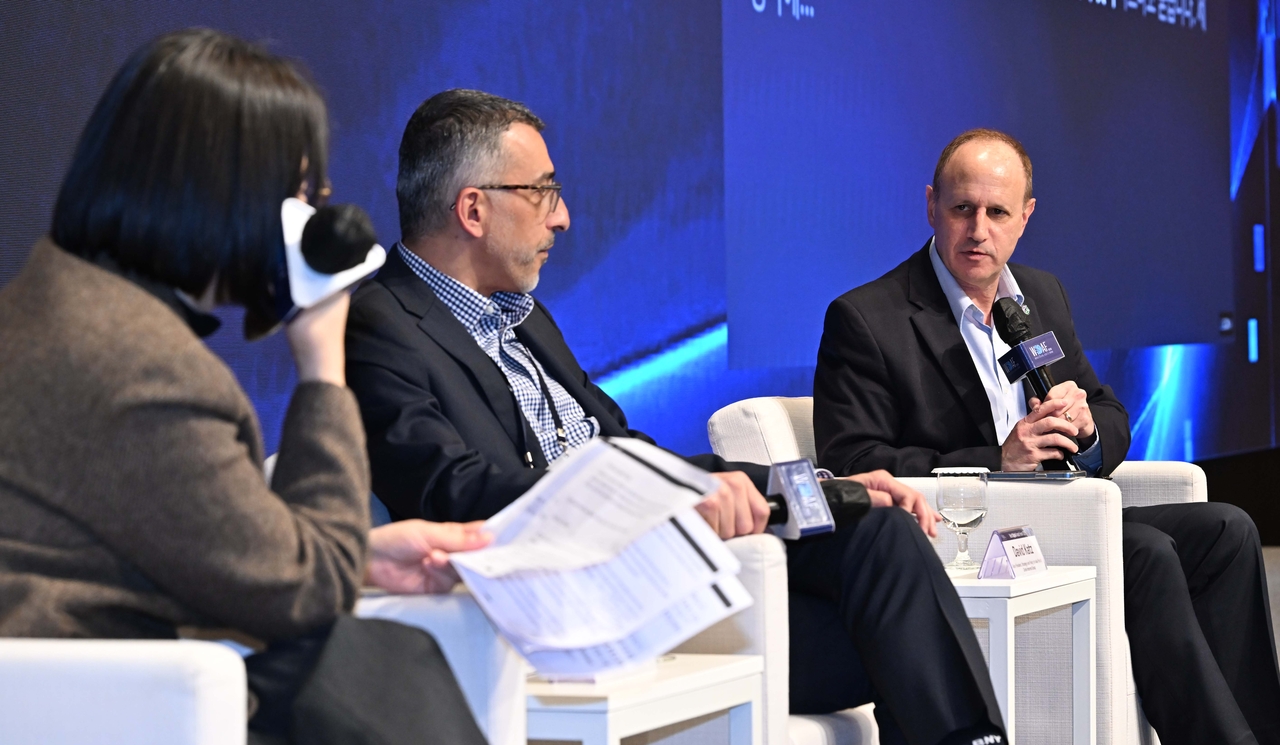
David Katz, Circle's vice president of Asia-Pacific strategy and policy, praised South Korea's virtual asset trading environment as among the best in the world and said the country must now seize a far larger opportunity — the real economy.
Katz made the remarks Monday during a panel discussion at the inaugural World Digital Assets Forum (WDAF), hosted by The Herald Business and The Korea Herald at the Grand Lotte Seoul in Sogong-dong. He was joined on stage by Fabian Koschat, BNY's Asia-Pacific head of global payments and trade, for a wide-ranging debate on the future of stablecoins and traditional finance.
Drawing on a building metaphor to describe South Korea's digital asset market, Katz said the country's virtual asset trading environment "ranks among the most robust in the world" and that "the energy around digital assets you feel in Seoul is second to none anywhere on the planet." He added, however, that bitcoin's market capitalization of $1.5 trillion, while large, is small compared with the real economy. "Korea's bigger opportunity lies in the real economy," he said.
Katz said that to build a taller structure, the foundation must come first. He noted that the first phase of virtual asset legislation — the Virtual Asset User Protection Act — had established a basic framework, and that strong signals were emerging from the National Assembly that second-phase legislation, a digital asset framework act, was on its way. He added that the private sector had already formed a consortium that would lay the groundwork for issuing a won-denominated stablecoin once the Financial Services Commission, the Bank of Korea and the National Assembly moved forward. "The Korean market is doing everything it can to be ready to move the moment legislation follows," he said.
Koschat said he, too, had felt the shift in the Korean market firsthand. "Korean customers are asking questions today that they would not have asked six to 12 months ago," he said. "At the start of last year it was pure curiosity — now they are asking for advice on what to do. It is a fundamental change, and it is happening across both banks and non-bank financial institutions." He added that the pace at which Korea had delivered innovative technology over the past decade was "remarkable compared with other North Asian markets," and that just as Korea had transformed the electronics and automotive industries, digital assets represented the next stage of that evolution.
On the relationship between stablecoins and legacy payment networks, the two panelists diverged sharply. Koschat said stablecoin use had grown but had not displaced the traditional ways money crosses borders. "Hundreds of years of correspondent banking infrastructure will continue to handle cross-border payments," he said, pushing back on the notion that international transfers are slow. "We at BNY can send money in 25 different currencies in under 60 seconds."
Katz countered by pointing to what he called a structural advantage of stablecoins. "When you receive a bank wire, the amount shows up in your account but there is a 'pending' flag next to it — you receive the message before you receive the value," he said. "With a stablecoin, the message and the value arrive as one, which dramatically reduces credit risk and lets corporate treasurers manage their finances far more efficiently." He went on to cite tokenization and AI as the two key drivers, arguing that "Korea, as a high-technology, trade-oriented economy, needs the efficiency that stablecoins and digital assets provide."
The two also disagreed on the dollar's dominance in the stablecoin market. Katz acknowledged that the current dollar-centric picture was unsurprising given that 75 percent of intra-Asia-Pacific trade contracts are denominated in dollars, but said "that is what it looks like today — it is not what it will look like in the future." As real-world assets such as shares and bonds are tokenized and traded in local markets, he argued, demand for local-currency stablecoins will grow. He also pointed to "agentic commerce" — AI agents transacting autonomously — as a force that will further drive demand for non-dollar stablecoins. Circle operates StableFX, an on-chain foreign exchange system built on its own blockchain, Arc, that allows stablecoins to be exchanged directly without routing through the dollar.
Koschat was skeptical. "The de-dollarization debate has been repeated ad nauseam, but I have yet to witness actual de-dollarization," he said. "Whether it is Southeast Asia or small and medium-sized enterprises on the Chinese mainland, customers want dollars, not local currency." He noted that the dollar's share of trade settlements had fallen only 2 percentage points — from 82 percent five years ago to 80 percent today. "There will be a natural shift over time, but it will take a long time to get there," he said.
Asked which Asia-Pacific jurisdiction was furthest ahead on regulation and institutional frameworks, Koschat named Hong Kong. "A year and a half to two years ago I would have said Singapore was well ahead, but Singapore kept running proof-of-concept exercises and got stuck at that stage," he said. "Hong Kong decided it wanted to go live in real markets and issued stablecoin licenses. The goal should be actual implementation, not staying in proof-of-concept mode."
Katz ran through a list of regulatory milestones — the EU's Markets in Crypto-Assets regulation, the US GENIUS Act, and legislation in Japan, Singapore and Taiwan — before noting that momentum in Korea was also building rapidly. "The most important signal is that every major regulator in the world either has a digital asset framework in place or is putting one in place," he said.

kimstar@heraldcorp.com