Climate change experiment facility at Hongnŭng test forest to track shifts in carbon absorption
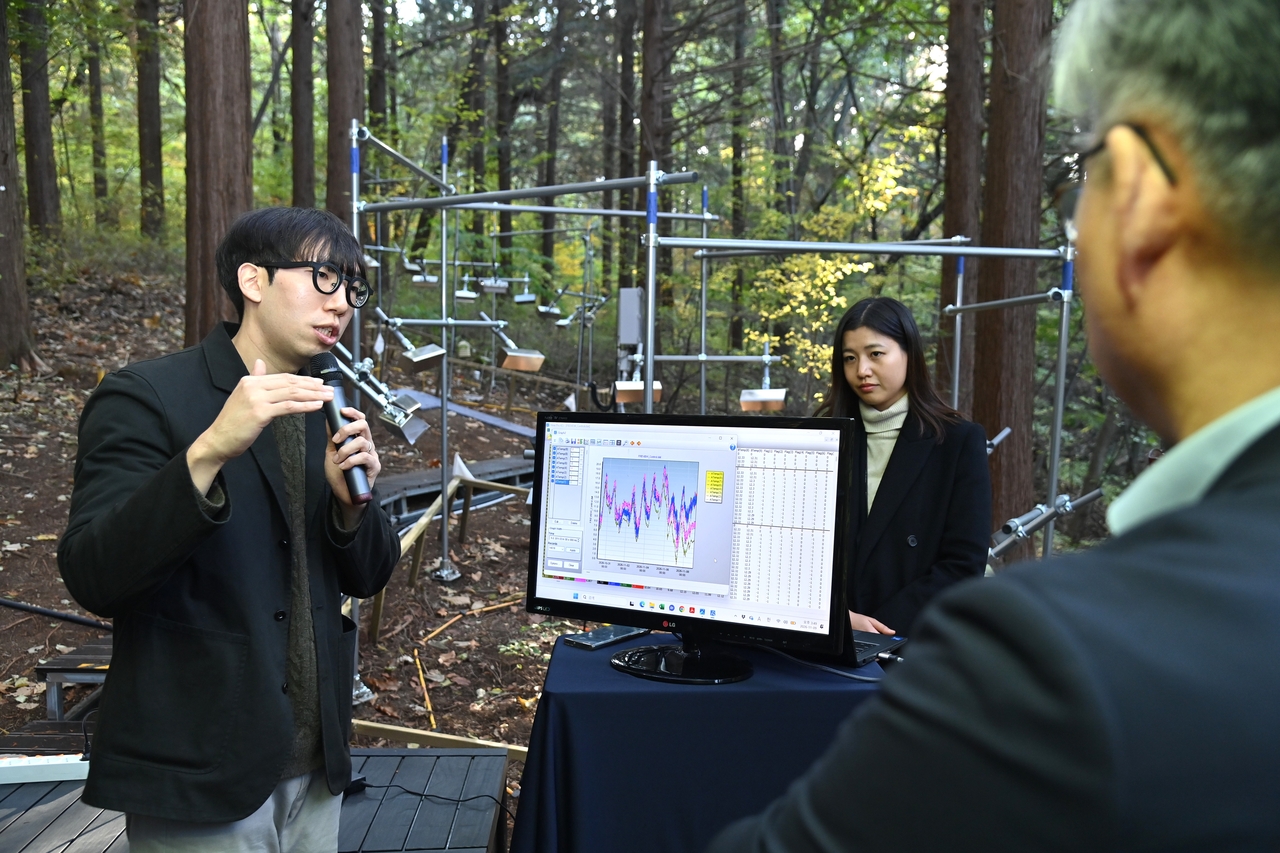
South Korean researchers have built an experimental facility inside a real forest that can simulate future heat waves and warming conditions to analyze how trees grow and absorb carbon under climate stress. The installation is expected to help scientists determine how severely the climate crisis could weaken forests' carbon-sequestration capacity and to inform future forest management strategies.
The Korea Institute of Science and Technology (KIST) announced Tuesday that it had established the "FReVIEW Forest Climate Change Testbed" at the Hongnŭng test forest in Seoul, in collaboration with the National Institute of Forest Science and the Smithsonian Environmental Research Center in the United States.
Forests are a critical carbon sink, absorbing carbon dioxide from the atmosphere. But as global warming drives more frequent and intense heat waves, concerns are growing that forests' ability to absorb carbon may be significantly altered.
Existing research has largely relied on methods that raise temperatures at a constant, steady rate, leaving a gap in understanding how the repeated, episodic heat waves that occur in real climates affect forest ecosystems.
To address this limitation, the research team developed a climate simulation technology capable of reproducing both sustained warming and recurring heat waves at the same time.
The facility operates under experimental conditions reflecting a future climate 3.4 degrees Celsius warmer than today, with heat wave patterns modeled on detailed climate scenarios for the Korean Peninsula.
This setup allows researchers to compare how trees and soil respond differently to a steadily elevated temperature versus an environment punctuated by repeated heat waves, even when the average temperature increase is identical.
The testbed is designed to maintain the natural environment of a real forest while allowing precise, simultaneous control of temperatures in both vegetation — including trees — and soil.
Using the facility, the team plans to conduct long-term observations of changes in tree growth, photosynthesis and other physiological activity caused by heat waves, as well as carbon emissions from soil. The researchers will also comprehensively analyze shifts in the carbon forests absorb and release to assess how much of their carbon storage capacity can be maintained under future climate conditions.
The project brings together the expertise of three institutions. KIST led the development of the climate simulation technology and research into ecosystem carbon cycling. The National Institute of Forest Science is analyzing vegetation growth and physiological responses using its forest research infrastructure. The Smithsonian Environmental Research Center contributed its experience with ecosystem-scale climate change experiments to support the facility's design and operational technology.
The team plans to link long-term observational data with ecosystem prediction models to precisely forecast forests' vulnerability to climate change and their carbon absorption capacity. The goal is to develop forest management technologies capable of responding to extreme heat waves and to build the scientific evidence base needed to shape national carbon neutrality policy.
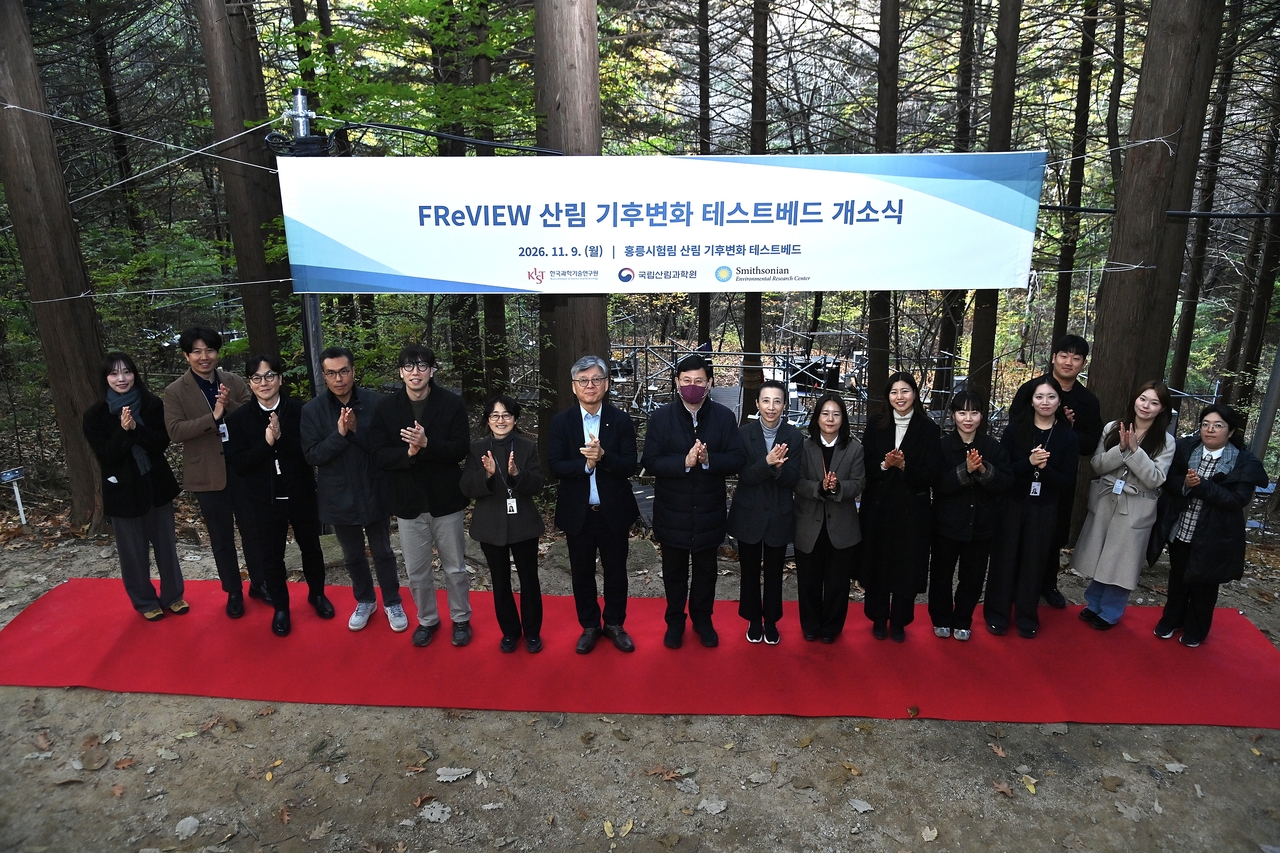
KIST and the National Institute of Forest Science held the opening ceremony for the FReVIEW Forest Climate Change Testbed at the Hongnŭng test forest in Seoul on Monday, where participants also discussed plans for joint research and expanded international cooperation.
"We have secured a core research platform that can reproduce and verify the effects of future climate change in an actual forest setting," KIST President Oh Sang-rok said. "We will work to clarify changes in forest ecosystems and carbon cycling to support national carbon neutrality and climate crisis response policy."
nbgkoo@heraldcorp.com