Live exercise simulates compound disaster scenario
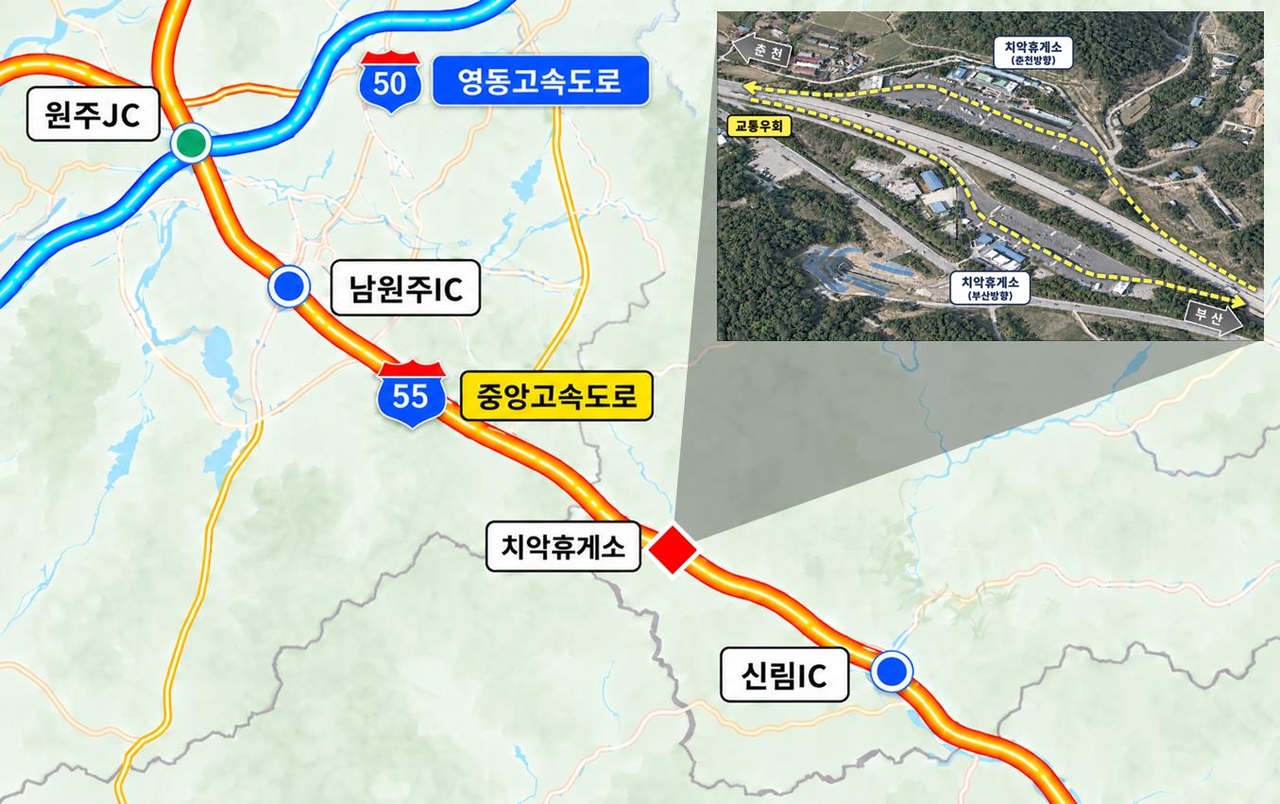
Korea Expressway Corporation said Tuesday it will conduct a joint heavy-snow disaster preparedness drill Wednesday near the Chiaksan rest area on the Jungang Expressway, in cooperation with the Ministry of Interior and Safety, the Ministry of Land, Infrastructure and Transport, Wonju city and other relevant agencies.
The exercise is a field-based live drill premised on a compound disaster scenario in which a sudden winter snowstorm triggers a multi-vehicle pileup, large-scale vehicle entrapment and a hazardous materials spill.
The drill is designed to comprehensively assess initial emergency response, the actual mobilization of disaster management resources and coordination among participating agencies.
Ahead of the exercise, advanced equipment slated for use in disaster response will also be demonstrated on site. Key items include a disaster scene reconnaissance robot and a wired-and-wireless disaster response drone.
The reconnaissance robot is deployed into hazardous zones where human access is difficult, conducting unmanned, remote surveillance. It transmits information gathered through its sensor system in real time, reducing personnel exposure to danger.
The disaster response drone can provide live footage from disaster scenes and lighting support for recovery operations, as well as rear-end traffic safety management following road accidents and safety monitoring at construction sites.
To facilitate the drill, both directions of the main line at the Chiaksan rest area on the Jungang Expressway will be closed to traffic for two days beginning Wednesday.
Vehicles passing through the affected section during restricted hours must detour through the Chiaksan rest area plaza. Because the large parking lot at the Chiaksan rest area (Busan-bound) will be unavailable due to drill operations, heavy freight vehicles must use the parking lot at the Jecheon rest area (Busan-bound), located 21 kilometers ahead.
The corporation urged drivers using the affected section to check variable message signs and traffic information in advance and to drive safely, as traffic will be restricted in some parts of the section during the drill period.
"This drill is meaningful in that it tests whether the response systems among relevant agencies can operate swiftly and in a coordinated manner on the actual scene of a compound disaster triggered by a sudden heavy snowfall," a Korea Expressway Corporation official said. "We will actively incorporate improvements identified during the drill to minimize public inconvenience and damage caused by winter snowstorms."
Meanwhile, data from the Korea Transportation Safety Authority and its Traffic Accident Analysis System show that traffic accidents occurring during snowfall carry a higher fatality rate than those on clear days. Over the three years from 2022 to 2024, there were 3,159 traffic accidents on snowy days, resulting in 46 deaths and a fatality rate of 1.46 — about 1.18 times higher than the clear-day rate of 1.24. The fatality rate is calculated by dividing the number of deaths by the total number of accidents and multiplying by 100, representing the number of deaths per 100 accidents.
hss@heraldcorp.com