Three Korean nutrition societies present new dietary strategies linking whole-food consumption to cancer prevention, healthy aging and blood sugar control
A nutritional approach that prioritizes eating vegetables and fruits in their natural form — rather than taking separate vitamins or antioxidant supplements — is drawing growing attention in South Korea. Known as "Raw Core Nutrition," the concept emphasizes a food's inherent structure and the synergistic interaction of its many nutrients over any single isolated compound. A series of research findings presented at three domestic nutrition conferences has positioned it as a new strategy for healthier eating, with links to cancer prevention, extended healthy lifespan and blood sugar management.
According to the Korea Food Communication Forum, Jo Jin-a, a professor in the Department of Food and Nutrition at Chungnam National University, introduced Raw Core Nutrition at the Korean Society of Food Science and Nutrition's international conference on Oct. 29 as a nutritional framework that places vegetables and fruits at the core of the diet. The concept values real food, minimal processing and whole foods — underscoring that what people eat and in what form matters just as much as how much of any given nutrient they consume.
Jo said attention should be paid to the "food matrix" — the way dietary fiber, vitamins, polyphenols, flavonoids and other compounds in vegetables and fruits work together within the food's physical structure. The share of Korean adults consuming 500 grams or more of vegetables and fruits per day has fallen from 38.6 percent in 2015 to 24.4 percent in 2024, meaning three in four adults fall short of that threshold.
At the same conference, Jeon Sin-young, a professor in the Department of Food and Nutrition at Soonchunhyang University, presented research linking five daily servings of vegetables and fruits to lower mortality and reduced frailty risk. Choi Jeong-hwa, a professor in the Department of Food and Nutrition at Keimyung University, said consuming a variety of vegetables and fruits in whole-food form is more important than supplementing with specific antioxidant nutrients, noting that some antioxidant supplements have not been shown to deliver the same health benefits as whole vegetables and fruits.
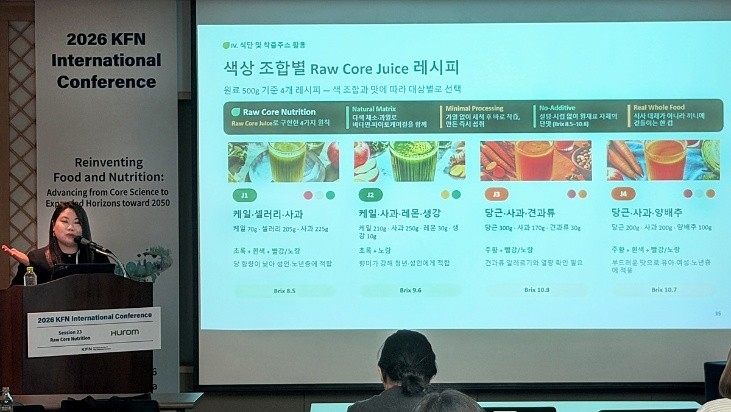
Kang Min-ji, a professor in the food and nutrition program at Duksung Women's University, introduced a practical approach: eating a colorful variety of vegetables and fruits and supplementing any shortfall with "Raw Core Juice." The juice is made by cold-pressing three or more raw vegetables and fruits together to preserve as many phytochemicals, vitamins, minerals and other complex nutrients as possible. A representative example is KCA juice — pressed from kale, celery and apple — which keeps sugar content low by increasing the proportion of vegetables.
Links to cancer prevention were also presented. At the Korean Cancer Prevention Society's international conference on Nov. 3, Shin Da-yeon, a professor in the Department of Food and Nutrition at Ewha Womans University, said a meta-analysis of 95 studies found that each additional 200 grams of daily vegetable and fruit intake was associated with roughly a 3 percent lower overall cancer risk. The association held up to about 600 grams per day.
Shin proposed several practical steps under Raw Core Nutrition: eating raw vegetables every day, consuming cruciferous vegetables such as broccoli and cabbage raw by chewing or chopping them, and drinking cold-pressed juice fresh. The aim is to preserve as fully as possible the wide range of bioactive compounds found in vegetables and fruits.
On Friday, the Korean Community Nutrition Society's autumn academic conference featured research on the blood sugar effects of vegetable-centered cold-pressed juice. A research team led by Kwak Jeong-hyeon, a professor in the Department of Food and Nutrition and Food Engineering at Inje University, tested 20 healthy adults and found that drinking a cold-pressed juice of celery, cabbage, kale and lemon 30 minutes before eating white rice lowered peak blood glucose concentration by an average of 15.87 mg/dL compared with drinking water. Kwak said the findings suggest that consuming vegetable-centered cold-pressed juice before meals may help blunt post-meal blood sugar spikes, but added that long-term effects require further verification.
Bae Yun-jeong, a professor in the food and nutrition program at Korea National University of Transportation, said hands-on education tailored to different life stages is needed to boost vegetable and fruit consumption. Programs combining education and practical training for youth and middle-aged adults showed significant improvements in awareness of recommended daily intake and in participants' sense of self-efficacy, highlighting the importance of building real-world skills.
Researchers said the core of Raw Core Nutrition lies not in relying on any single nutrient or food but in building the habit of eating vegetables and fruits in sufficient variety and quantity. They said vegetables and fruits should anchor the daily diet, with vegetable-centered Raw Core Juice serving as a practical supplement to fill gaps when whole vegetable and fruit intake falls short.
At a recent Korean Society of Food Science and Nutrition conference, Duksung Women's University professor Kang Min-ji introduced a practical approach to eating a colorful variety of vegetables and fruits and using Raw Core Juice to make up any shortfall.
kty@heraldcorp.com