Government reflects only 4.6% of requested budget increase; union says wage-gap funds entirely cut
Union cites court ruling payouts, staffing costs as threats to this year's pay raises
Agency ranks 79th out of 88 public institutions in wages; 96% of members voted for industrial action
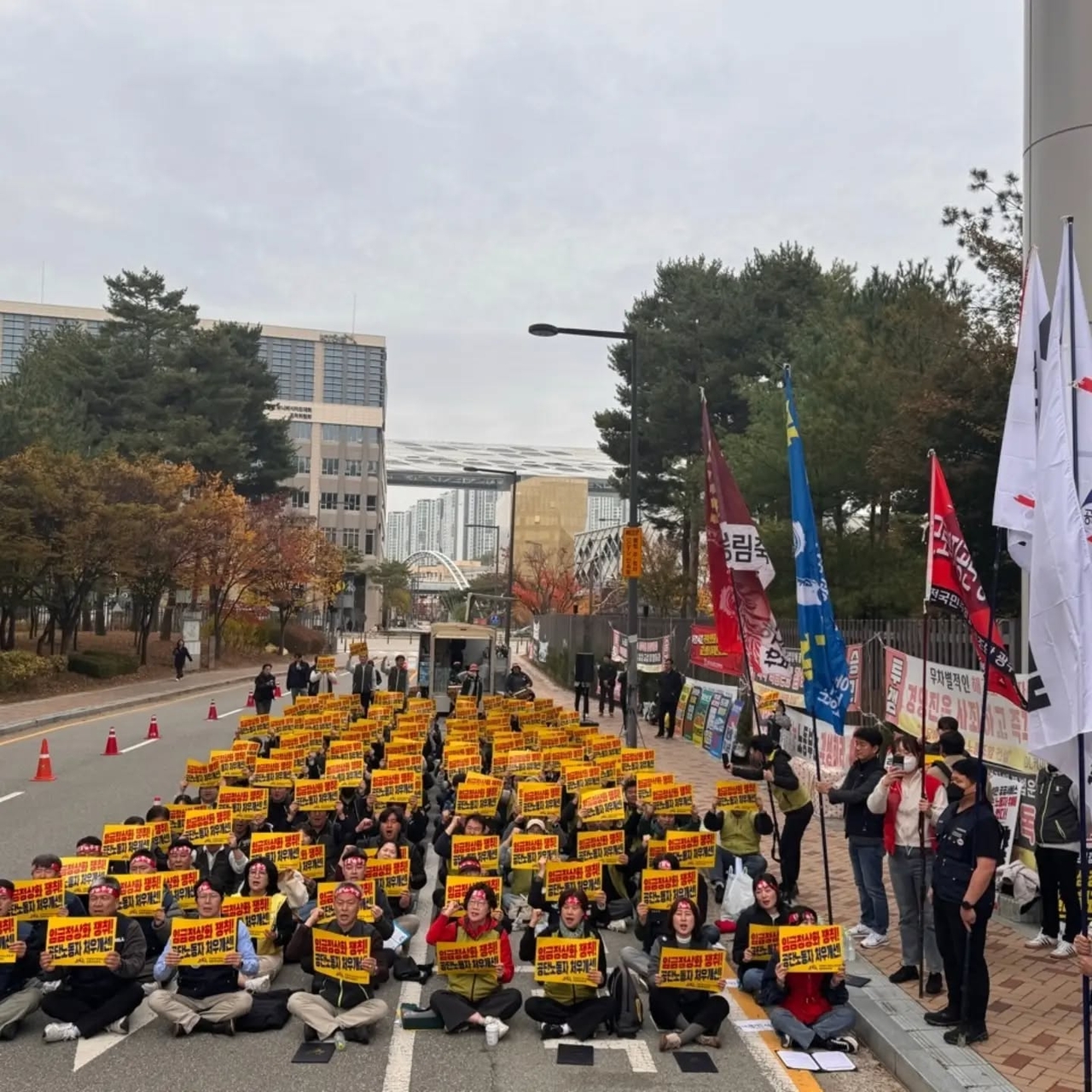
The Korea Workers' Compensation and Welfare Service requested a budget increase of 37.01 billion won ($27.3 million) for next year, but the government's draft budget reflected only 1.69 billion won — just 4.6% of the amount sought.
The government included an additional 0.5 percentage point raise in total personnel costs applicable to low-wage public institutions, but entirely excluded the 21.75 billion won the agency had requested to narrow the wage gap with peer organizations.
35.3 billion won cut from next year's government draft; over half was for wage-gap relief
According to a document on special budget requests and approvals over the past five years provided by the union Tuesday, 35.31 billion won of the agency's requested increase was left out of the government's draft budget for next year. Of that amount, 61.6% consisted of funds requested to close the wage gap with peer agencies — covering items such as long-service allowances and holiday bonuses. Also excluded were 9.31 billion won in internal management evaluation performance bonuses, 2.57 billion won for child allowances and similar benefits, and 1.68 billion won tied to changes in the ordinary wage calculation standard.
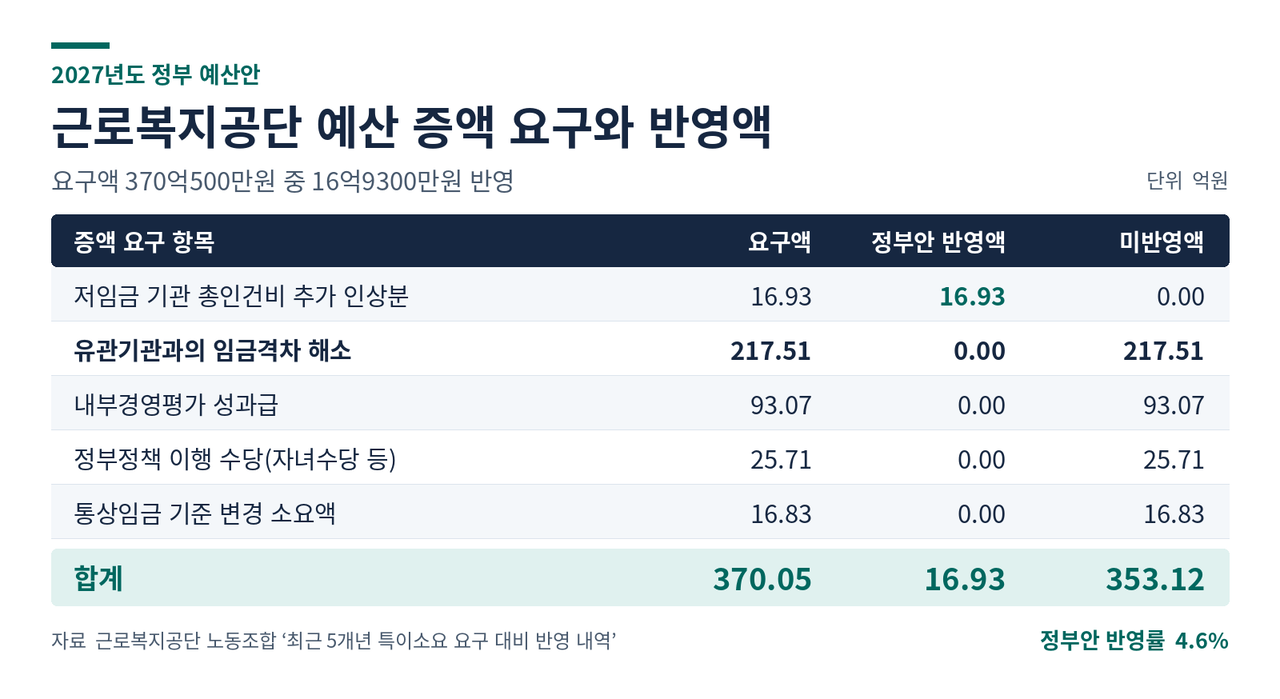
The 1.69 billion won included in the government draft represents an additional 0.5% raise in total personnel costs. According to the union, the agency's wages stand at 49.4% of the industry average. Under this year's budget guidelines for public enterprises and quasi-government agencies, institutions paying below 60% of the industry average wage qualify for the additional raise. The agency meets that threshold, yet the additional increase was not reflected in this year's budget. That is why the union is separately demanding that 1.7 billion won be secured by revising this year's fund management plan, independent of next year's government draft.
This is not the first time the agency's supplementary budget requests have been largely excluded during the government's budget formulation process.
From 2023 through next year, the agency requested a cumulative total of 115.57 billion won in special budget items, of which only 3.98 billion won (3.4%) was reflected in government budget drafts and fund management plan revisions. In 2023, the agency sought 17.24 billion won to cover ordinary wage litigation costs and retirement benefit reserves, but none of it was approved. In 2024, no increase was granted under a public institution reform plan. In 2025 and this year, the agency requested 32.55 billion won and 28.77 billion won respectively, but in both years only 1.14 billion won — covering costs from changes to the ordinary wage standard — was approved.
Court payouts and staffing costs add pressure; union says 14.23 billion won needed this year
At a labor affairs forum for central public institutions held Monday, the union presented a total funding need of 14.23 billion won for this year. The figure combines the 1.7 billion won additional personnel cost raise, a 2.3 billion won shortfall in management evaluation performance bonuses, 3.8 billion won in court-ordered payments following a lost ordinary wage lawsuit, and 6.43 billion won in personnel costs for newly added staff at the Occupational Disease Adjudication Committee.
According to the union, the agency had budgeted performance bonuses based on a B rating but received an A rating for the first time in 16 years, creating an additional payout obligation of 2.3 billion won. The agency also lost a lawsuit filed by grade-2 and above employees over ordinary wages and must pay 3.8 billion won. The union argued that paying the court-ordered sum within the existing total personnel cost ceiling would reduce funds available for across-the-board wage increases, and demanded that the payout be covered through a separate budget outside that ceiling.
The largest single item is the personnel cost for the Occupational Disease Adjudication Committee. When the committee was established, the agency added 71 staff in 2008. The union said those positions were never given a separate personnel budget, leaving the agency to absorb 6.43 billion won from its existing payroll.
The agency handles work directly tied to workers' livelihoods, including reviewing and paying industrial accident insurance benefits and processing unpaid wage advance payments. The union said workloads have grown as industrial accident insurance coverage expanded to platform and gig workers and as the agency took on a mandate to shorten processing times, but staffing and compensation have not kept pace. Excluding medical staff, the agency's wage level ranked 79th out of 88 comparable public institutions, and the turnover rate among new employees stood at 22%. The union contends that the departure of experienced workers is creating operational gaps.
The union plans to hold warning strikes Thursday and Nov. 17 before launching a general strike on Nov. 26. In an earlier ballot on industrial action, 96% of union members voted in favor.
fact0514@heraldcorp.com