Buy-side circuit breakers triggered in both markets within 6 minutes of open
Foreign investors end 7-session selling streak
Philadelphia Semiconductor Index surge, falling oil prices lift sentiment
US CPI data and CoreWeave earnings in focus this week
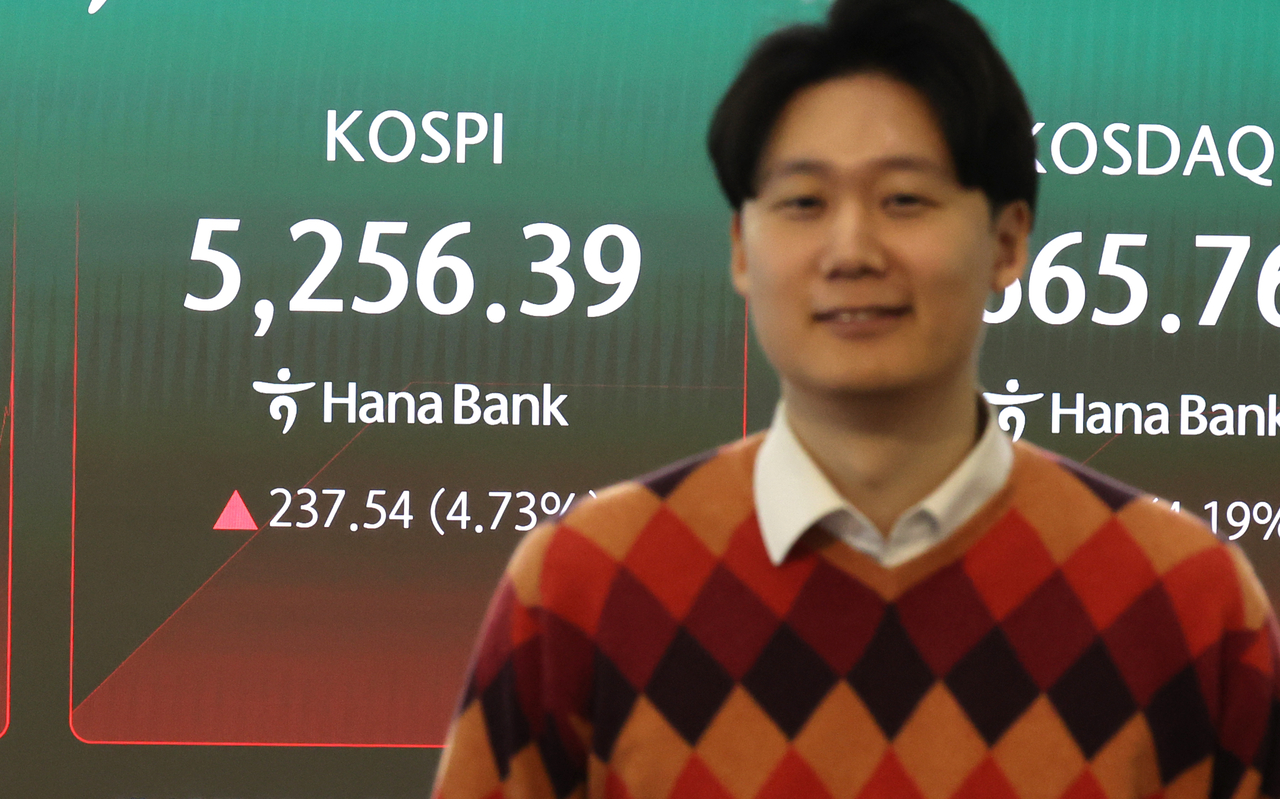
The Kospi and Kosdaq both triggered buy-side circuit breakers within roughly six minutes of Tuesday's open, staging a sharp rebound after three consecutive sessions of losses that had sent the benchmark index tumbling 5 to 6 percent in a single day. The turnaround stands in stark contrast to the sell-side circuit breakers triggered on two consecutive days — Thursday and Friday — in the wake of a Democratic blue wave in the US midterm elections. The Kospi volatility index also retreated to pre-blue-wave levels.
According to Korea Exchange, the Kospi opened up 4.55 percent at 5,247.22 before the buy-side circuit breaker was activated. Foreign investors, who had been heavy sellers during last week's selloff, turned net buyers during the session, while institutional investors also joined the buying, together driving the early gains.
As of 10 a.m., the Kospi had given back a portion of its early advance, trading up 4.12 percent at 5,225.69. At that point, institutions had net purchased 317 billion won ($234 million) and foreign investors had net purchased 136.4 billion won on the Kospi market, while retail investors were net sellers of 541.2 billion won.
Foreign investor flows showed clear improvement. After net selling 12.58 trillion won on the Kospi over the previous seven sessions, foreign investors flipped to net buyers during Tuesday morning's session. Combined buying by foreign and institutional investors underpinned a broad index rebound led by large-cap semiconductor stocks.
As markets rebounded from the midterm-election shock, the Kospi Volatility Index (VKOSPI) — which had spiked to levels last seen in May — retreated to where it stood before the blue wave hit. The VKOSPI measures expected market volatility based on KOSPI 200 options prices; a higher reading signals greater anticipated swings. After closing at 63.93 points and 65.17 points on the two prior sessions — Friday and Monday, respectively — the index fell below 60 points as of 10 a.m. Tuesday.
The rebound was largely attributed to a strong overnight rally in US semiconductor stocks. The Philadelphia Semiconductor Index surged 6.86 percent on Monday (local time), while the MSCI Korea ETF, which reflects investor sentiment toward Korean equities, rose 3.72 percent. Kospi overnight futures also jumped 5.78 percent.
Expectations that the hedge fund position unwinding behind the recent selloff may be nearing its end also contributed to the recovery. Because the wave of selling was concentrated in AI and semiconductor-related positions being simultaneously reduced, analysts said further selling pressure could be limited.
"With analysis emerging that the excessive concentration unwind by hedge funds that caused last week's plunge may be stabilizing, the Philadelphia Semiconductor Index also surged in the US market the previous day, creating a favorable backdrop for Korean equities," said Seo Sang-young, a managing director at Mirae Asset Securities. "A strong rebound is flowing into the Kospi, which had closed lower the previous day."
Falling oil prices and expectations of a stronger won also provided tailwinds for foreign investor flows. Crude prices dropped sharply on hopes of easing tensions between the United States and Iran, reducing inflation concerns. A stronger won lowers the currency-loss risk for foreign investors, making domestic equities more attractive.
Seo added that he expected foreign investors to take a more favorable stance toward Korean stocks, reflecting the drop in oil prices and stabilizing interest rates. "Dollar-selling by exporters converting their export proceeds into won flowed into the market the previous day, and that won-strengthening trend is likely to continue through today," Seo said.
Notably, global markets — which had been particularly sensitive to headwinds such as data center regulations following the US midterm elections — appear to be returning to stability, shifting the broader market dynamic.
"The market's sensitivity to the negative factors that had been driving equity instability since October appears to be fading, raising the appeal of entering the domestic market," said Han Ji-young, a researcher at Kiwoom Securities. "Market consensus is converging on the view that the Democratic Party is unlikely to significantly tighten data center regulations after the midterms."
Espionage allegations surrounding Nvidia CEO Jensen Huang have also had a limited impact on the rebound in global semiconductor stocks, including those in Korea. Market sentiment was steadied by expectations that the risk is unlikely to lead hyperscalers to delay their AI investment timelines or cut GPU orders.
"Concerns were raised that the espionage allegations against Nvidia could escalate into a national security issue or tighter technology export controls to China, but those worries did not spread across the broader industry," Han said. "Given that last week's chain of crashes produced corrections as severe as those seen during past major crises — the IMF crisis, the dot-com bubble collapse and the global financial crisis — the release of US October consumer price index data and earnings from AI infrastructure firm CoreWeave, both scheduled for this week, could serve as a turning point for market sentiment."
The Kosdaq also opened more than 3 percent higher before its own buy-side circuit breaker was triggered, starting the session up 3.56 percent at 661.73. As of 10 a.m., institutions had net purchased 69.6 billion won and retail investors had net purchased 50.9 billion won on the Kosdaq, while foreign investors were net sellers of 106.9 billion won.
kacew@heraldcorp.com