950 billion won invested in second terminal
LNG storage capacity rises 43%, from 930,000 to 1.33 million kiloliters
Largest private-sector facility in Korea — enough to heat all households for 40 days
Ship commissioning and bunkering services to drive new revenue
Long-term US LNG imports to link trading and power generation
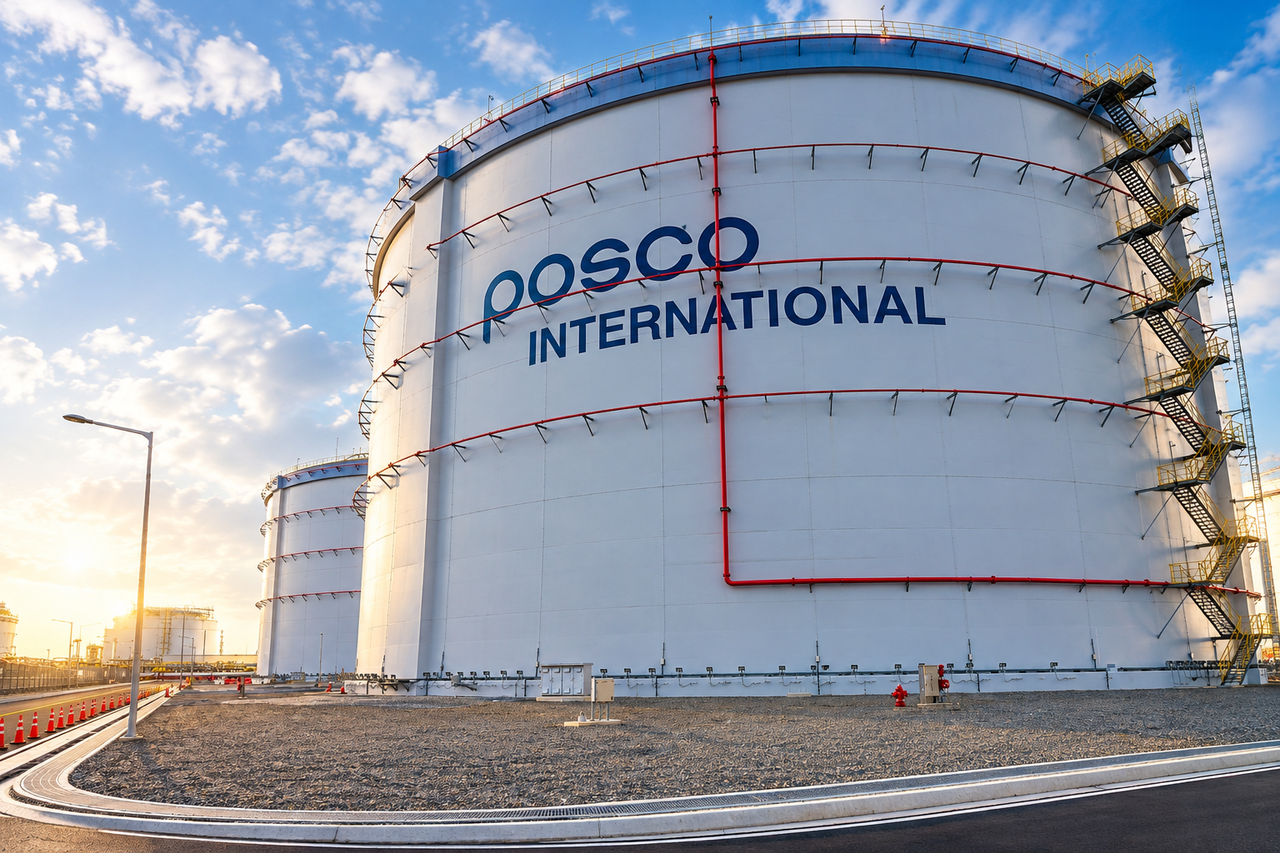
POSCO International has expanded the LNG storage capacity of its terminal in Gwangyang, South Jeolla Province, by 43 percent. The company plans to diversify its revenue streams by growing its ship fuel supply business alongside existing storage leasing and ship commissioning services, and by linking overseas LNG imports with trading operations.
POSCO International held a completion ceremony Tuesday at the Gwangyang No. 2 LNG Terminal. About 100 guests attended, including POSCO Group Chairman Jang In-hwa, POSCO International President Lee Gye-in, National Assembly lawmaker Kwon Hyang-yeop, Gwangyang Mayor Park Sung-hyun and Korea Development Bank Chairman Park Sang-jin, along with government, local authority and customer representatives.
"The Gwangyang No. 2 LNG Terminal is a clear demonstration, on the ground, of the POSCO Group's energy and resources strategy — one of our three core pillars," Jang said. "With this completion, we will deepen the LNG value chain and contribute to national energy security."
Two 200,000-kiloliter tanks added, large LNG carriers now able to berth
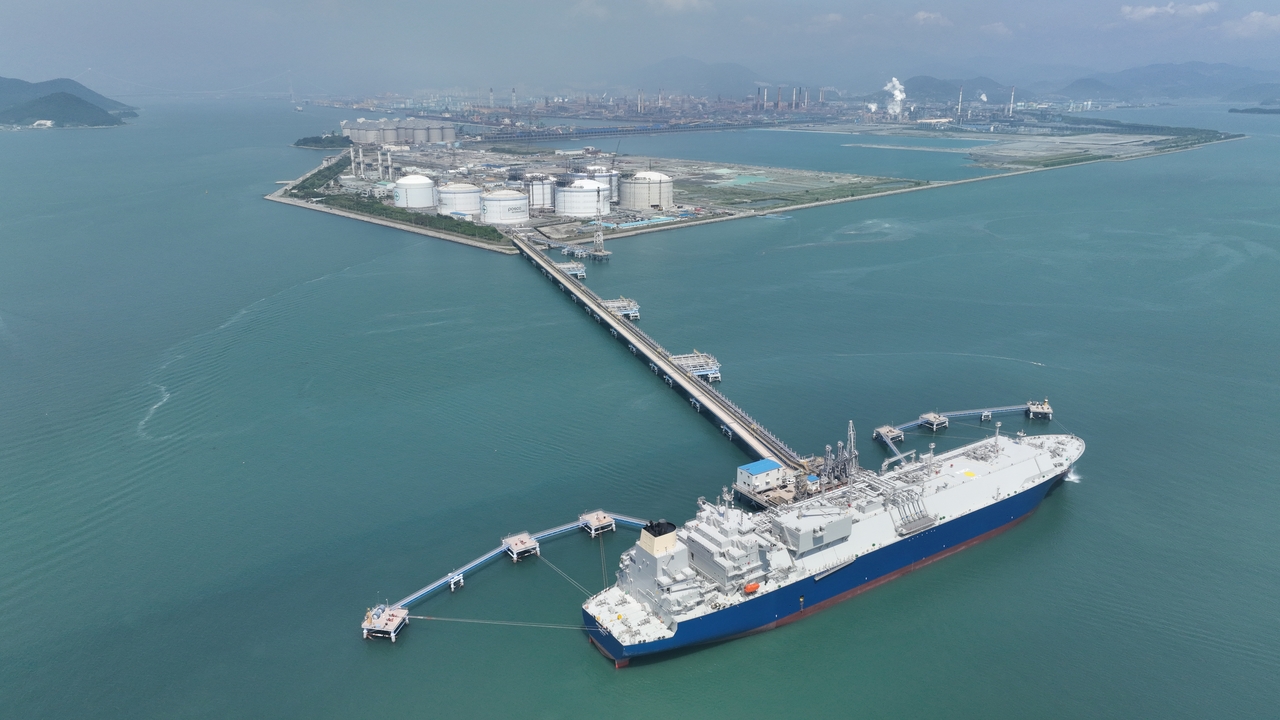
When a reporter visited the Gwangyang LNG Terminal on Nov. 2, two large storage tanks stood side by side, nearing completion. The newly built No. 2 Terminal is equipped with Tanks No. 7 and No. 8 — each capable of holding 200,000 kiloliters of LNG — along with berthing facilities for large vessels.
The project required a total investment of 949.2 billion won and took approximately 47 months to complete. With the new terminal online, the Gwangyang LNG Terminal's total storage capacity has grown from 930,000 kiloliters to 1.33 million kiloliters — the largest of any single private-sector company in Korea, and enough to store heating gas for the entire country for about 40 days.
The Gwangyang LNG Terminal is Korea's first privately operated LNG import terminal. It began commercial operations in 2005 and has expanded in stages since. The completion of the No. 2 Terminal follows the full commissioning of the No. 1 Terminal in July 2024.
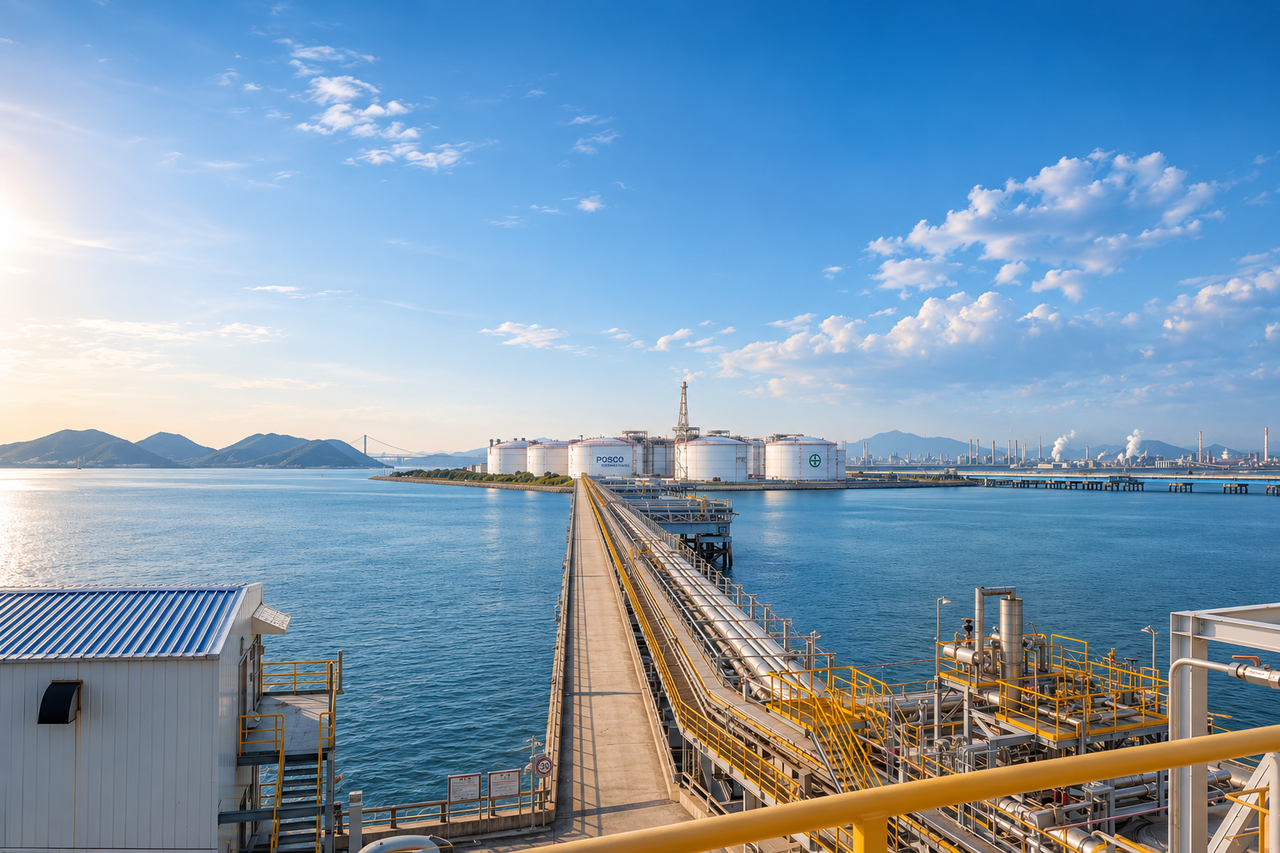
An LNG terminal stores natural gas imported from overseas and supplies it to domestic customers. Natural gas converts to liquid form at minus 162 degrees Celsius, shrinking to roughly one-six-hundredth of its original volume. It is transported by LNG carrier, stored at the terminal, then regasified and delivered through pipelines as customers require.
POSCO International earns revenue by leasing storage facilities and providing LNG unloading, regasification and sendout services. It supplies gas directly by pipeline to nearby customers such as the Gwangyang steelworks and power plants, and uses Korea Gas Corporation's pipeline network to reach customers in other regions.
The new No. 2 Terminal also includes a berth capable of accommodating large LNG carriers of up to 270,000 cubic meters. The Gwangyang terminal's location on the south coast — where tidal variation is smaller and seas are calmer than on the west coast — makes it well suited for large vessel traffic.
The storage tanks incorporate high-manganese steel for cryogenic use, developed independently by POSCO. The high-manganese steel used in Tanks No. 5 through No. 8 maintains high strength at minus 162 degrees Celsius while costing less than the conventional 9-percent nickel steel it replaces.
For the No. 2 Terminal's construction, POSCO supplied the steel and POSCO E&C handled engineering and construction. The site also has room to grow: POSCO International has already secured land for the future construction of Tanks No. 9 through No. 12.
Beyond storage: bunkering expands revenue base
POSCO International plans to use the expanded terminal as a springboard for new revenue-generating businesses.
Ship commissioning is one of its core offerings. Before a newly built LNG carrier enters service, it must undergo checks to verify that its storage tanks and key systems are functioning properly. POSCO International provides that service at the Gwangyang terminal.
The company also plans to scale up its LNG bunkering business, which supplies fuel directly to vessels. It has operated a pier-to-ship model — fueling vessels from the dock — but intends to expand into ship-to-ship bunkering, in which a dedicated bunkering vessel pulls alongside another ship to transfer fuel.
To support that expansion, a dedicated bunkering berth capable of accommodating vessels of up to 20,000 cubic meters has been built at the No. 2 Terminal. Working with POSCO Flow and the Yeosu Gwangyang Port Authority, the company is also securing a 12,500-cubic-meter bunkering vessel, with full commercial operations set to begin in the second quarter of next year.
POSCO International's strategy is to build on its existing storage and unloading infrastructure by adding bunkering to broaden its earnings base. "LNG is a cryogenic fuel, so it requires dedicated supply equipment and bunkering vessels," said Seo Gi-sik, executive director and head of POSCO International's terminal construction task force.
Long-term US LNG imports to anchor trading and power generation
The expanded storage capacity also underpins POSCO International's LNG trading ambitions. Greater capacity means more room to hold gas procured overseas and supply it in line with domestic and international demand.
POSCO International is diversifying its procurement sources through long-term imports of US LNG. In 2022, it signed a 20-year contract with US-based Cheniere Energy to receive 400,000 metric tons of LNG annually. The first shipment is scheduled to arrive at the Gwangyang terminal this month aboard the dedicated LNG carrier HL Fortuna.
The company's broader vision is to transform the Gwangyang LNG Terminal from a simple storage facility into a hub for an integrated energy business spanning imports, trading, ship fuel supply and power generation.
"As more newly built vessels adopt LNG propulsion, the importance of dedicated fueling infrastructure is growing," Seo said. "We plan to launch our LNG bunkering vessel operations in the first half of next year."
Why is trading house POSCO International betting on LNG?
POSCO International's push into LNG reflects the fuel's growing status as a bridge energy source. LNG emits less carbon than conventional fossil fuels, positioning it as a transitional fuel in the shift toward cleaner energy.
POSCO International moved early to capitalize on LNG's growth potential, building a portfolio that spans gas production — including the Myanmar gas fields and Australia's Senex Energy — LNG trading and terminal operations, and power generation. The company is also pursuing distributed power generation using the Gwangyang LNG terminal, going beyond its existing Incheon LNG combined-cycle power plant.
Bold investment is showing up in earnings. Senex Energy posted sales of 199.3 billion won and operating profit of 55.1 billion won in the third quarter of this year, up 83.6 percent and 106.4 percent, respectively, from the same period last year. The Myanmar gas fields generated third-quarter operating profit of 98 billion won, up 8.9 percent year on year.
kwater@heraldcorp.com