Minutes of 20th Monetary Policy Board meeting released
Some members urge caution on timing of next hike
Final rate decision of the year set for Nov. 26
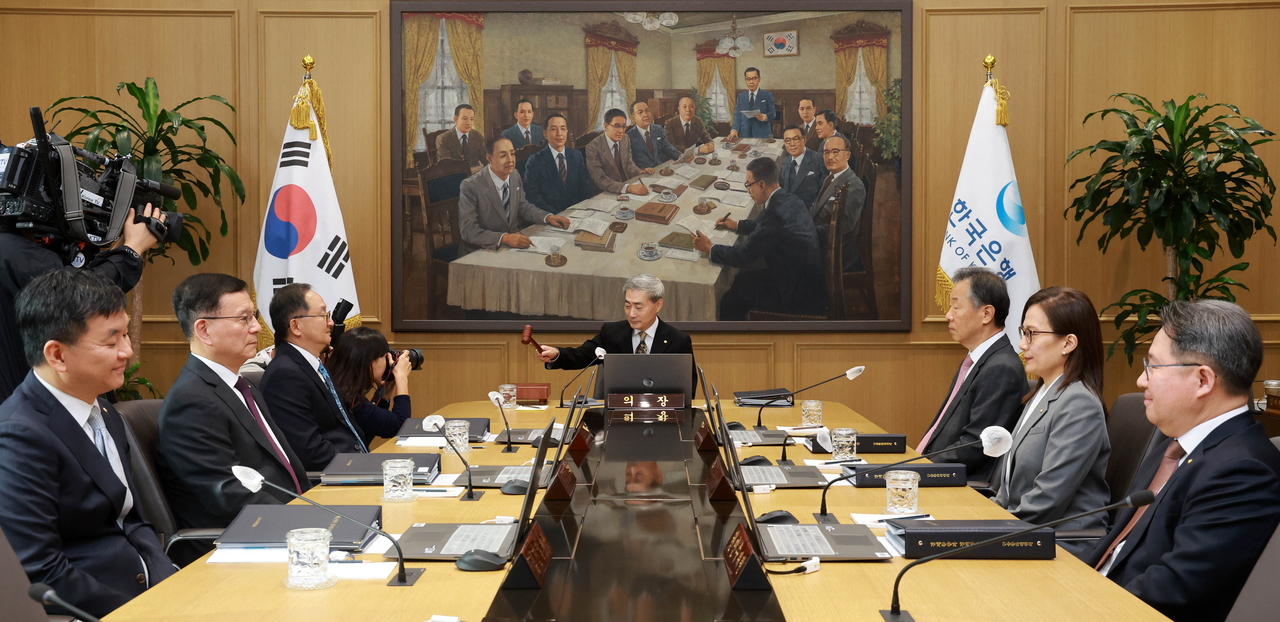
A majority of Bank of Korea Monetary Policy Board members supported the need for further monetary tightening even as the board held the benchmark interest rate steady at 3 percent last month, newly released meeting minutes show.
According to the minutes of the 20th Monetary Policy Board meeting of 2026, released Tuesday, all seven board members voted unanimously on Oct. 22 to keep the benchmark interest rate at 3 percent per annum. It was the first hold after two consecutive 0.25 percentage point hikes in July and August.
Members cited the need for time to assess the impact of the previous rate increases as the main reason for the pause. "The current tightening stance needs to be maintained, but at this meeting it is appropriate to keep the benchmark interest rate at its current level and observe the effects of the two preemptive hikes and the direction of heightened domestic and external uncertainties," one member said.
Another member echoed the view. "Given current overall economic conditions, the need for a restrictive monetary policy has grown, but since we have already carried out two consecutive rate hikes to preemptively address inflationary pressures, it is appropriate to assess their effects before determining the future policy direction," the member said.
On the future course of monetary policy, most members agreed on the need to maintain a tightening bias. One member said the board should closely monitor how the rate hikes to date affect key policy variables — including prices, growth and financial stability — and how export-led growth feeds through to domestic demand and demand-side inflation pressures. The member added that the timing of any additional rate increase should also take into account developments in the Middle East, shifts in major central banks' monetary policies, global financial market volatility and the effects of government economic policy.
Another member said the board should "monitor trends in inflation and financial stability conditions before deciding on the timing and pace of further hikes."
A note of caution was also sounded. One member said the two preemptive rate hikes had already transmitted into market interest rates and the exchange rate, reducing the degree of financial accommodation and creating room to calibrate the pace of policy. "There is a need to carefully judge whether and when to raise rates further," the member said.
Another member said the board was at a point where it needed to "strike the right balance between the need for additional monetary tightening to address inflationary pressures and financial imbalances on one hand, and consideration for sectors left behind by the economic boom on the other."
Concerns were also raised about the slow trickle-down of the semiconductor boom to the domestic economy. One member noted that while nominal income in the Korean economy was rising sharply, the spillover into private consumption and employment remained gradual. The member stressed the need to "closely monitor the pace and extent to which the semiconductor sector's strong performance, alongside global AI trends, spreads to other parts of the domestic economy."
The Monetary Policy Board is scheduled to hold its final rate-setting meeting of the year on Nov. 26, at which it will announce the benchmark interest rate decision and release updated economic projections.
kimstar@heraldcorp.com