Union to begin work-to-rule campaign Monday; full strike set for Nov. 25
Demands include halt to restructuring and safety staffing increases
Management vows to negotiate in good faith to minimize disruptions
Lines 1, 3 and 4 expected to run at around 50% capacity during strike
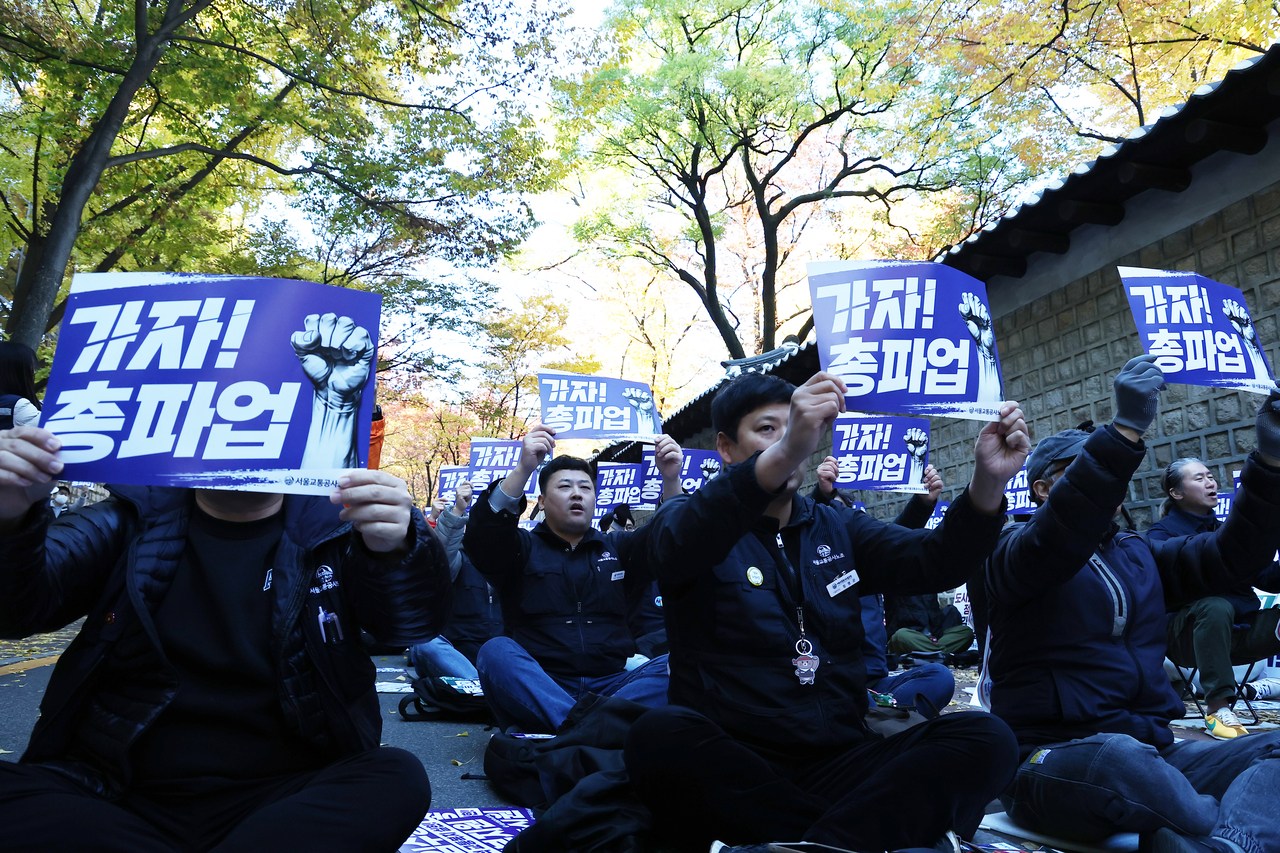
The Seoul Metro Workers' Union, the largest union at Seoul Metro and an affiliate of the Korean Confederation of Trade Unions (KCTU), has announced a general strike. The union is demanding that Seoul Metropolitan Government and Seoul Metro halt ongoing workforce restructuring and increase safety staffing. It said it will launch a work-to-rule campaign starting Monday and escalate to an indefinite general strike from Nov. 25 if management does not change its position.
The action threatens to disrupt not only daily commutes but also university entrance essay examinations held on weekends following the College Scholastic Ability Test. Train delays caused by the work-to-rule campaign are expected during Nov. 21-22, when Kyung Hee University, Korea University, Sogang University, Sungkyunkwan University and Sookmyung Women's University are scheduled to hold their exams. The strike period beginning Nov. 25 overlaps with Nov. 28-29 exams at Sejong University, Ewha Womans University, Chung-Ang University, Hankuk University of Foreign Studies and Hanyang University, listed in Korean alphabetical order.
The union held a field leadership rally Tuesday morning in front of the Seoul Metropolitan Council annex in Jung-gu, Seoul, and followed it with a press briefing that afternoon at the Jeon Tae-il Memorial Hall in Jongno-gu, where it declared it would proceed with industrial action.
Union Chairman Kim Jeong-seop said the entire organization would immediately enter full strike-readiness mode in line with the result of a strike authorization vote, which passed with 86.3 percent support. "All union members will launch a full work-to-rule campaign starting with the day shift on Nov. 20," he said, adding that if management and the city government showed no change in position despite the campaign, the union would begin an indefinite general strike from Nov. 25.
Wage negotiations between the union and management broke down earlier, prompting the union to file for labor dispute mediation with the Seoul Regional Labor Relations Commission last month. The two sides failed to narrow their differences, and mediation was suspended Nov. 2. A subsequent strike authorization vote held among union members from Nov. 2 to Nov. 5 saw 7,782 of 9,201 eligible members cast ballots — a turnout of 84.6 percent — with 6,715, or 86.3 percent, voting in favor.
The union's demands include a halt to restructuring and timely replenishment of frontline staff, resolution of vacancies caused by long-term absences, an increase in safety personnel, and a 5.2 percent rise in labor costs compared with the previous year. However, the union has indicated during negotiations that it would accept a 3.5 percent increase in line with government guidelines.
The union is particularly insistent on halting the current restructuring and expanding safety staffing. Kim said the restructuring that had already eliminated 684 positions must be reversed and that additional safety personnel were needed to enable genuine two-person work teams. "A 5.2 percent wage increase reflecting inflation is also necessary, but we are prepared to accept the government guideline of 3.5 percent," he said.
Kim added that management was refusing to fill even the 383 vacancies created this year by parental leave. "Our demand to fill more than 1,000 positions lost each year to mandatory retirement and long-term absences is not being met," he said.
The union plans to hold a general membership meeting at City Hall Station on Nov. 17 before beginning the work-to-rule campaign with the day shift on Monday. Once the campaign begins, the vehicle division will strictly observe standard maintenance times. Two-person teams will be required for all vehicle depot operations and hazardous tasks, banning solo dispatches and solo work. Station staff will wear civilian clothes with union vests, and train crews will adhere strictly to scheduled operating times.
Kim said that until now, when trains fell behind schedule, operators had been running above the regulated speed or closing doors and departing before all passengers had boarded. "Once we go to work-to-rule, everything will be done by the manual. Trains will run strictly according to the timetable," he said.
He acknowledged that trains would likely run behind their usual schedule as a result. "We apologize for the inconvenience passengers will face, but we ask for their understanding as this is an unavoidable choice," he added.
The general strike itself will begin with the day shift on Nov. 25, with a strike launch rally planned in front of Seoul City Hall in Jung-gu. Once the strike begins, only the minimum number of workers designated under the essential services maintenance agreement will remain on duty, with all other union members joining the walkout.
During the strike, Lines 1, 3 and 4 — which Seoul Metro operates jointly with Korail — are expected to run at around 50 percent of normal capacity. Line 2 and Lines 5 through 8, operated solely by Seoul Metro, are forecast to run at 70 to 80 percent.
Kim said management had yet to propose any talks. "The union is always open to dialogue. We want to reach an amicable compromise with the city and Seoul Metro as soon as possible," he said.
A Seoul Metro official said the company would keep communication channels open with the union and do its utmost to negotiate in good faith and with mutual trust, so that the strike would not translate into inconvenience for the public.
ikson@heraldcorp.com