National Institute of Biological Resources publishes waterbird community data Wednesday
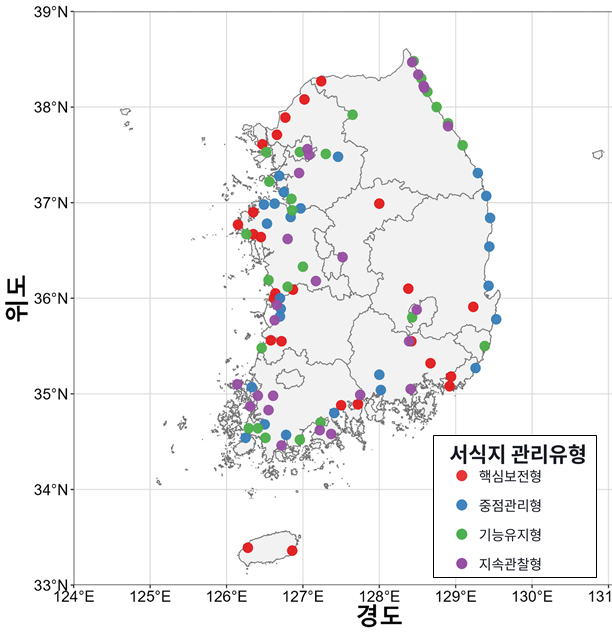
The National Institute of Biological Resources, under the Ministry of Climate, Environment and Energy, said Wednesday it is publishing a report titled "Waterbird Community Characteristics of Winter Migratory Bird Habitats in Korea."
The report analyzes 27 years of wintering waterbird community data — collected from 1999 across 100 major winter migratory bird habitats nationwide — and draws on findings from the institute's ongoing "Simultaneous Winter Bird Census," which covers more than 200 key wetland sites across the country.
For the report, the institute consolidated the original 200 census survey sites into 100 habitats by grouping locations with similar ecological characteristics and functions — such as estuaries and tidal flats, reservoirs and surrounding farmland, and coastal lagoons and adjacent shorelines — to better reflect the actual living and foraging ranges of waterbirds.
Each habitat was assessed using six indicators: average population size, year-to-year stability, dominant species structure (the species most numerous or widespread enough to define the overall character of a community), representative species persistence (the species that best symbolizes or illustrates a community's general appearance and traits), long-term population trends, and use by endangered species. Together, these indicators were used to evaluate each habitat's stability and conservation value.
Based on that analysis, the 100 major habitats nationwide were divided into four management categories of 25 sites each: core conservation, priority management, function maintenance, and continuous monitoring.
The core conservation category covers sites that have been stably used over the long term and require active protection. These include farmland used by cranes in Cheorwon, Junam Reservoir and Upo Wetland.
The priority management category covers sites that complement core habitats or serve key wintering functions within their regions, requiring proactive responses to environmental change. These include Jinyang Lake–Namgang River, the South Han River (between Yangpyeong and Yeoju), and Asan Lake — areas where water level and quality management demand focused attention.
The function maintenance category covers sites where wintering, resting and foraging functions must be continuously sustained. These include Paldang Lake, the North Han River and the middle reaches of the Geum River. The continuous monitoring category covers sites where long-term surveys are needed to confirm their potential habitat value, including Daecheong Lake, Yedang Reservoir and Tapjeong Reservoir.
The publication will be made available on the institute's website simultaneously with its release, to support a range of applications including avian influenza response and environmental impact assessments.
Yu Ho, director of the National Institute of Biological Resources, said the results represent a comprehensive compilation of 27 years of domestic winter migratory bird survey data. "This goes beyond simple record-keeping to provide a scientific foundation for the effective management of wintering waterbird habitats and for international research on migratory bird movements," Yu said. "We will continue to conduct precise data-driven analysis to play a central role in the national biodiversity strategy as we respond to the climate crisis."
thlee@heraldcorp.com