Yongsan-gu gets 47% of future-space planning budget; eight northeastern districts share just 1.9%
Nodeul Global Arts Island alone receives 41.75 billion won — 23 times the entire northeastern zone's allocation
Two Han River sites absorb 1.13 trillion won while seven Jungnangcheon districts share 12.9 billion won
Foreign tourist daily foot traffic: 100,910 in Myeong-dong, 729 at Achasan — a 138-to-1 gap
Lawmaker urges new spatial strategy to draw visitors beyond the city center
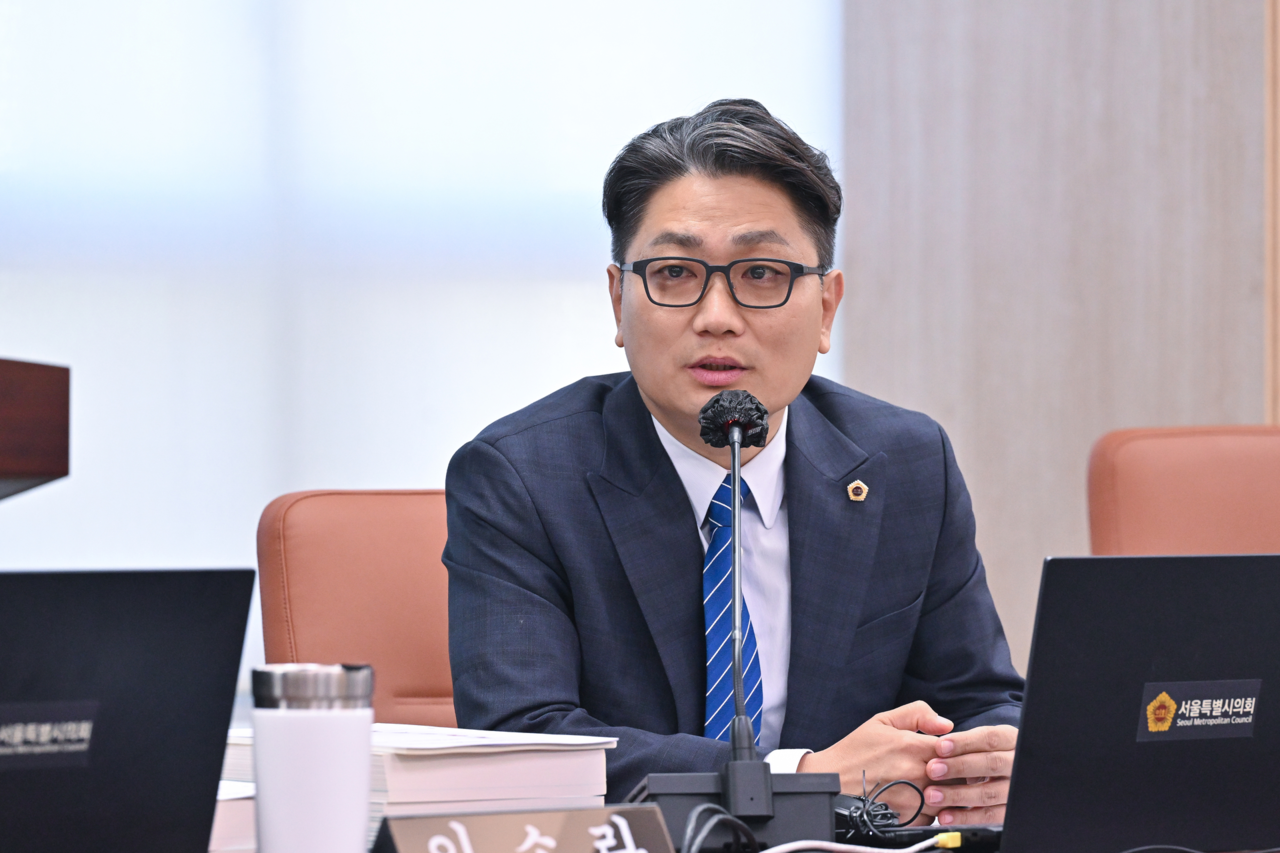
Seoul's future-space planning budget is heavily concentrated in the city center and along the Han River, leaving outer areas such as the northeastern districts relatively underserved, a city council member said Friday. While vast sums are being poured into large-scale landmark projects, investment to close spatial gaps between districts and to broaden foreign tourists' travel routes remains inadequate, the lawmaker said.
Oh Jung-seok, a Seoul Metropolitan Council member from the Democratic Party of Korea representing Dongdaemun-gu District 2, raised the issue of regional budget concentration in the city's spatial development spending at the Housing and Space Committee's administrative audit of the Future Space Planning Division during the 340th regular session of the council on Friday. Oh urged the city to establish fair investment criteria and develop a spatial policy that draws tourists to outer neighborhoods.
An analysis of documents submitted to Oh by the Seoul Metropolitan Government showed that of the Future Space Planning Division's 2026 budget of 96.9 billion won ($71.5 million), project costs classified under Yongsan-gu totaled 45.57 billion won, or 47.0 percent of the total. Of that, the Nodeul Global Arts Island project alone accounted for 41.75 billion won. Jongno-gu was allocated 15.2 billion won, or 15.7 percent, for projects related to the Songhyeon-dong site.
By contrast, the eight northeastern districts — Seongdong-gu, Gwangjin-gu, Dongdaemun-gu, Jungnang-gu, Seongbuk-gu, Gangbuk-gu, Dobong-gu and Nowon-gu — received a combined project allocation of about 1.8 billion won, just 1.9 percent of the total budget.
The breakdown showed only three identifiable line items for the northeastern zone: 1 billion won for improving the space beneath the elevated section at Changdong Station, 775 million won for upgrading the underground pedestrian and vehicle underpass at Seokgye Station, and 27.5 million won for a basic development concept study for the Jeongneung public bus depot. Dongdaemun-gu, Seongdong-gu and Gangbuk-gu had no identifiable budget allocations at all.
The allocation for the Nodeul Global Arts Island project alone was roughly 23 times the combined project budget for all eight northeastern districts.
The analysis covered 75.3 billion won of the total budget — the portion traceable to specific locations by project name — and calculated each district's share against the full 96.9 billion won budget. Broad, non-location-specific programs were excluded.
"We are all part of the same Seoul — what is the basis for the northeastern districts receiving just 1.9 percent?" Oh said, pressing the city on the criteria used to select sites and allocate funds for spatial development projects.
A similar disparity emerged in waterfront investment centered on the Han River and the Jungnangcheon stream.
Oh's comparison of major waterfront project costs — combining city and public funding for projects with identifiable district locations from 2022 to 2026 — found that spending concentrated in Yeongdeungpo-gu and Yongsan-gu totaled 1.13 trillion won. The largest items were the Second Sejong Center for the Performing Arts at 617.5 billion won and the Nodeul Global Arts Island at 451.2 billion won.
The seven districts through which the Jungnangcheon stream flows, by comparison, had combined major waterfront project costs of just 12.9 billion won. That figure includes 3.9 billion won for a waterfront arts and play space along the Jungnangcheon in Gwangjin-gu, and planned project costs of 3 billion won each for waterfront vitality hub projects along Jeongneungcheon in Dongdaemun-gu, Seongbukcheon in Seongbuk-gu and Danghyeoncheon in Nowon-gu.
The major project spending in Yeongdeungpo-gu and Yongsan-gu was roughly 87 times that of the seven Jungnangcheon districts combined.
The city's Waterfront Sensory City project also excluded the Jungnangcheon from its list of streams eligible for design work costing 100 million won or more, even as Bulgwangcheon, Segokcheon and Dorimcheon were included.
The comparison did not include the Future Han River Division's 2026 base budget of 128.16 billion won — for which district-level breakdowns were unavailable — nor flood-control projects or the underground rerouting of the Eastern Arterial Road. Differences in the nature and stage of individual projects also mean that investment figures alone have limits as a measure of policy impact by district.
"Nodeul Island alone gets 451.2 billion won; seven Jungnangcheon districts together get 12.9 billion won — what is the basis for that gap?" Oh said, raising the question of equity in waterfront investment across the city.
Oh argued that the spatial imbalance is directly connected to the movement patterns of foreign tourists.
Seoul set targets in 2023 to attract 30 million foreign tourists annually, with per-visitor spending of 3 million won, a seven-day average stay and a 70 percent return-visit rate. Yet tourist movement in practice remains concentrated in major downtown attractions.
Data from the Seoul AI Foundation based on 2025 figures showed that average daily foreign foot traffic was highest in Myeong-dong at 100,910, followed by N Seoul Tower at 57,370 and Samsung Station and COEX at 46,813. Achasan in Gwangjin-gu, by contrast, recorded just 729.
Foreign foot traffic in Myeong-dong was roughly 138 times that of Achasan. However, Achasan posted the second-highest growth rate in foreign visitor numbers at 11.8 percent, suggesting outer-area attractions have room to grow.
The gap also shows up in tourism zone designations. None of Seoul's seven designated tourism special zones falls within the eight northeastern districts. The Dongdaemun Fashion Town tourism special zone, designated in 2002, is administratively located in Jung-gu, meaning Dongdaemun-gu itself has no designated tourism zone at all.
Oh said that extending tourists' length of stay and spreading their spending to local commercial areas would require a new spatial strategy that pushes the city's tourism footprint beyond the downtown core.
As examples, Oh cited the Bellagio fountain show in Las Vegas, the Ebisu Bridge and Glico sign along Dotonbori in Osaka, the Dubai Fountain, and Jeonju's Deokjin Park, which draws about 2.04 million visitors a year. The argument was that spaces combining water, bridges, light, cultural symbols and experiential content can sharpen a city's competitive edge in tourism.
The proposal amounted to a call to move beyond relying solely on large new buildings or landmark structures, and instead to use existing streams, bridges and local cultural assets to give tourists reasons to venture into outer neighborhoods.
"Landmarks have always grown up where there is water, bridges, light, culture and experience," Oh said. "To fill a seven-day stay, we need landmarks that draw foreign visitors from the city center out to the periphery."
Oh then asked what role the Future Space Planning Division plays in policies designed to move foreign tourists from the downtown core to outer areas, and urged the city to develop a spatially broader and more balanced investment strategy.
7toy7@heraldcorp.com