Goal includes 1 decacorn, 20 unicorns in AI sector
Selected startups to receive more than 10 billion won each
Support to cover R&D, tech validation, investment and overseas expansion
Ministry of SMEs and Startups, National AI Strategy Committee unveil joint plan
The government plans to nurture 20 AI startups with valuations of at least 1 trillion won ($738 million) by 2030, selecting high-potential companies for intensive support spanning research and development, investment attraction and overseas expansion. The initiative also sets a goal of producing at least one decacorn — a company valued at 10 trillion won or more.
The Ministry of SMEs and Startups unveiled the plan, titled "AI Startup Beyond Unicorn Nurturing Strategy," on Wednesday at the Grand Hyatt Seoul in Yongsan-gu, Seoul, during the "Deep Dive Into 2026" conference. The strategy was jointly developed with the National AI Strategy Committee.
The strategy focuses not merely on identifying promising AI startups but on developing them into globally competitive companies. To that end, the government will pursue three core strategies — full-cycle support, accelerated innovation growth and promotion of global market entry — broken down into 12 detailed tasks.
The government, universities, research institutions and the private sector will collaborate to identify a pool of AI startups with unicorn potential. From that pool, companies ranking in the top 20 percent by investment and employment metrics will be selected for concentrated support.
Selected companies will be assigned performance targets tied to each stage of growth and will receive support to strengthen their technology commercialization capabilities. Companies that advance to the final stage of the program can receive more than 10 billion won per company in R&D and commercialization funding. Tailored support for technology validation and investment attraction will also be provided in parallel.
The plan also calls for industry-specific support. The government will connect demand-side companies with startups along the value chains of five key sectors — including manufacturing and biotech — and will establish a joint AI unicorn development control tower with the National AI Strategy Committee.
Funding supply will also be expanded. AI-related funds, including the Next-Generation Unicorn Project and the National Growth Fund, will be deployed according to each startup's stage of development to help companies attract investment.
The strategy also aims to strengthen cooperation across the AI industry ecosystem, from semiconductors and cloud infrastructure to large language models and services. Fabless chip designers, AI solution companies and demand-side firms will be grouped into a single cooperative body to pursue joint design and technology validation.
To help startups secure early customers for their technologies, the government's existing "Government First Validation and Purchase" program — under which government agencies and public institutions serve as initial buyers — will be expanded to cover the AI sector. A separate track will apply startup technologies to large companies' products for performance verification, with the aim of converting that into actual purchases.
Support for overseas expansion will also be strengthened. Country-specific "AI connectors" will be established to facilitate technology transactions between domestic startups and overseas buyers, and the government will work with the Public Procurement Service to create opportunities for domestic AI technologies to be validated at overseas institutions. The ministry also plans to connect domestic and international AI specialists with promising startups and to support the hiring and secondment of research personnel.
The strategy is significant in that it shifts the emphasis of AI startup support from early-stage technology development to tangible business growth. The government intends to link not only R&D funding but also technology validation, procurement, investment and overseas market access into a single support framework. However, the more-than-10-billion-won per-company figure applies only to those that advance to the final stage of the program, meaning the actual scope and scale of support will vary depending on each company's growth stage and performance.
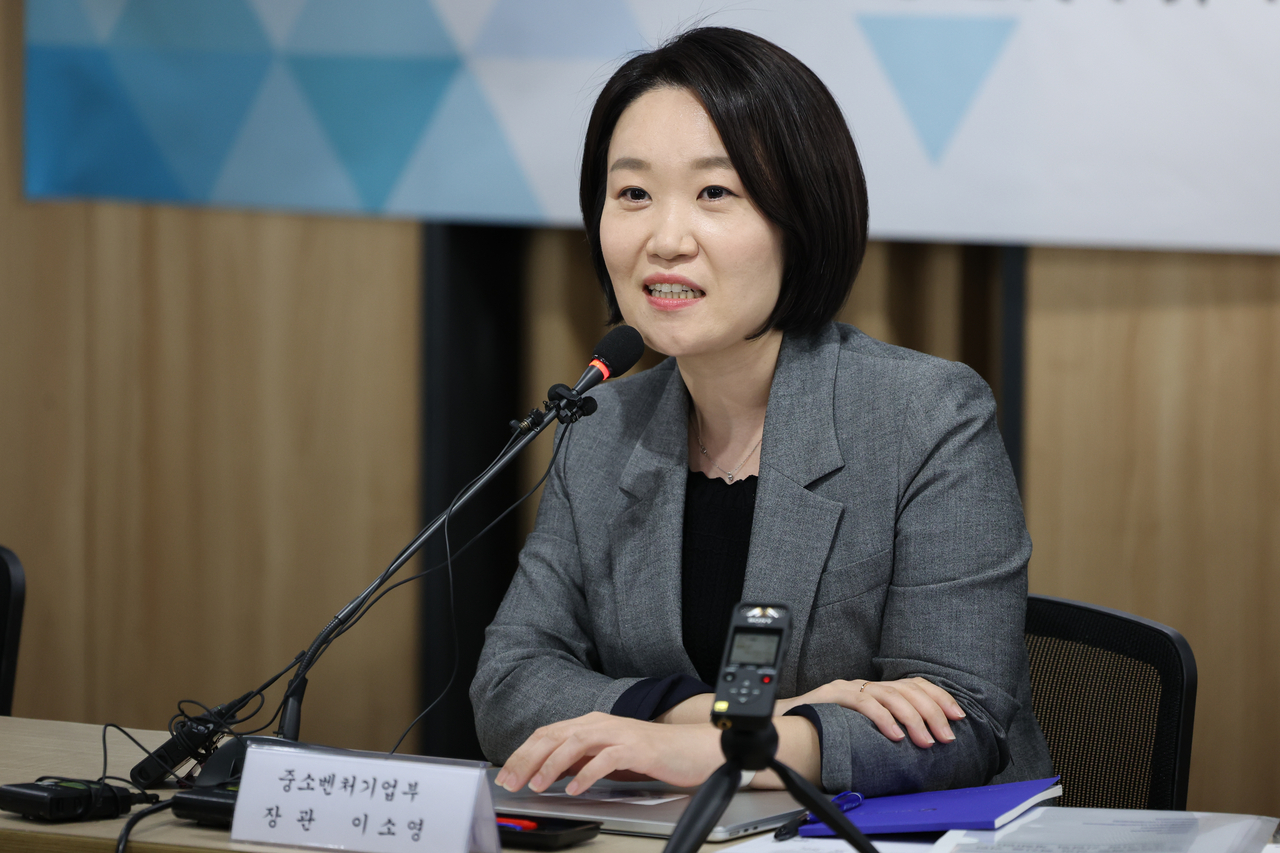
At the event, Minister of SMEs and Startups Lee So-young held an open dialogue on AI startup growth strategies with representatives and experts from global AI companies, including US AI unicorn Human&, Japan's Sakana AI and domestic firm Wrtn Technologies.
"For AI startups to grow into global unicorns, they need comprehensive support that goes beyond technology development — including commercialization through technology validation, investment, market access and overseas expansion," Lee said. "Through this strategy, we will provide intensive support so that companies in South Korea can grow not just into global AI unicorns but into decacorns."
Deep Dive Into 2026, running Tuesday through Thursday, is a conference where deep tech startups share their technologies and growth strategies. This year's event is themed "AI Makes Sense" and features 36 programs across three areas — physical AI, agentic AI and AI for humanity. More than 140 global speakers and domestic and international experts are participating.
boo@heraldcorp.com