Japan now requires tourists to pay full price and claim refunds at departure; Korea deducts the tax on the spot for purchases between 15,000 won and 1 million won, with a 5 million won cap per stay
"Don't even think about the tax refund — just shop and enjoy yourself."
That was the advice a Japan travel expert recently gave two children heading to Osaka. The message: with Japan's revamped refund procedures, spending time at customs on the way home is not worth the trouble — better to skip the benefit altogether.
Pay first, prove it at the airport — Japan's first overhaul in 74 years
Japan switched to a refund-based system for purchases made from Nov. 1, requiring tourists to pay consumption tax upfront at the store and then claim it back only after customs officers confirm the goods are leaving the country.
The new system operates on a pure refund model, with no grace period running alongside the old regime — the changeover date is the purchase date.
Until Oct. 31, shoppers could show their passport at the register and pay a tax-free price. Now they pay the full tax-inclusive amount. On an item priced at 10,000 yen ($63) before tax, a tourist pays 11,000 yen and collects the 1,000-yen consumption tax at departure.
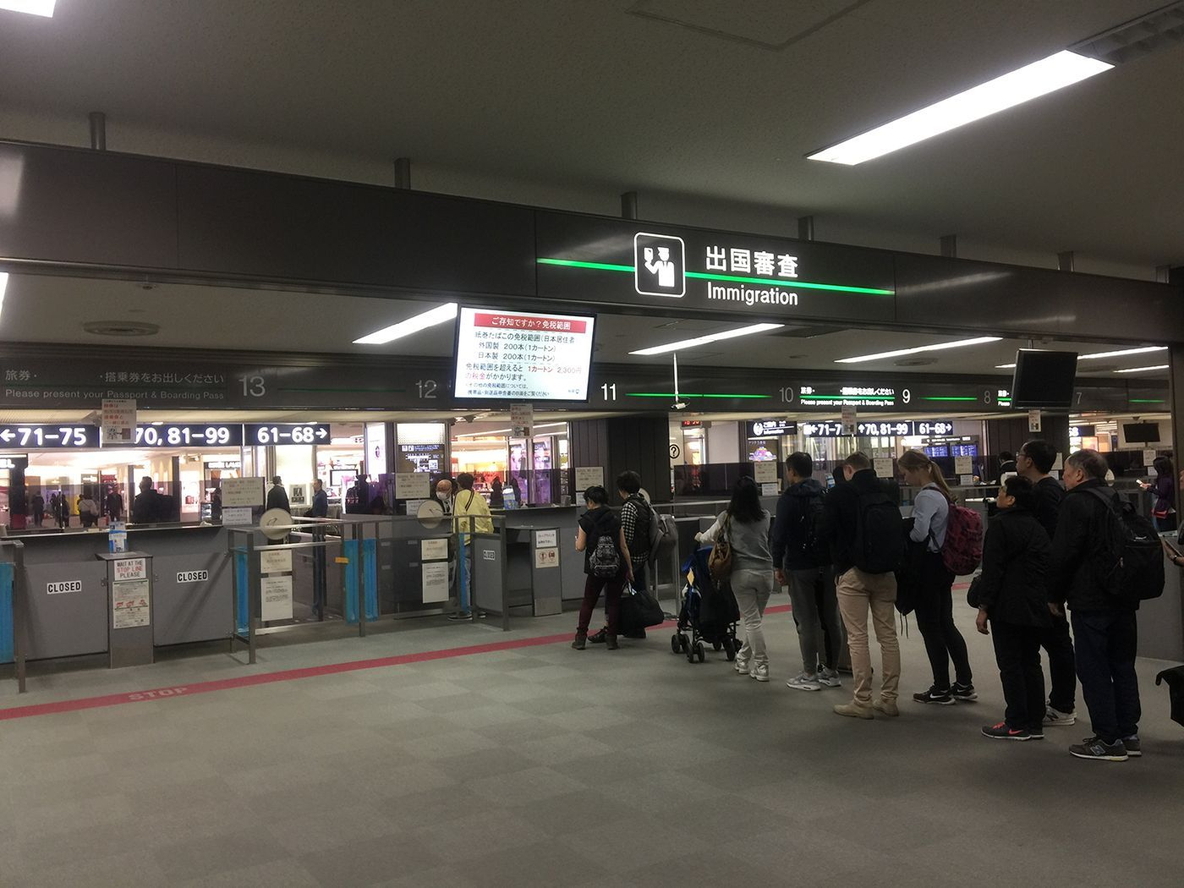
To receive the refund, travelers must clear an export-confirmation check at airport or seaport customs. The process involves holding the passport used at the time of purchase up to a dedicated terminal, which matches it against the purchase record — and it must be completed before security screening or checked-baggage drop-off. Once the export is confirmed, the refund is issued either by the original store or a refund agency it has contracted with, through bank transfer, card credit, app payment or cash at the airport, depending on the retailer.
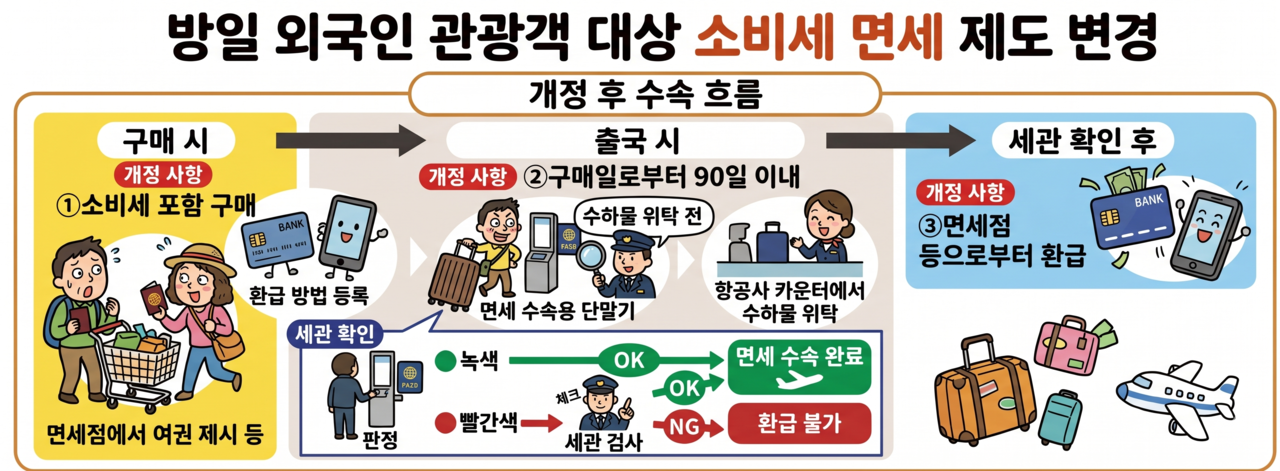
Conditions apply. The existing minimum threshold — spending at least 5,000 yen before tax at the same store on the same day — remains in place. Tourists who fail to obtain the export confirmation within 90 days of their purchase date forfeit the refund. Verification is done receipt by receipt: if even one item on a receipt cannot be presented, every item on that receipt is excluded. Cosmetics already opened or food already consumed are also ineligible.
Japan did ease some restrictions in tandem. It abolished the distinction between general goods and consumables, lifted the 500,000-yen cap on consumable purchases and dropped the special-packaging requirement. The overhaul was driven by the illegal resale of duty-free goods — as cases of tourists reselling tax-exempt items inside Japan multiplied, authorities decided to withhold the refund until departure is confirmed.
Concerns are already surfacing on the ground. Industry observers warn that changes to checked-baggage handling and item-classification rules could cause missed refunds and confusion, and that tourists' purchasing power may decline. With a customs confirmation step now added to the departure-day schedule, some travelers — like the expert quoted above — are choosing to forgo the refund entirely.
In Korea, a passport is all it takes — the discount happens at the register
Korea works the opposite way. Foreign tourists, including Japanese visitors, simply present their passport at the register and pay only the amount after the tax refund has been deducted.
Take a Japanese tourist on a short trip to Korea who buys 110,000 won ($82) worth of cosmetics at a store participating in the instant-refund program. After the cashier verifies refund eligibility and remaining allowance via passport, the tourist pays only the post-refund amount on the spot. Domestic shoppers pay the full price including value-added tax, but tourists receive the benefit on the condition that the goods will be taken out of the country.
The threshold is a single-transaction purchase of at least 15,000 won and less than 1 million won, tax included. The cumulative total eligible for the instant refund during a single stay must not exceed 5 million won — a figure that refers to the purchase price of qualifying goods, not the amount of tax returned.
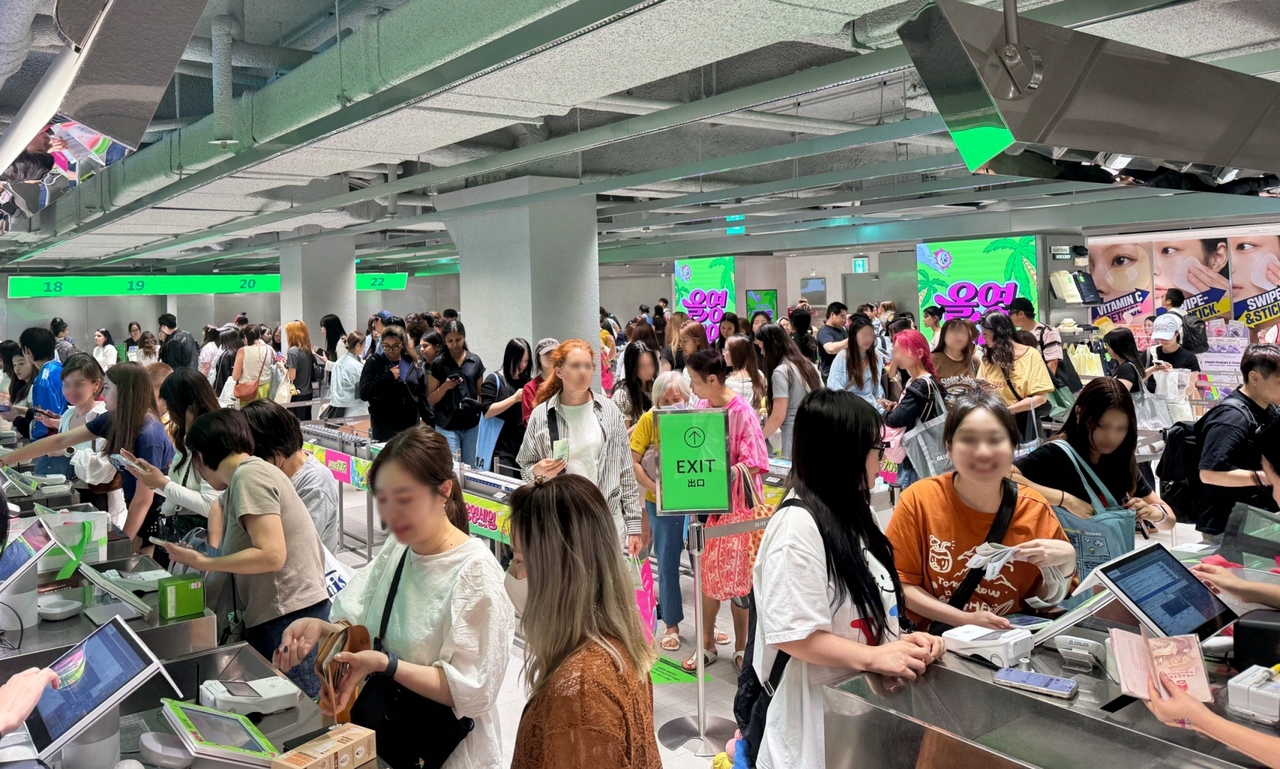
The instant-refund benefit is not limited to airports. Designated downtown tax-refund stores — including department stores and cosmetics shops approved by local tax offices — are also covered. According to the Korea Customs Service, about 23,000 such stores were registered as of the end of last year, though the instant-refund service is available only at participating outlets within that network.
There is one overarching condition: the benefit applies to foreign tourists and others who have stayed in Korea for less than six months, and purchased items must be taken out of the country unused within three months of the purchase date. Japanese tourists are subject to the same rules.
Expecting a refund of 11,000 won — 10 percent of 110,000 won — leads to a miscalculation. The 110,000-won price already embeds 10,000 won in VAT on a pre-tax base of 100,000 won, so the tax component is 10,000 won, not 11,000. After deducting refund-agency fees and other charges, the amount actually returned is smaller still. The Korea Tourism Organization puts the effective refund at roughly 5 to 8 percent of the purchase price, varying by purchase amount, refund operator and refund method.
Spending 1 million won or more in a single transaction does not eliminate the benefit. Purchases that exceed the instant-refund ceiling can still qualify for a post-departure refund at an airport or seaport. That route requires meeting export and other conditions but carries no upper purchase limit.
A third option is an advance refund at a downtown refund counter. This applies to single-transaction purchases of up to 6 million won and requires collateral equivalent to the tax amount. The same underlying tax can be handled in three different ways — deducted at the register, collected in advance downtown, or claimed at departure — each with its own limits and procedures.
Departure fees differ too — 7,000 won in Korea, about 25,000 won in Japan
Korea has steadily lowered the bar for tax refunds to attract shopping tourists. Since 2024, the single-transaction ceiling for the instant-refund program has doubled from under 500,000 won to under 1 million won, and the cumulative purchase cap per stay has doubled from 2.5 million won to 5 million won.
Since April 6 this year, cruise passengers have also been able to use the instant-refund and downtown-refund programs. Verifying their refund eligibility had been difficult because their entry procedures differ from those of regular travelers, but the Korea Customs Service resolved the issue by linking its vessel-arrival reports and passenger manifests to the refund system.
The flow of visitors between the two countries remains heavily lopsided. According to figures from the Japan National Tourism Organization and South Korean tourism authorities, 8,262,700 South Koreans visited Japan in the first nine months of this year. Over the same period, about 3.12 million Japanese visited South Korea — meaning 2.65 times as many South Koreans traveled to Japan as Japanese traveled to South Korea.
The financial burden on the last day of a trip also differs. South Korea charges a departure tax of 7,000 won for air travelers. Japan's International Tourist Passenger Tax amounts to about 25,000 won at current exchange rates, or 3,000 yen ($19). Both levies apply equally to foreign visitors and nationals, and airport facility fees are charged separately.
VAT refunds on hotel stays exist — but the government wants to end them early
A separate VAT refund applies to accommodation. Tourists who stay 30 days or fewer at a government-designated tourism accommodation facility, among other conditions, can reclaim the VAT included in their hotel bill. The benefit does not apply automatically to every hotel or booking.
South Korea does not levy a separate accommodation tax of the kind collected in Kyoto and other Japanese cities. What Korea refunds is the VAT embedded in the room rate — a fundamentally different type of levy from the local lodging tax that Japanese municipalities impose on top of the room price.
The benefit may not last as long as currently planned, however. Under existing law, the VAT refund on foreign tourists' accommodation is available through the end of 2028. The government's tax reform proposal for this year would cut that window short, ending the program on June 30, 2027.
If the National Assembly passes the government's bill as submitted, foreign tourists — including Japanese visitors — would no longer be able to reclaim VAT on stays at designated hotels from the second half of next year onward. The change is separate from the duty-free regime governing retail shopping.
fact0514@heraldcorp.com