Pan-government TF on polarization to be led by deputy PM
Economic outlook frequency raised to 3 times a year for first time in 32 years
Physical AI components, regional firms to receive preferential support
The government plans to pursue two overarching goals in its "2027 Economic Growth Strategy," to be unveiled in December: raising the potential growth rate and easing polarization. The plan will add three new physical AI component sectors to existing growth initiatives and establish a pan-government task force led by the deputy prime minister to address disparities across five areas. The frequency of official economic outlooks will also increase from twice to three times a year — the first such change in 32 years.
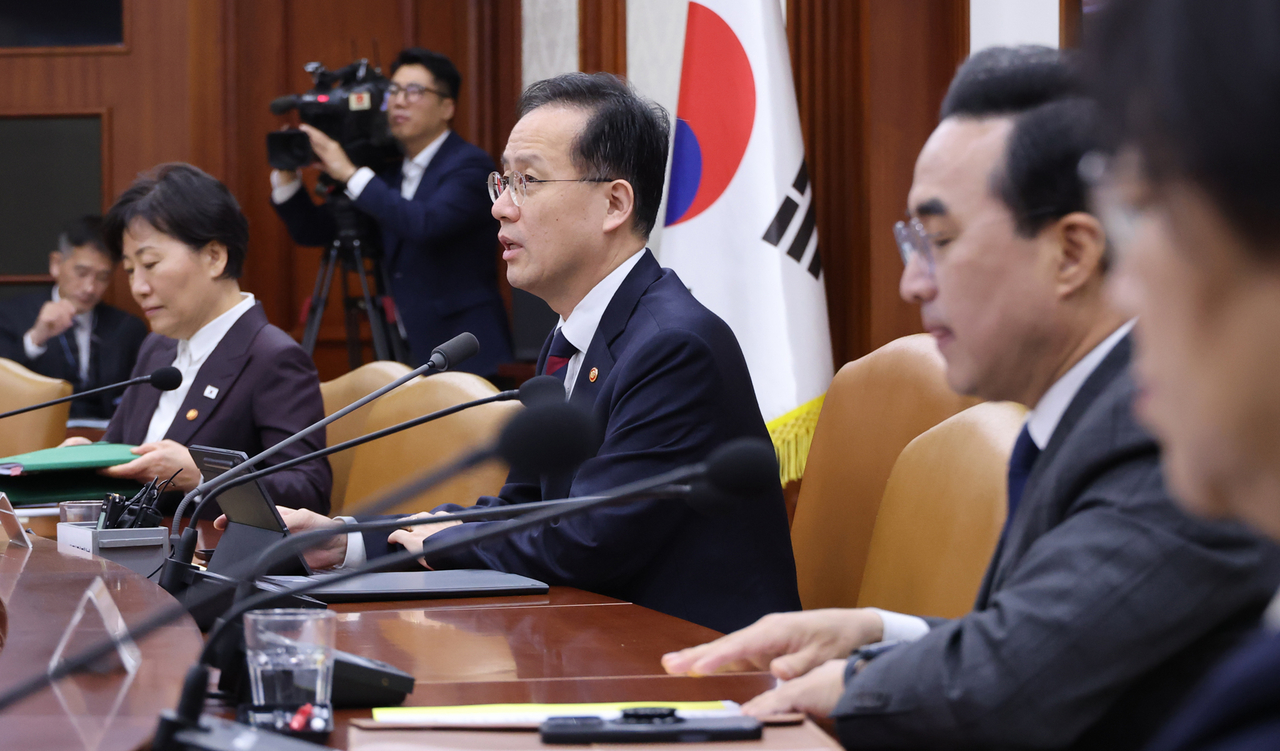
Deputy Prime Minister and Minister of Economy and Finance Lee Hyeong-il chaired an emergency economic ministers' meeting at Government Complex Seoul on Wednesday, saying the government would "mobilize all national capabilities for greater growth and a warmer livelihood for the people."
Lee said the government would "firmly lay the groundwork for a great leap toward stronger growth," pledging to press ahead with three mega-projects aimed at sustaining a rebound in the potential growth rate, the development of seven SEED new industries, support for corporate investment and innovation, enhanced competitiveness in the service sector, and the transition to an ultra-innovative economy.
Lee also vowed to resolve structural problems — including institutions and practices that deepen inequality — and to devote full effort to three livelihood projects covering residential support, employment and grassroots financial services, so that "everyone can equally enjoy the opportunities and fruits of growth."
Through the 2027 Economic Growth Strategy, the government intends to flesh out specific policy tasks for easing polarization and raising the potential growth rate. To respond more swiftly to changing domestic and external conditions, the economic outlook cycle will expand from twice to three times a year. As a result, the government will no longer prepare a separate second-half economic growth strategy; instead, it will present supplementary measures addressing shifts in economic conditions alongside each revised outlook release.
To bolster growth engines, the government will add three physical AI component tasks — next-generation sensors, actuators and secondary batteries for humanoid robots — to the existing 15 ultra-innovative economy flagship projects. "If semiconductors are the brain of AI, physical AI is the body that realizes AI on the manufacturing floor," Lee said.
For actuators and secondary batteries for humanoid robots, the government will build a large-scale mass production base by 2030 through localization and standards development. For next-generation sensors, it will pursue global market leadership through the development and demonstration of core on-sensor AI source technologies.
Efforts to address polarization and spread the gains of growth to everyday livelihoods will also begin in earnest. "I will personally lead the team as deputy prime minister and bring together related ministries, state-run research institutions and others to form a polarization-response TF and concentrate our capabilities," Lee said.
Under the TF, a general coordination unit will be jointly led by the first vice ministers of the Ministry of Economy and Finance and the Ministry of Health and Welfare, with five working groups covering improvements to the dual structure of the labor market, narrowing gaps between industries and companies, reducing regional disparities, bridging generational divides and easing social inequality. Related ministries, state-run research institutions and private experts will participate to identify core policy tasks focused on structural problems that the public feels most acutely.
Tasks identified will be divided into those to be pursued immediately, those requiring institutional reform next year and those needing broader social deliberation. Major tasks will receive concentrated support through policy packages linking fiscal, tax, financial and regulatory improvements. The three livelihood projects — covering residential support, employment and grassroots financial services — along with tasks related to basic financial rights, will also be reviewed. The general coordination unit is set to launch Thursday, with key tasks agreed upon before year-end to be incorporated into the 2027 Economic Growth Strategy.
The government will also reform the national procurement system to help narrow regional gaps. The ceiling on contract amounts for which local firms can be required to participate in joint contracts will be raised from 8.8 billion won ($6.55 million) to 30 billion won for national agencies, and from 26.5 billion won to 30 billion won for public institutions.
The recognized range of construction ratios — used to reflect local firms' actual participation in projects during bid and award evaluations — will be expanded from the current one times the construction capacity assessment amount to in principle two times, and up to three times when necessary. For goods and service procurement bids, regional preference points of up to three points will be awarded on a differentiated basis according to a local preference index. Small and medium-sized enterprises that have relocated from the Greater Seoul area to non-metropolitan regions will benefit from an extended period for recognizing delivery records — from five years to seven years — along with preferential treatment in financial condition assessments and delivery record requirements.
To ease the fuel cost burden stemming from the prolonged war in the Middle East, the current fuel tax cut will be maintained at its present level for two more months. Reduction rates of 15 percent for gasoline and 25 percent for diesel and liquefied petroleum gas butane will apply through Jan. 31 next year. The 12th round of maximum petroleum prices, effective from midnight Saturday, will be announced at 6 p.m. Friday after a review of international oil prices and the burden on the public.
y2k@heraldcorp.com