Exports hit record $33.5 billion in first 10 days of November; semiconductors account for half
Semiconductor exports reach $16.6 billion, up 331% on-year
Energy imports jump 86.3% as crude oil, gas and coal purchases surge
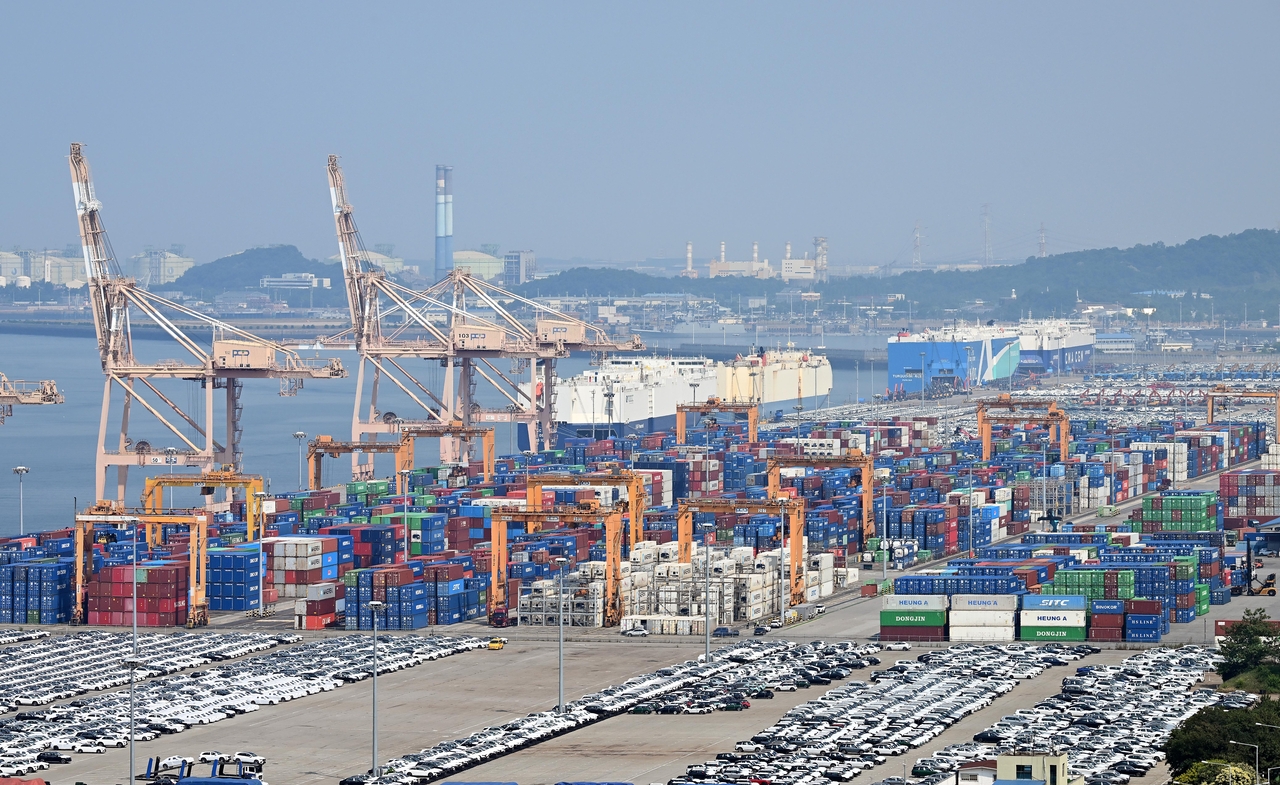
Semiconductor exports more than tripled compared with a year earlier in the first 10 days of November, driving overall exports to more than double and setting an all-time record for the period.
South Korea's cumulative exports this year have reached $963.7 billion, leaving just $36.3 billion to go before the country hits the $1 trillion mark — a milestone it is on track to reach next week, which would make it only the fourth country in the world to do so, after the United States, China and Germany.
According to the Korea Customs Service, exports from Nov. 1 to 10 came to $33.5 billion on a customs-clearance basis, up 111.9 percent from the same period a year ago.
The figure is the largest ever recorded for the first 10 days of any November. Among all early-month periods, it ranks second only to September's $35.1 billion. The number of working days in the period was 7.5, half a day more than the 7 days logged in the same period last year. Adjusting for working days, the daily average export value came to $4.46 billion, up 97.7 percent year on year.
Cumulative exports from January through Nov. 10 stand at $963.7 billion. With $36.3 billion remaining to reach $1 trillion, South Korea is expected to achieve its first-ever annual export total of $1 trillion around Nov. 20 — late next week — if the current daily average is maintained.
South Korea's exports crossed $100 billion in 1995, then surpassed $200 billion in 2004, $300 billion in 2006, $400 billion in 2008, $500 billion in 2011 and $600 billion in 2018. Last year, exports reached a then-record $709.3 billion, crossing the $700 billion threshold for the first time. This year, the country has already surpassed both $800 billion and $900 billion in succession.
Semiconductors led the export surge. Semiconductor exports from Nov. 1 to 10 reached $16.6 billion, up 331.2 percent from the same period a year ago — the largest figure ever for that period and the highest growth rate among all major export categories. Semiconductors accounted for 49.7 percent of total exports, a share 25.3 percentage points wider than a year earlier.
Petroleum products (up 100.7 percent) and computer peripherals (up 237.7 percent) also contributed to export growth. Passenger car exports, however, fell 4.3 percent.
By destination, exports grew broadly across major markets: China (up 148.0 percent), the United States (up 163.6 percent), Vietnam (up 113.3 percent), Taiwan (up 182.5 percent) and the EU (up 20.0 percent). The top three destinations — China, the United States and Vietnam — together accounted for 57.3 percent of total exports.
Imports came to $24.7 billion, up 45.0 percent from a year earlier. By category, semiconductors (up 101.3 percent), crude oil (up 75.8 percent), gas (up 192.1 percent) and machinery (up 16.5 percent) all posted increases. Energy imports — covering crude oil, gas and coal — rose 86.3 percent.
By country of origin, imports increased from China (up 63.8 percent), the United States (up 35.3 percent), the EU (up 9.0 percent), Taiwan (up 77.8 percent), Japan (up 28.0 percent) and Russia (up 20.3 percent).
With exports outpacing imports, the trade balance posted an $8.8 billion surplus — the largest ever for the same period. The cumulative trade surplus for this year also reached a record high. Notably, South Korea's trade surplus with the United States exceeded $100 billion for the first time in history, raising concerns that the Donald Trump administration could use the trade imbalance as grounds to intensify tariff and investment pressure following the US midterm elections.
oskymoon@heraldcorp.com