Ruling party calls it 'future investment'; PPP calls it 'election slush fund'
Fund draws fire across standing committees as budget season heats up
FSC, trade and education panels all see clashes over fund-linked spending
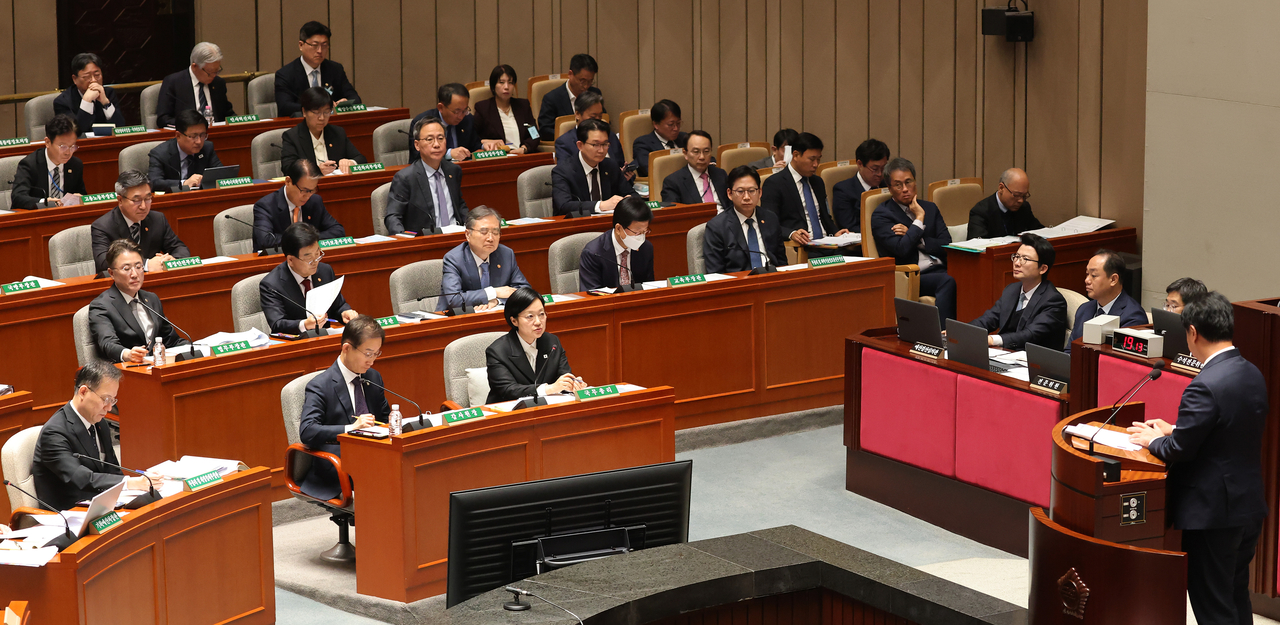
As the ruling and opposition parties continue their standoff over next year's budget proposal, clashes are intensifying across National Assembly standing committees over the 162.3 trillion won future response fund — the session's most contentious flashpoint. The Democratic Party of Korea, which holds the majority, has championed the fund as a "future investment," while the People Power Party has dismissed it as "election slush money," with neither side showing signs of giving ground.
At a budget subcommittee session of the Assembly's Political Affairs Committee Wednesday, the PPP called for sweeping cuts to Financial Services Commission project spending linked to the future response fund.
Of the 3.54 trillion won ($2.63 billion) the FSC had budgeted, the PPP argued that 2.5 trillion won — everything except the 1 trillion won allocated to growth initiatives such as the National Growth Fund — was tied to the future response fund and demanded it be cut entirely.
A PPP member of the Political Affairs Committee said the party had submitted its position to the Budget and Accounts Special Committee calling for reductions in future response fund-related spending distributed across government ministries. The lawmaker added that the PPP had also called for cuts to the Youth Future Home Loan and K-Livelihood Protection Loan programs.
The Trade, Industry, Energy, SMEs and Startups Committee saw similar friction, with the PPP criticizing the government's "Everyone's Startup" budget item included in the future response fund. The party argued that related spending had increased for next year despite the program proceeding without a preliminary feasibility review. The government responded that "the basic purpose and intent remain the same."
In the Education Committee, the fund's proposed overhaul of the local education finance grants system drew fire. Education Committee Chair Kim Hee-jung had already declared at a full committee session her opposition to what she called the hasty creation of the future response fund and the related restructuring of education grants. Debate has continued since, with the ruling and opposition parties trading arguments over the validity of the grants overhaul, how education-sourced fund money should be spent, and the committee's authority to review the relevant budget.
At a full session of the Health and Welfare Committee Tuesday, lawmakers from both sides raised concerns about the appropriateness of routing spending through the future response fund.
The government proposed channeling 2.93 trillion won for a basic child allowance and 698.1 billion won for a childbirth support payment — totaling 3.63 trillion won — through next year's future response fund. The PPP questioned the stability of that funding source and called for the amounts to be cut or shifted to the general account. Some Democratic Party lawmakers also called for a review of the government's plan, citing the need for "stable fiscal support."
The two sides remain far apart on the fund's overall scale and how it should be managed. The government's revenue plan for the future response fund stands at 162.3 trillion won, of which 45.4 trillion won is earmarked for investment in youth, growth engines, regional development, and education and talent.
The Democratic Party insists the fund is "an investment resource for securing future growth engines," while the PPP counters that "repaying national debt should come first."
Meanwhile, the Budget and Accounts Special Committee began department-by-department reviews of non-economic ministries Wednesday, continuing through Thursday. Starting Monday, the budget adjustment subcommittee will take up the detailed work of deciding increases and decreases for individual programs, after which the full committee will vote on the revised plan.
The legal deadline for the full Assembly to pass the new budget is Dec. 2. The ruling party has said it intends to finalize both the budget bill and the fund management plan at a plenary session by that date.
raining@heraldcorp.com