Yonsei University professors Ahn Chul-woo and Kang Jung-hyun lead research establishing link between preoperative blood musclin and post-surgical skeletal muscle changes; findings published in EJSO

A new study suggests that the risk of skeletal muscle loss following colorectal cancer surgery can be predicted in advance through a preoperative blood test.
A research team led by professors Ahn Chul-woo (endocrinology) and Kang Jung-hyun (colorectal surgery) at Yonsei University's Gangnam Severance Hospital — including researchers Kim Yu-sik, Nam Ji-sun, Shin Su-jin and Kim Young-hyun — found that higher preoperative blood musclin levels were associated with better preservation of skeletal muscle mass and a lower risk of muscle loss after colorectal cancer surgery.
Patients who undergo cancer surgery frequently experience muscle loss due to malnutrition and reduced physical activity. Post-surgical skeletal muscle decline is a major factor that slows recovery and worsens prognosis. CT scans have traditionally been used to measure current muscle mass, but they have limitations in predicting how much muscle a patient may lose after surgery.
Musclin, the protein the research team focused on, is a type of myokine — a hormone secreted primarily by skeletal muscle — and is known to be involved in maintaining skeletal muscle mass, supporting metabolic adaptation in muscle tissue and inhibiting protein breakdown.
The team measured preoperative blood musclin concentrations and inflammatory markers in 106 colorectal cancer surgery patients at Gangnam Severance Hospital, with an average age of 63.3. Of those, 95 patients for whom pre- and post-operative CT follow-up was available were included in a retrospective analysis of changes in the skeletal muscle index based on third lumbar vertebra CT scans, taken at a median interval of 198 days (approximately 6.5 months).
The analysis found that 28.4 percent of the tracked patients — 27 of 95 — experienced a post-surgical decline in the skeletal muscle index exceeding 5 percent.
After adjusting for confounding variables including age, sex and inflammatory markers in a multivariate analysis, preoperative blood musclin levels showed a significant positive correlation with post-surgical skeletal muscle index (p=0.001). Each 1 ng/mL increase in preoperative blood musclin concentration was associated with a 0.529-fold reduction in the odds of post-surgical skeletal muscle loss exceeding 5 percent (odds ratio; p=0.038).
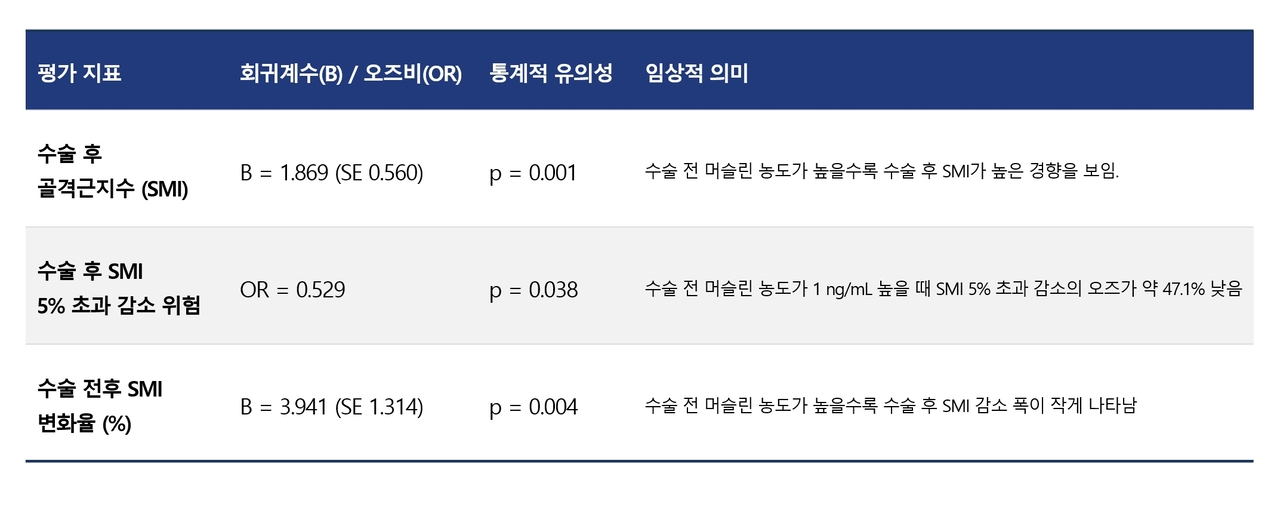
When blood musclin levels were added to a predictive model for post-surgical skeletal muscle index that had previously relied only on clinical data and inflammatory markers, the model's explanatory power (R²) improved from 0.767 to 0.794. The researchers said this suggests musclin can provide additional information about muscle loss vulnerability that CT measurements and inflammatory markers alone cannot capture.
The research team said the study is significant in that it extends musclin's role beyond a simple muscle-secreted hormone, positioning it as a candidate blood biomarker for identifying patients at high risk of post-surgical muscle loss before an operation.
"Muscle is not merely an organ that moves the body — it is an endocrine organ that secretes signaling molecules reflecting the body's health status," said Professor Ahn. "This research demonstrates that musclin, a health signal sent by muscle, can serve as a new biomarker candidate reflecting metabolic adaptation and post-surgical muscle loss vulnerability in cancer patients."
"Skeletal muscle loss after colorectal cancer surgery is directly linked to a patient's recovery and long-term treatment outcomes, but CT scans alone have made it difficult to identify in advance who will experience rapid muscle decline," said Professor Kang. "If we can use blood tests to screen high-risk patients for muscle loss before surgery, we expect it will be of great help in developing patient management strategies."

The study was published in the European Journal of Surgical Oncology (EJSO), an international journal in the field of surgical oncology, under the title "Preoperative circulating musclin as a candidate biomarker of postoperative skeletal muscle vulnerability in colorectal cancer."
kty@heraldcorp.com