- Eight superconducting gravimeters across East Asia linked
- Experts from 14 countries gather in Jeju
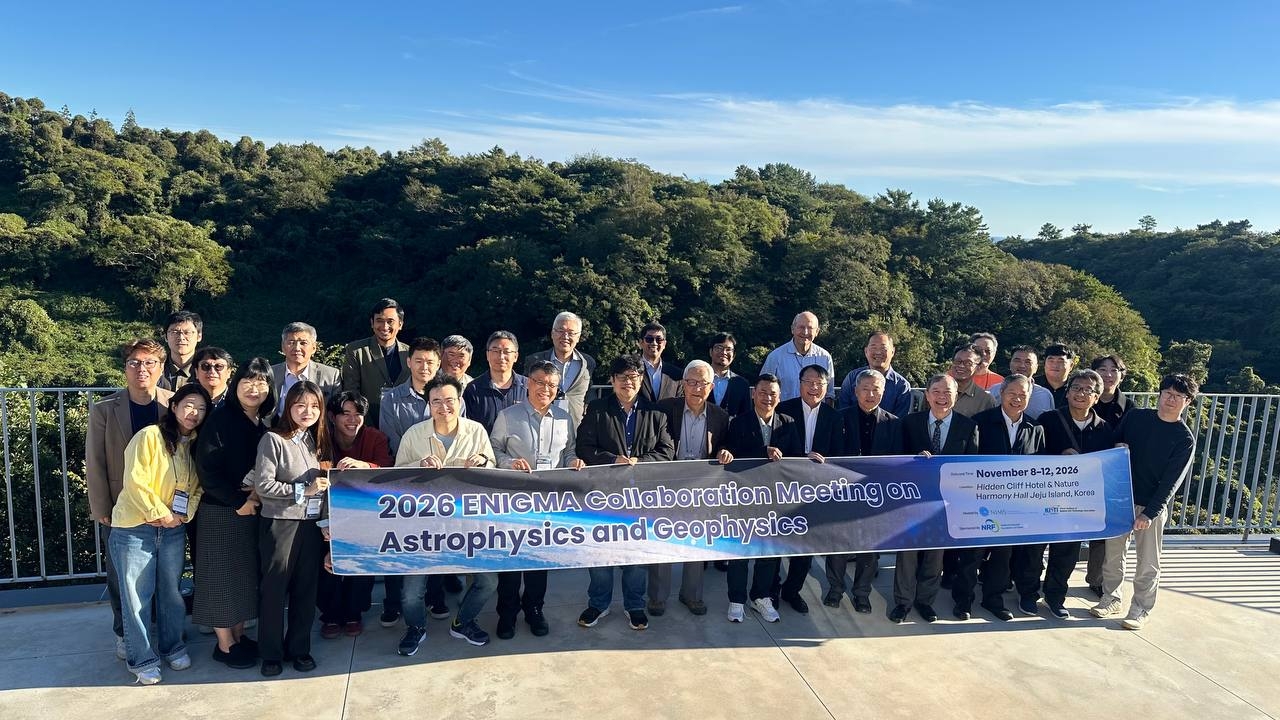
An international observation network linking eight ultra-precision gravity measurement instruments across South Korea, China, Japan and Taiwan has been established, creating a foundation for jointly analyzing gravity data to more accurately study complex natural phenomena such as earthquakes and changes within Earth's interior.
The National Institute for Mathematical Sciences (NIMS) announced Wednesday that it is co-hosting the 2026 ENIGMA Astrophysics and Geophysics International Cooperation Conference with the Korea Institute of Science and Technology Information (KISTI) at the Hidden Cliff Hotel and Nature in Jeju from Sunday through Thursday.
About 50 experts from 14 countries are attending the event to discuss expanding the precision gravity observation network and ways to promote international joint research.
ENIGMA is an East Asian gravity measurement international cooperation network launched in 2024 under NIMS leadership. Its goal is to share and conduct integrated analysis of observational data from eight superconducting gravimeters installed across four regions — South Korea, Japan, China and Taiwan.
Superconducting gravimeters precisely measure minute changes in Earth's gravity and are used to study geophysical phenomena such as mass movement within Earth's interior and earthquakes.
Analyzing gravity data collected simultaneously from multiple locations allows researchers to more accurately understand large-scale gravity changes and geophysical phenomena that are difficult to detect from a single observation station.
The conference will feature a presentation of observational results from the Yemi Microgravity Observatory, jointly operated by NIMS and the University of Calgary in Canada, along with updates on the current state of gravity observation across East Asia.
Key topics under discussion include earthquake observation and disaster research, next-generation gravity sensor development, and the analysis of gravity and seismic observation data.
Son Jae-ju, a researcher at NIMS, introduced observational experience from the Yemi Microgravity Observatory and presented proposals for international cooperation to improve data quality through long-term stable observation and environmental noise analysis.
NIMS and KISTI also plan to strengthen data infrastructure for the joint use of precision observational data. Centered on the ENIGMA Data Hub operated by KISTI's Global Science Data Center, they plan to consolidate management of observational data from each country and improve the environment for researchers to conduct joint data analysis.
The initiative aims to increase the utility of gravity observational data currently scattered across individual countries and expand international joint research in geophysics and astrophysics.
Cho Gyu-jin, director of KISTI's Global Science Data Center, said the organization would "support data sharing among institutions through the ENIGMA Data Hub and strengthen support for joint research."
The conference also addressed ways to promote public understanding of the connection between gravity observation and mathematics. Yoo Myung-san, a researcher at NIMS, presented findings on precision gravity observation and mathematical modeling research, and outlined approaches for communicating to the public how mathematics can be used to understand complex natural phenomena.
Choi Yun-seong, director of NIMS, said mathematics is "a core discipline for understanding complex natural phenomena and connecting diverse fields of science and technology," adding that he hopes the conference will strengthen cooperation among domestic and international research institutions and lead to new achievements in geophysics and fundamental physics through mathematics-based convergence research.
nbgkoo@heraldcorp.com