Driver-assist feature that adjusts speed and following distance
has detection limits near stopped vehicles and construction zones
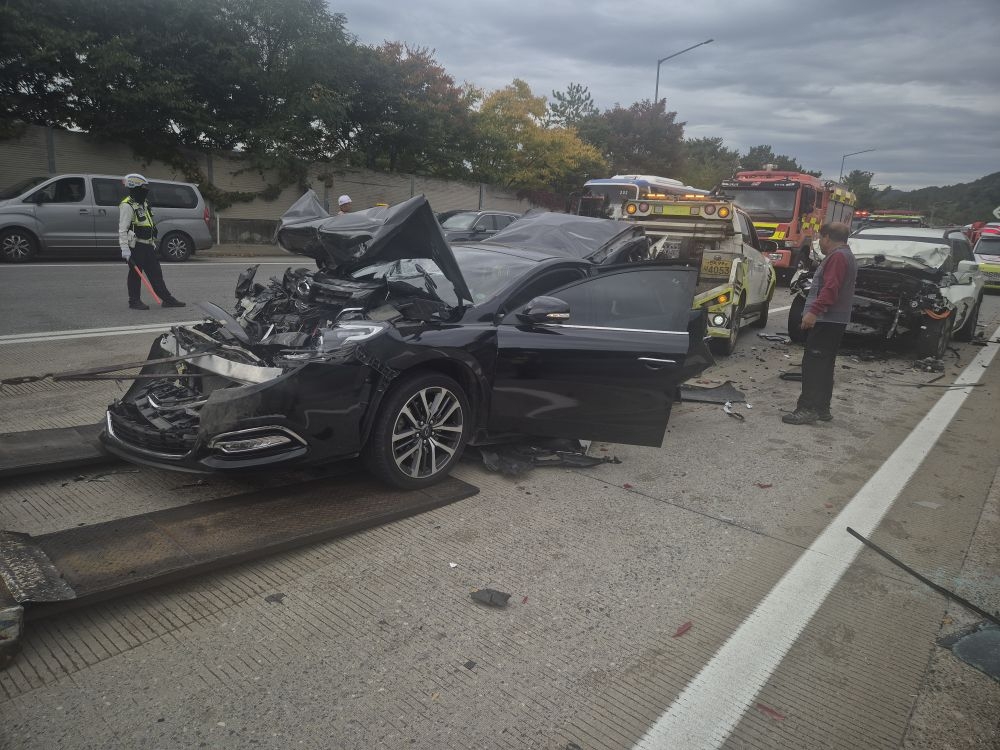
In October, a car traveling on the Namhae Expressway near Suncheon IC rear-ended a safety vehicle stopped in the first lane for maintenance work. The driver had been relying on adaptive cruise control (ACC) and failed to watch the road ahead, injuring two people.
Accidents involving adaptive cruise control, or ACC, have killed 15 people over the past three years, with fatalities surging this year. Through late October, six ACC-related crashes on expressways claimed eight lives — a 60 percent increase over the three-year average.
Korea Expressway Corporation released the findings Wednesday based on its analysis of expressway traffic accidents.
The overall fatality rate for expressway accidents from 2023 to 2025 averaged 10.3 percent, while the rate for ACC-related crashes averaged about 62.5 percent — meaning such accidents are far more likely to result in death. The fatality rate is calculated by dividing the number of deaths by the number of accidents and multiplying by 100, representing the number of deaths per 100 accidents.
According to owner's manuals from major domestic and foreign automakers, ACC has significant limitations in detecting and responding to stopped vehicles ahead and in work zones where some lanes are temporarily closed. The system struggles to accurately detect vehicles moving very slowly or stopped, situations where lanes are temporarily blocked, and vehicles whose rear profiles are small or partially obscured. Drivers who rely solely on ACC in such conditions face a high risk of rear-end collisions.
Tests by automotive YouTube channel Motrline found that three out of five vehicles failed to stop in front of a stationary construction vehicle, and only one out of five stopped for a stationary pedestrian — highlighting wide performance gaps depending on conditions. "Even if it works nine times out of ten, one failure is dangerous," the tester said, urging drivers not to place blind trust in ACC.
"ACC is not a substitute for driving — it is only a driving aid," a Korea Expressway Corporation official said. "Drivers should read their vehicle's owner's manual in advance, keep their eyes on the road at all times while using ACC, and keep their hands on the wheel so they can brake manually in an emergency."
The official also called on automakers to act. "Vehicle manufacturers should actively inform customers of proper ACC usage at the time of delivery, implement stepped warning systems that monitor whether drivers are watching the road, and improve the system's ability to recognize construction zone safety vehicles and stopped vehicles," the official added.
Meanwhile, eight safety patrol workers — one fatally — were injured at expressway accident scenes over the past three years. In response, Korea Expressway Corporation said it is developing an AI-based autonomous driving robot signal operator to take over rear traffic management duties, with plans to begin a pilot program on expressways from 2027 after performance verification.
hss@heraldcorp.com