Analysis of seven MOG protein variants identifies MOGα3 antibody as relapse marker; study of 161 patients in South Korea and UK finds roughly 2.7-fold higher adjusted relapse risk in antibody-positive group
MOG antibody-associated disease, a rare inflammatory disorder of the central nervous system that causes optic neuritis, myelitis and other serious neurological conditions, relapses in more than half of adult patients — yet predicting at first onset who will relapse has remained elusive. A multinational research team has now identified an antibody tied to that relapse risk: one that reacts to MOGα3, a specific form of the MOG protein. Patients who tested positive for the antibody faced a significantly higher risk of relapse than those who did not.
The team — led by Kim Sung-min, a professor in the neurology department at Seoul National University Hospital, Patrick J. Waters of the University of Oxford, Kwon Young-nam, a professor in the neurology department at Kangbuk Samsung Hospital, and Miguel Leal Rato of Oxford University Hospitals — analyzed serum samples and medical records from 161 MOGAD patients in South Korea and the United Kingdom, the researchers announced Wednesday.
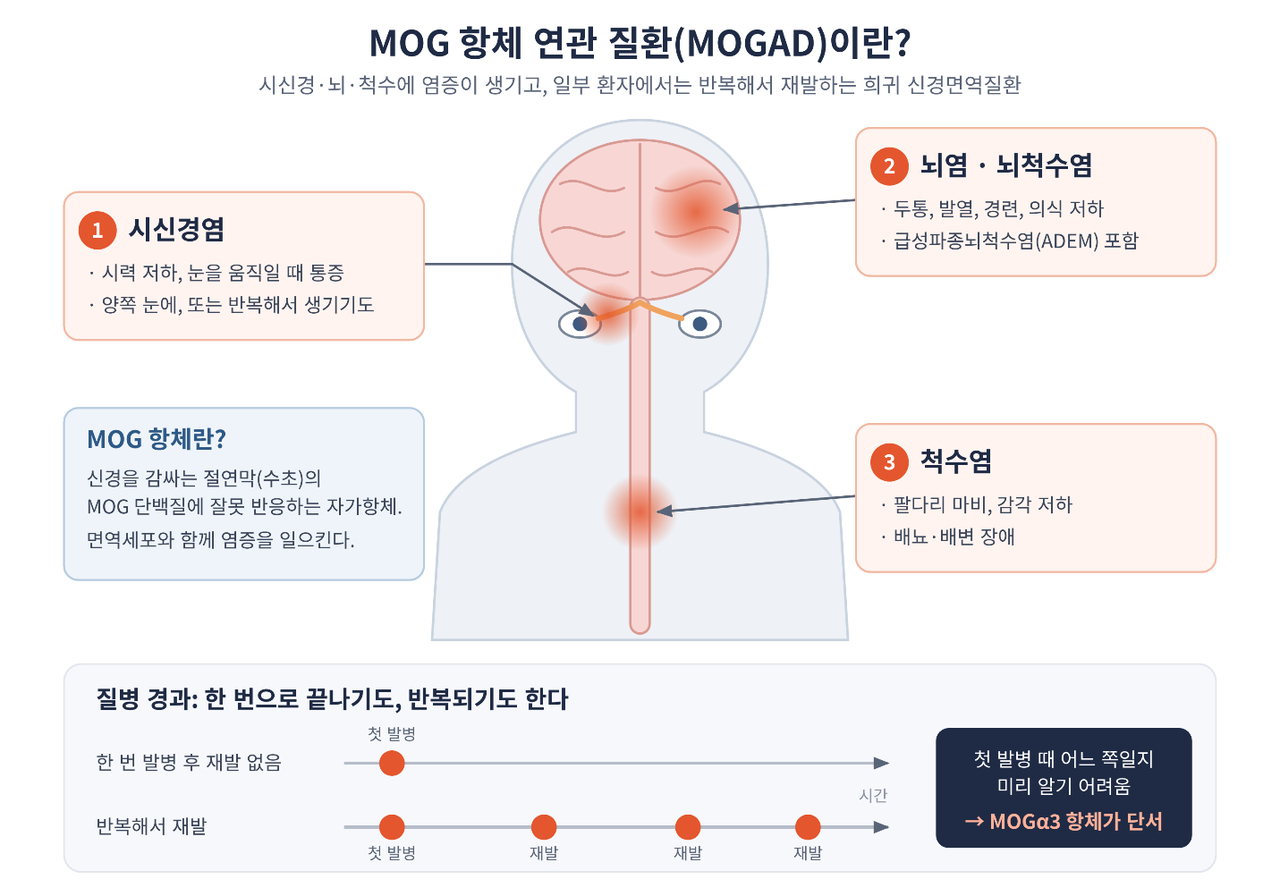
Key symptoms and clinical course of MOG antibody-associated disease
MOGAD occurs when the immune system mistakenly attacks the MOG protein in myelin, the protective sheath surrounding nerve fibers, triggering rare inflammatory damage to the central nervous system. Autoantibodies against the MOG protein, along with immune cells including T cells, drive the inflammation. The disease can manifest as optic neuritis, myelitis, encephalitis or acute disseminated encephalomyelitis, causing vision loss, paralysis, sensory disturbances and seizures.
Conventional MOG antibody testing has focused primarily on detecting antibodies against MOGα1, one form of the MOG protein. The protein exists in seven structural variants, called isoforms, that share the same extracellular region but differ in their intracellular structure. Whether antibodies against the remaining isoforms carry diagnostic or prognostic significance had not been clearly established.
The research team first measured antibodies against all seven MOG isoforms in serum from 56 patients at Seoul National University Hospital to identify which variants were associated with relapse. They then independently validated the relationship between MOGα3 antibodies and relapse in serum from 49 patients across eight hospitals in South Korea and 56 patients at Oxford.
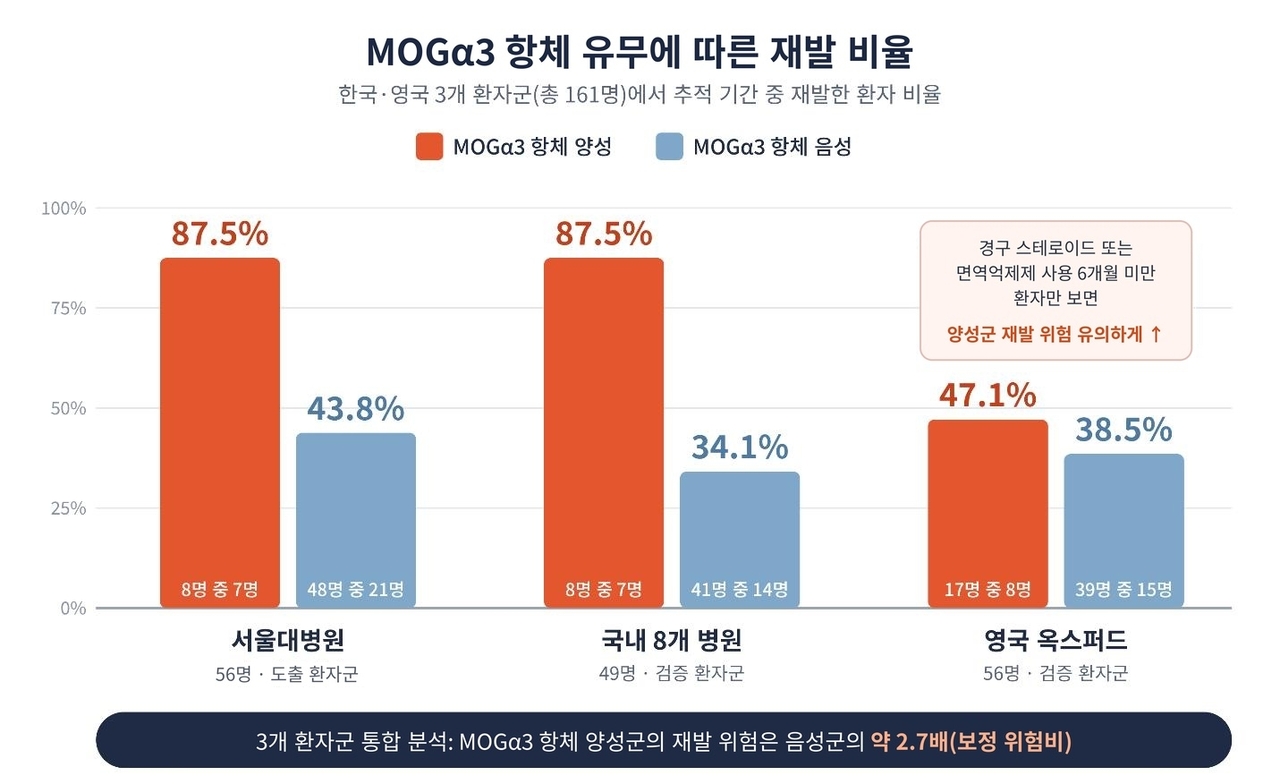
Relapse rates during follow-up and pooled analysis results for three patient cohorts in South Korea and the UK, by MOGα3 antibody status
In the Seoul National University Hospital cohort, the overall relapse rate during the follow-up period was 87.5 percent (7 of 8 patients) in the antibody-positive group, compared with 43.8 percent in the negative group — a difference that did not reach statistical significance. The relapse rate within one year of onset, however, was significantly higher in the positive group at 87.5 percent, roughly three times the 31.2 percent recorded in the negative group. Adjusted for observation period, the relapse risk in the positive group was 4.3 times that of the negative group.
Validation in the cohort of 49 patients from eight South Korean hospitals also showed a statistically significant difference in relapse rates during follow-up: 87.5 percent in the positive group versus 34.1 percent in the negative group. The relapse rate within one year of onset did not differ significantly between the two groups — 37.5 percent versus 26.8 percent.
In the UK cohort, overall relapse rates of 47.1 percent in the positive group and 38.5 percent in the negative group showed no statistically significant difference. Those patients had used oral steroids for longer after first onset than the South Korean patients, and longer steroid use was associated with lower relapse risk. When the analysis was restricted to patients who had used oral steroids or immunosuppressants for less than six months, the positive group showed a significantly higher relapse risk.
In a pooled analysis of all three cohorts, the adjusted relapse risk in the MOGα3 antibody-positive group was approximately 2.7 times that of the negative group. When restricted to patients who had used oral steroids or immunosuppressants for less than six months, the adjusted risk ratio rose to approximately 3.6.
The research team cautioned, however, that a negative MOGα3 antibody result does not mean a patient will not relapse. The antibody is best regarded as a supplementary indicator signaling a higher probability of relapse when positive, they said.
"This study shows that knowing which form of the MOG protein a patient's antibodies react to can provide additional information for assessing relapse risk," Kim said. "For patients who test positive for MOGα3 antibodies, this could serve as a basis for considering more proactive relapse-prevention treatment from the time of first onset. We plan to examine through larger prospective studies whether this finding can help guide clinical care and treatment planning in practice."

The study was supported by the National Research Foundation of Korea under the Ministry of Science and ICT and by the Ministry of Health and Welfare's Patient-Centered Clinical Research Coordinating Center project. The findings were published in the latest issue of the international journal Neurology: Neuroimmunology & Neuroinflammation (impact factor 9.6).
kty@heraldcorp.com