Jeonse renewals account for 52.7% of contracts; all lease renewals at 46.5%
Renewal rights used more actively in non-Gangnam districts such as Seongbuk-gu and Nowon-gu
Jeonse listings fall 15.8% over the year, raising concerns over housing costs
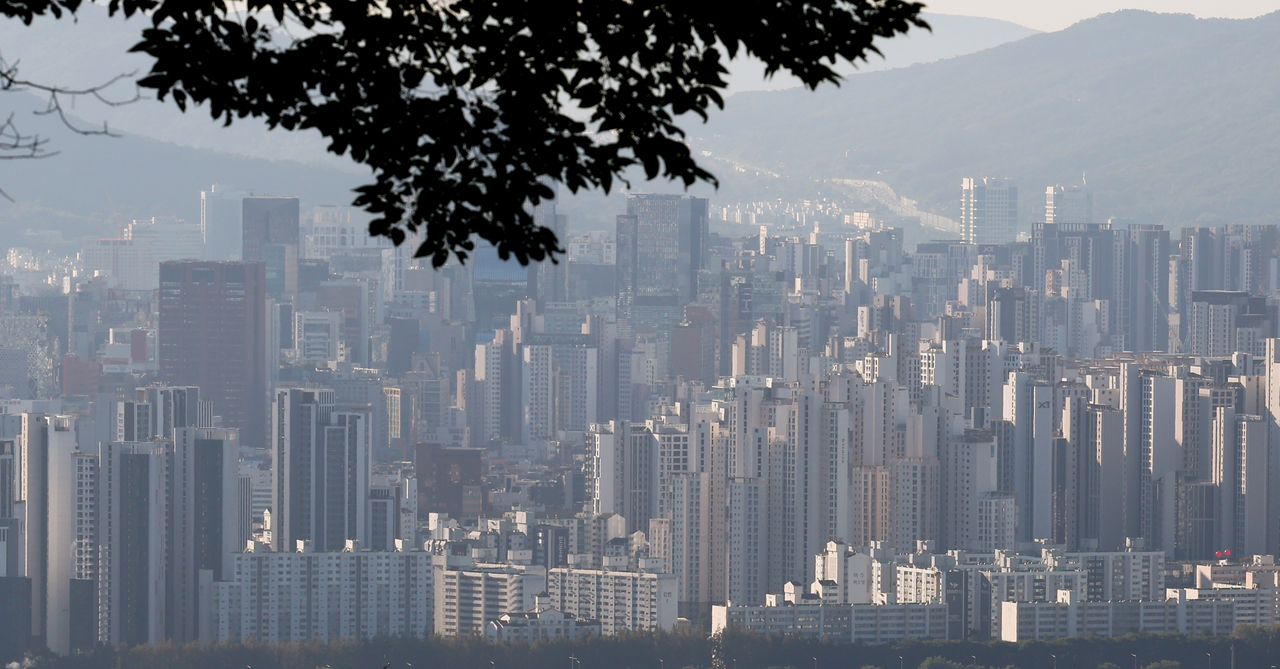
More Seoul apartment tenants renewed their leases with existing landlords this year than last year, data showed Thursday. The trend was especially pronounced in non-Gangnam districts, where tenants made greater use of the contract renewal right — a legal provision that caps rent increases.
According to the Ministry of Land, Infrastructure and Transport's actual transaction price disclosure system, renewal contracts accounted for 86,877 of the 186,724 Seoul apartment jeonse and monthly rent transactions with confirmed contract types this year, or 46.5% of the total. That is up 5.2 percentage points from the 41.3% renewal share recorded for all of last year.
Analysts attributed the increase to a shrinking pool of available listings and greater difficulty moving between homes, as expanded land transaction permit zones and tighter loan regulations this year made residential relocation harder, pushing more tenants to extend contracts with their current landlords.
However, among renewal contracts, the share in which tenants exercised the formal renewal right fell 6.1 percentage points — from 49.2% last year to 43.1% this year. By contrast, the share of mutually agreed renewals, in which landlords and tenants extend contracts by consent, rose from 50.8% to 56.9% over the same period.
In Gangnam districts, renewal contracts increased even as use of the formal renewal right declined. In Gangnam-gu, renewals made up 52% of all jeonse and monthly rent contracts this year, up from 50% last year, but the share of renewals using the formal renewal right dropped from 54.3% to 44.4%.
Seocho-gu and Songpa-gu also saw their renewal right usage rates fall this year, to 39.2% and 44.0% respectively, down from 53.2% and 48.1% last year.
"This year, rising jeonse prices and tighter jeonse loan conditions made it harder for tenants to move, so many preferred to renew through mutual agreement," an official at a real estate agency in Daechi-dong, Gangnam-gu, said. "It also seems that many tenants have already used up their renewal right, as the tenant protection law is now in its sixth year."
In non-Gangnam districts, by contrast, use of the formal renewal right was relatively active. Among renewal contracts this year, Jung-gu had the highest share of renewal right usage at 56.2%, followed by Seongdong-gu (55.6%), Dobong-gu (53.9%), Seongbuk-gu (52.5%) and Gwangjin-gu (52.4%).
Looking at jeonse contracts alone, renewals accounted for 52.7% of the total — more than half — and 53.3% of those used the formal renewal right. By district, the renewal right usage rate among jeonse renewal contracts was highest in Jung-gu at 66.2%, followed by Jongno-gu (64.2%), Seongdong-gu (62.2%), Dongdaemun-gu (61.7%) and Gwanak-gu (61.4%).
The higher renewal right usage in non-Gangnam areas reflects the sharp rise in jeonse prices in northern Seoul districts this year.
According to the Korea Real Estate Board, Seoul apartment jeonse prices rose a cumulative 8.21% from January through September this year. Seongbuk-gu posted the steepest increase at 13.58%, followed by Nowon-gu (12.96%), Gangbuk-gu (10.75%), Seongdong-gu (10.69%) and Dobong-gu (10.43%).
The northeastern Seoul zone as a whole recorded the highest cumulative increase among the city's five major zones at 11.13%. Over the same period, jeonse price gains in Gangnam-gu and Seocho-gu were limited to 2.52% and 4.13%, respectively. Monthly rents in the northeastern zone also climbed 10.10%, driven by Nowon-gu (12.88%), Seongbuk-gu (11.82%) and Seongdong-gu (10.46%).
In Seongbuk-gu's Gireum-dong, a new jeonse contract for a 59-square-meter unit at Raemian Gireum 1 was signed for 480 million won ($357,000) early this year, but the same unit type traded for 650 million won last month — a gain of 170 million won, or 35.4%, in roughly 10 months.
In Junggye-dong, Nowon-gu, new jeonse contracts for an 84-square-meter unit at Geonyoung 3rd Complex were priced in the 650 million to 680 million won range early this year but have recently risen to the 850 million to 870 million won range — an increase of around 200 million won.
"It appears that the sharp rise in jeonse prices this year and a prolonged shortage of listings have led more tenants to use the renewal right, which caps rent increases at 5%," an official at a real estate agency in Junggye-dong, Nowon-gu, said. "Some tenants who cannot find an apartment on jeonse are moving to multi-family homes or villas instead."
Meanwhile, the decline in available jeonse listings, combined with the growing trend of contract renewals, could further increase housing costs for new tenants. According to Asil, a real estate big data platform, Seoul apartment jeonse listings stood at 22,021 as of Wednesday — down 4,130, or 15.8%, from 26,151 a year earlier.
quq@heraldcorp.com