Five-sector response covers labor, industry, regions, generations and society
Pan-government TF to identify policy tasks and improve regulatory regime
Agreed measures to feed into '2027 Economic Growth Strategy'
The government will pursue a policy package combining fiscal, tax, financial and regulatory measures to address polarization across five key sectors: the labor market, industry and business, regions, generations, and society. It plans to finalize agreed inter-agency measures by year-end and incorporate them into the "2027 Economic Growth Strategy," with regulatory improvements and follow-up actions to proceed according to each task's implementation schedule.
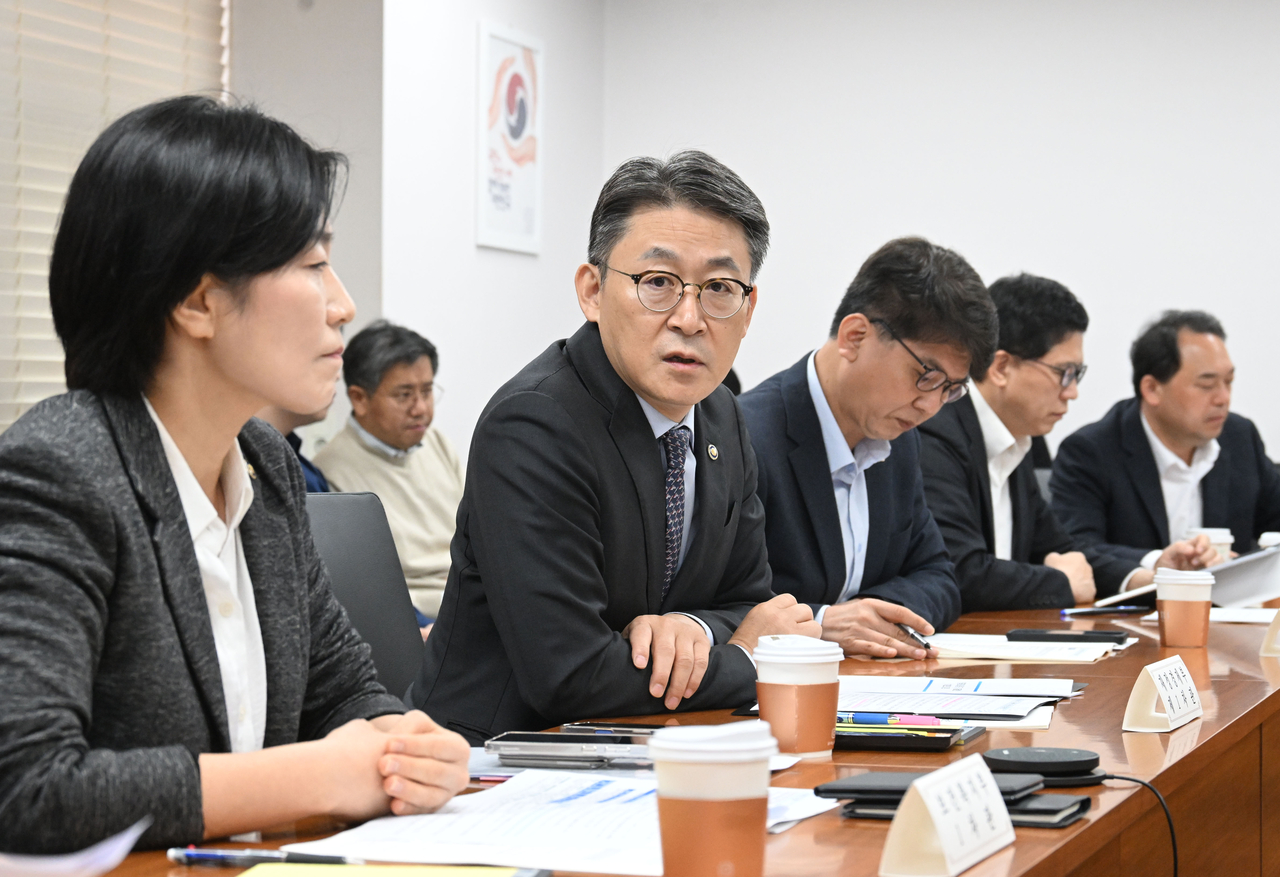
The Ministry of Economy and Finance and the Ministry of Health and Welfare held the inaugural meeting of the steering committee of the "Polarization Response Task Force" on Thursday at Government Complex Seoul. The session was co-chaired by First Vice Minister of the Ministry of Economy and Finance Kwon Dae-young and First Vice Minister of the Ministry of Health and Welfare Hyun Su-yeop, and was attended by presidential secretaries for growth economy and health and welfare, along with officials from related ministries and agencies.
The pan-government collaboration framework was formally activated just one day after the government unveiled its "Direction for Polarization Response" at an emergency economic ministers' meeting.
The government set the core objectives of the initiative as restoring socioeconomic mobility and relieving downward pressure on vulnerable sectors. Policy efforts will focus on strengthening the capacity of citizens and businesses to grow and adapt to change, while preventing the erosion of the self-reliance base in vulnerable sectors.
To that end, five working groups will operate under the Polarization Response TF, which is headed by the deputy prime minister for economic affairs. The groups will address the dual structure of the labor market, the gap between large and small industries and businesses, regional disparities, generational disparities, and social disparities. Related ministries and state-funded research institutions will participate in each group, which will also identify polarization challenges arising from the AI transformation.
Rather than listing individual support measures, the policy approach focuses on identifying core tasks capable of resolving structural problems and concentrating support on them. Actionable tasks will receive an integrated policy package combining fiscal, tax and financial support with regulatory improvements, with successful models then scaled to other sectors. Core tasks requiring broader social deliberation will be taken up through public forums and other consultative processes.
The government cited the shipbuilding industry's mutual-growth agreement between prime contractors and subcontractors as a model for the initiative. In the first half of next year, the government plans to review and strengthen the existing agreement, and will consider drawing up a new agreement covering AI transformation responses along with complementary government support. From the second half of next year, it will assess outcomes and examine extending the model to other industries such as defense and automobiles.
Identified policy tasks will be categorized and pursued according to their timing and nature — those that can be implemented immediately, those requiring regulatory improvements or action next year, and those that need broader social deliberation and public consultation — with the aim of making the impact tangible to the public.
To support this, each working group will meet weekly, and the steering committee will convene at least twice a month. As each working group identifies and refines its core tasks, the steering committee will coordinate policy across ministries and monitor progress.
The steering committee will also oversee follow-up measures under the three existing livelihood projects covering residential support, employment and financial services for low-income households. Within the Ministry of Economy and Finance, a dedicated polarization-mitigation unit will be established, and the existing livelihood stabilization support team will be reorganized and expanded into a tentatively named polarization-mitigation support team to strengthen operational capacity.
From November through early December, the five working groups will report and discuss their sector-specific directions at the TF. Agreed inter-agency measures and next year's implementation roadmap will be compiled by year-end and incorporated into the "2027 Economic Growth Strategy." The TF and working groups will continue operating beyond next year to identify additional tasks, improve the regulatory regime and monitor implementation.
The pan-government response reflects the government's assessment that disparities in the labor market and between industries and regions have become entrenched, and that the spread of AI could deepen polarization further. Last year, the wage ratio of non-regular to regular workers at large companies fell to 61.1 percent, and South Korea's elderly income poverty rate stood at roughly 2.7 times the OECD average.
"The government must now answer the question of whether everyone is growing together," Kwon said. "Last year, the wage ratio of non-regular to regular workers at large companies fell to around 61 percent, the elderly poverty rate reached 2.7 times the OECD average, and the spread of AI transformation risks deepening K-shaped polarization."
Kwon called on participants to "concentrate pan-government capacity on identifying projects that citizens can feel, by focusing support through policy packages combining fiscal, tax, financial and regulatory improvements, and then scaling up successful models."
Hyun said polarization is a structural problem that threatens the sustainability of society, and that addressing it requires going beyond simply expanding support — striking a balance between preventive investment to restore socioeconomic mobility and protection to prevent the entrenchment of poverty.
Hyun urged close coordination and collaboration centered on the steering committee to ensure that each working group's tasks develop into a coherent policy package addressing structural problems rather than fragmented ministry-by-ministry measures. Participating ministries and agencies were asked to explore a wide range of approaches to narrowing sector-specific disparities in ways that citizens can feel directly.
y2k@heraldcorp.com