Korea Employment Information Service, Ministry of Employment and Labor hold 2nd open data academic conference Thursday
Discussions to cover intergenerational job competition, youth career disruption and unemployment benefit reform
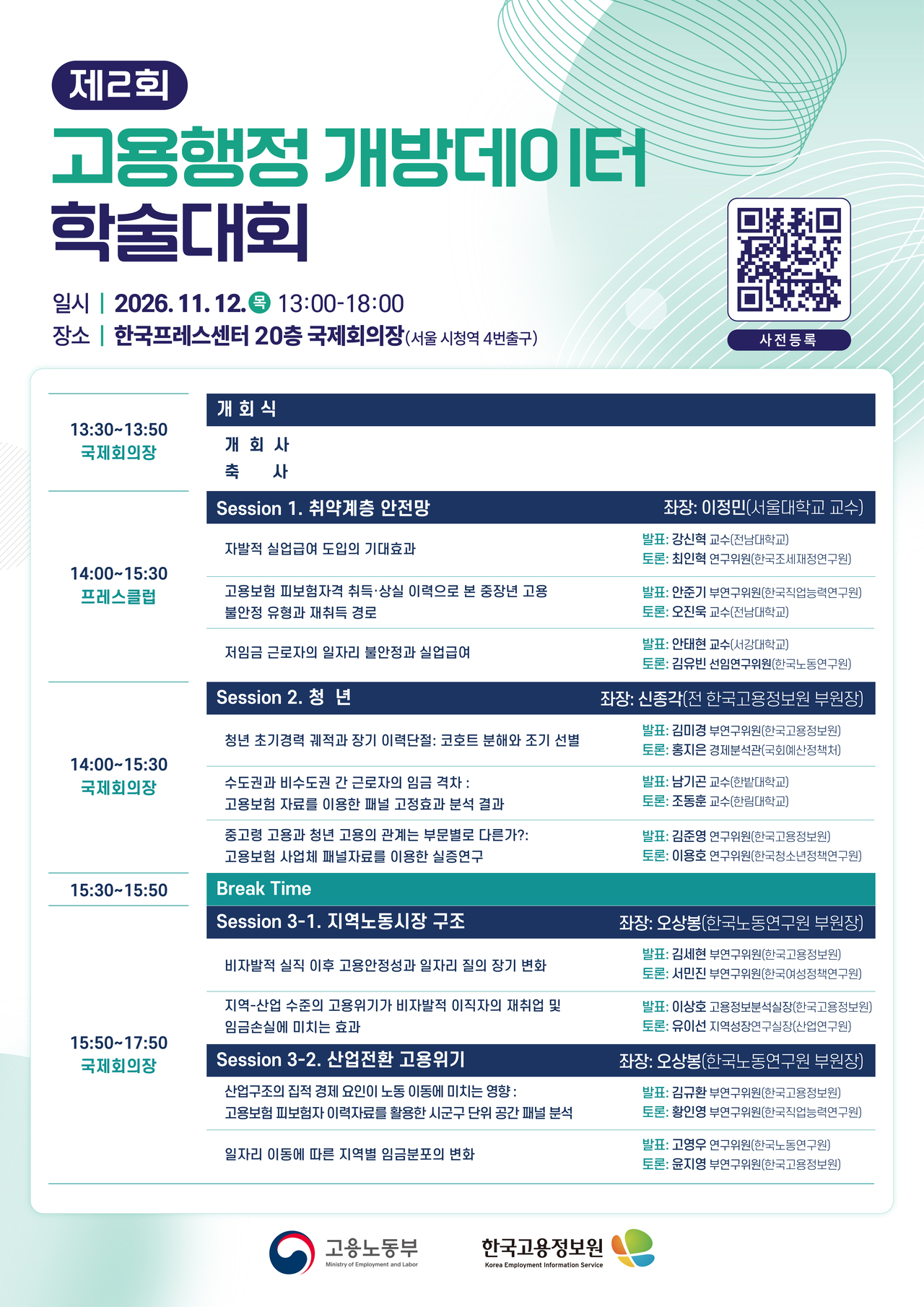
Researchers will gather Thursday to analyze pressing labor market challenges — from youth unemployment and job insecurity among middle-aged workers to regional employment crises driven by industrial restructuring — using actual employment insurance data to develop policy solutions. The conference will pay particular attention to whether expanded hiring of older workers is crowding out jobs for young people, and to the problem of long-term career disruption among youth.
The Korea Employment Information Service said it will co-host the "2nd Open Employment Administration Data Academic Conference" with the Ministry of Employment and Labor at the Korea Press Center in Seoul on Thursday. Now in its second year, the event will feature empirical research drawing on employment insurance subscriber records and business panel data.
Youth employment is the central theme. Kim Mi-kyung, a research fellow at the Korea Employment Information Service, will examine how young workers build early careers and where long-term employment gaps emerge. Nam Ki-gon, a professor at Hanbat National University, will compare the characteristics of youth jobs in the greater Seoul area and in other regions.
A study by Kim Jun-young, a senior research fellow at the Korea Employment Information Service, is expected to draw particular interest: it analyzes how the relationship between older-worker employment and youth employment differs across sectors. The research comes as debate intensifies over whether extending the mandatory retirement age or reforming continued-employment arrangements could reduce job opportunities for young people.
Improving the employment safety net is also on the agenda. Kang Sin-hyeok, a professor at Chonnam National University, will assess the potential effects of extending unemployment benefits to workers who voluntarily leave their jobs, while Ahn Jun-gi, a research fellow at the Korea Research Institute for Vocational Education and Training, will analyze patterns of job instability among middle-aged workers and the paths they take back into employment.
Regional employment crises and industrial transition will round out the program. Key research topics include the long-term wage losses and shifts in job stability that follow involuntary layoffs, the effect of regional and industry-level employment crises on workers' ability to find new jobs, and labor mobility in response to structural changes in industry.
"Employment administration data are a vital foundation for tracking changes in the labor market in fine detail and improving the effectiveness of policy," Korea Employment Information Service Director Lee Chang-su said. "We will do our best to share meaningful analysis and help shape employment policies and support that people can actually feel."
fact0514@heraldcorp.com