New method reduces high-altitude work and process interference compared with conventional RC construction
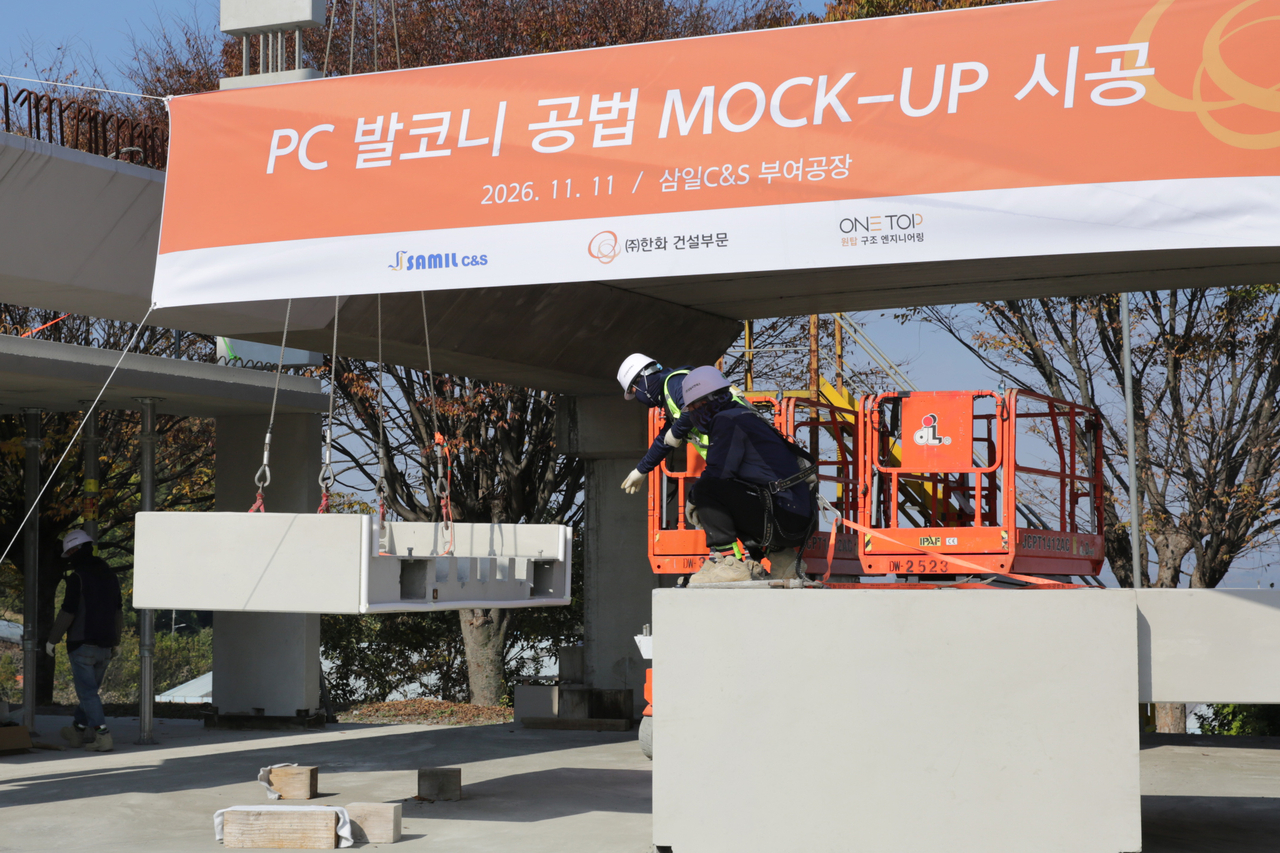
Hanwha Construction & Civil Engineering has developed a precast concrete balcony joint technology designed to improve construction precision and safety for protruding balconies.
The company said Thursday it completed a full-scale mock-up test installation Wednesday of the "PC balcony joint technology," a system co-developed with Samil C&S and Wontop Structural Engineering.
The technology involves factory-fabricating PC balconies in advance and attaching them to a building's exterior walls after the main structural frame is complete. The precast balcony units are slotted onto support brackets pre-installed on the outer wall, then connected to the main structure using a separate joining device.
Because the balconies are manufactured off-site, the company said on-site workload is reduced and rebar placement and concrete quality can be managed in a standardized environment.
Height-adjustable bolts are incorporated at the joints to correct minor elevation discrepancies that may arise during installation. The system is also designed to allow non-shrink mortar to be filled from the top of the slab, improving ease of work and joint quality management.
Conventional cast-in-place reinforced concrete construction requires the installation and removal of shoring and formwork on the building exterior. The new technology reduces exterior work processes, lowering the risks associated with high-altitude work and minimizing interference between construction phases.
The system also incorporates structural features from the initial installation stage of the PC balcony slab to prevent displacement and falling. Hanwha said the growing prevalence of open protruding balcony designs has made it increasingly important to secure both constructability and safety at the joint between the balcony and the main building structure.
Hanwha filed a patent application for the technology in July. The company plans to conduct structural performance tests on the joints based on the mock-up results to further verify structural safety, and intends to pursue application at apartment construction sites as the technology matures.
"This PC balcony joint technology was developed to reduce the risks of high-altitude work that arise during conventional open protruding balcony construction, and to improve joint precision and quality," said Choi Woo-seok, head of the operational innovation division at Hanwha Construction & Civil Engineering. "We will continue to develop off-site construction-based building technologies to enhance on-site safety and strengthen our construction competitiveness."
Meanwhile, Hanwha Construction & Civil Engineering is marketing Hanwha Forena Jije Station, a 1,098-unit residential complex in Pyeongtaek, Gyeonggi Province. The development comprises 12 buildings ranging from two below-ground floors to a maximum of 27 above-ground floors, with units of 84 square meters accounting for about 86.5 percent of the total. The model home opened Friday, marking the start of the formal pre-sale schedule.
quq@heraldcorp.com