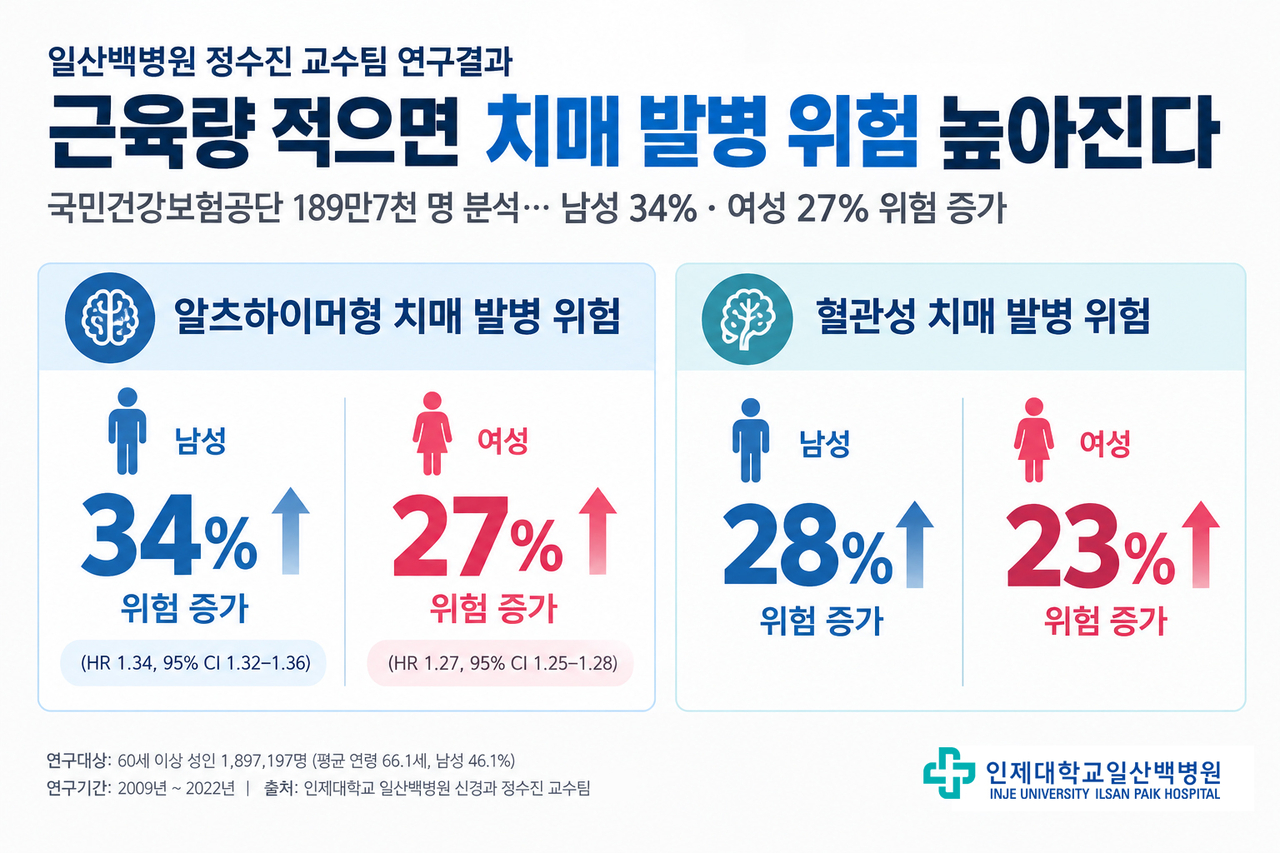
Men with low muscle mass face 34% higher Alzheimer's risk; women face 27% higher risk
Study of about 1.9 million adults finds bottom 25% in muscle mass at greater risk than normal group
Alzheimer's risk rises in stepwise fashion as muscle mass declines

A research team led by Professor Jung Su-jin of the neurology department at Inje University Ilsan Paik Hospital has found that lower muscle mass is associated with a higher risk of developing Alzheimer's disease, based on a long-term study tracking about 1.9 million South Korean adults aged 60 and older.
The study drew on health screening data from the National Health Insurance Service and followed 1,897,197 adults aged 60 and older who underwent health checkups between 2009 and 2015. The average age of participants was 66.1, and the group included 875,094 men and 1,022,103 women.
The researchers estimated skeletal muscle mass in the limbs of each participant, then compared the bottom 25% in muscle mass against the remaining 75%, tracking dementia diagnoses through 2022. Men with low muscle mass had a 34% higher risk of developing Alzheimer's-type dementia than men with normal muscle mass. Among women, the risk was 27% higher.
The incidence rate of Alzheimer's-type dementia among men with low muscle mass was 11.3 cases per 1,000 person-years — meaning per 1,000 people tracked over one year — compared with 5.1 in the normal group. Among women, the rate was 16.2 in the low muscle mass group versus 7.0 in the normal group.
The study also confirmed a stepwise pattern: the lower the muscle mass, the higher the Alzheimer's risk. Compared with the group with the highest muscle mass, men showed progressively higher risks of 16%, 30% and 58% as muscle mass declined. Among women, the corresponding increases were 4%, 13% and 36%. The trend was statistically significant in both sexes.
The researchers found similar results for vascular dementia. Men with low muscle mass had a 28% higher risk of vascular dementia than the normal group, while women had a 23% higher risk.
Particularly notable was that the association between muscle mass and Alzheimer's risk was more pronounced among relatively younger participants and those with fewer chronic diseases. The team said that low muscle mass at a comparatively young age — rather than the natural muscle loss that comes with aging — may reflect the influence of other health conditions or lifestyle factors.
The researchers proposed several possible mechanisms linking low muscle mass to Alzheimer's risk, including reduced physical activity, chronic inflammation, insulin resistance, mitochondrial dysfunction and changes in myokines, substances secreted by muscles. However, because the study was observational, the findings cannot establish that low muscle mass directly causes Alzheimer's disease.
The team said the study is significant for having analyzed the relationship between muscle mass and Alzheimer's disease using large-scale, nationwide data over a long follow-up period. Unlike previous research that examined "sarcopenia" as a whole — encompassing muscle strength and walking ability — this study separately analyzed how muscle mass itself relates to dementia risk.
"These findings show that maintaining muscle mass in daily life, not just brain health, should be an important consideration in dementia prevention," Jung said. "It is particularly important to manage muscle health from a relatively young age through regular physical activity and balanced nutrition."
The findings were published in a recent issue of Alzheimer's Research & Therapy, a leading journal in Alzheimer's dementia research, with an impact factor of 8.9.

kty@heraldcorp.com