Meteorological drought hits 58 cities and counties nationwide; six-month rainfall at 78.5% of average
Unmun and Seomjingang dams at 'Serious' level; government secures alternative water sources
Meteorological drought has struck 58 cities and counties across South Korea as nationwide rainfall over the past six months fell below 80 percent of the historical average.
The drought is worsening particularly in central regions, and Sokcho in Gangwon Province is expected to enter the "Alert" stage — classified as severe drought — by year's end.
According to the Ministry of Interior and Safety on Thursday, cumulative nationwide rainfall over the past six months stood at 824.8 millimeters, or 78.5 percent of the historical average of 1,046.2 millimeters. Meteorological drought is now affecting Daegu, Incheon, Ulsan, Gyeonggi Province, Gangwon Province, North Chungcheong Province, North Jeolla Province, South Jeolla Province, Gwangju, North Gyeongsang Province and South Gyeongsang Province.
Meteorological drought refers to a prolonged dry period in which rainfall remains below the historical average.
Under the standard classification system, a region is placed at the "Caution" level when six-month rainfall falls at or below 65 percent of the average, "Attention" at or below 55 percent, and "Alert" at or below 45 percent. The highest level, "Serious," applies when rainfall stays at or below 65 percent of the average for 20 or more consecutive days and widespread damage is anticipated nationwide.
As of Nov. 2, the "Caution" level — indicating moderate drought — was in effect for four areas: Seongnam and Uijeongbu in Gyeonggi Province, Namwon in North Jeolla Province, and Yeongcheon in North Gyeongsang Province. The "Attention" level, indicating mild drought, was issued for 54 other cities and counties.
Rainfall forecasts show that November is expected to bring above-average precipitation, with December also likely to see generally above-average levels.
However, drought conditions are expected to worsen in central regions that saw insufficient rainfall from mid-August through mid-October, and Sokcho in Gangwon Province is forecast to be reclassified at the "Alert" level for severe drought by the end of the year.
The national average storage rate at agricultural reservoirs rose 5.5 percentage points from last month to 53.8 percent, reaching 76.4 percent of the historical average of 70.4 percent. By region, storage rates were relatively low in North Jeolla Province (37.6 percent), Jeju (45.8 percent), South Jeolla Province (47.6 percent) and North Gyeongsang Province (53.9 percent).
The combined storage at 19 multipurpose dams and 12 water-supply dams — the main sources for residential and industrial water — stood at 83.8 percent and 66.9 percent of their historical averages, respectively.
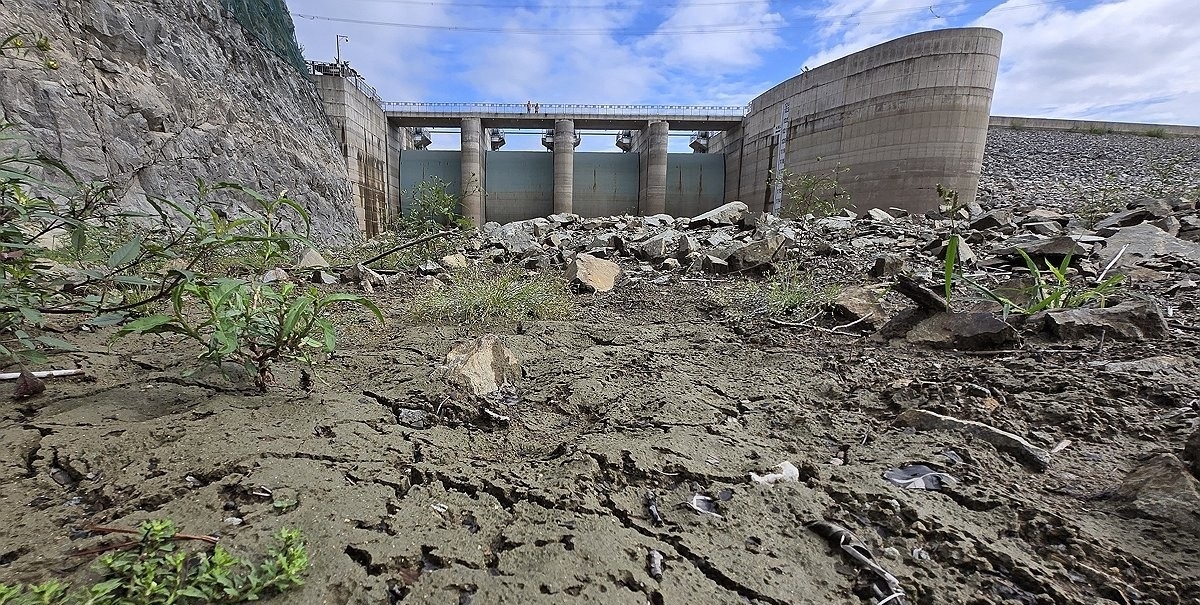
Unmun Dam and Seomjingang Dam are at the "Serious" level, Miryang Dam at "Alert," Seongdeok, Andong, Imha, Yeongcheon, Pyeongnim and Donghwa dams at "Caution," and Boryeong, Gunwi and Hapcheon dams at "Attention."
The government is supplying treated wastewater from the Nakdong and Geumho rivers as an alternative source for Unmun Dam, and is reducing instream flow releases and linking alternative water sources for Seomjingang Dam and Miryang Dam.
In addition, the government plans to activate an emergency supply facility on the Geumho River in anticipation of a prolonged drought at Unmun Dam, and will proactively pursue water-securing measures at reservoirs with low storage rates ahead of next year's farming season.
Kim Yong-gyun, director general of the natural disaster division at the Ministry of Interior and Safety, said the ministry would "carefully monitor drought conditions nationwide together with relevant agencies and manage areas at risk one step ahead, doing our utmost to prevent any inconvenience in water use."
thlee@heraldcorp.com