- Korea Institute of Machinery and Materials auto-corrects 32 electrode contacts in real time
- Simplified measurement process expected to improve EEG accuracy
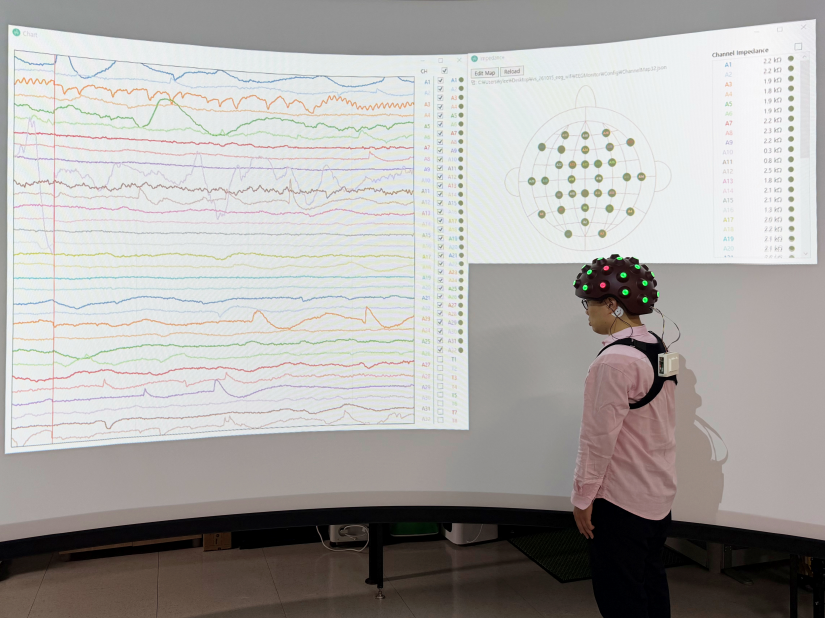
South Korean researchers have developed a helmet that automatically measures brainwaves without any complex preparation — simply by being worn. The technology is expected to find use in rehabilitation treatment as well as brain-computer interface, or BCI, systems that allow users to control devices through thought alone.
The Korea Institute of Machinery and Materials announced Thursday that a research team led by Senior Researcher Lee Seung-chan at the institute's Daegyeong Regional Convergence Research Headquarters has developed an "auto-adaptive EEG monitoring helmet" that automatically adjusts the position of brainwave-measuring electrodes.
Electroencephalography, or EEG, analyzes brain activity by measuring the faint electrical signals the brain produces. It is used across a wide range of fields, including the diagnosis of neurological disorders, rehabilitation treatment, cognitive science research and BCI applications.
Conventional EEG measurement has long required trained specialists to attach electrodes to the scalp one by one and manually adjust contact quality. Because head shape and hair condition vary from person to person, signal quality has been inconsistent. If an electrode shifted during measurement, the entire process had to be paused for repositioning.
To address these problems, the research team developed a technology that monitors electrode contact in real time and automatically corrects positioning.
The helmet can simultaneously capture brainwave signals from 32 channels at 500 times per second, enabling precise analysis of brain activity across multiple scalp locations.
The key innovation is a "closed-loop control" system that independently assesses the contact state between each electrode and the scalp.
Once the helmet is put on, the system analyzes the contact condition of every electrode in real time. Any electrode with unstable contact is automatically repositioned until it reaches the optimal contact state, at which point it stops moving.
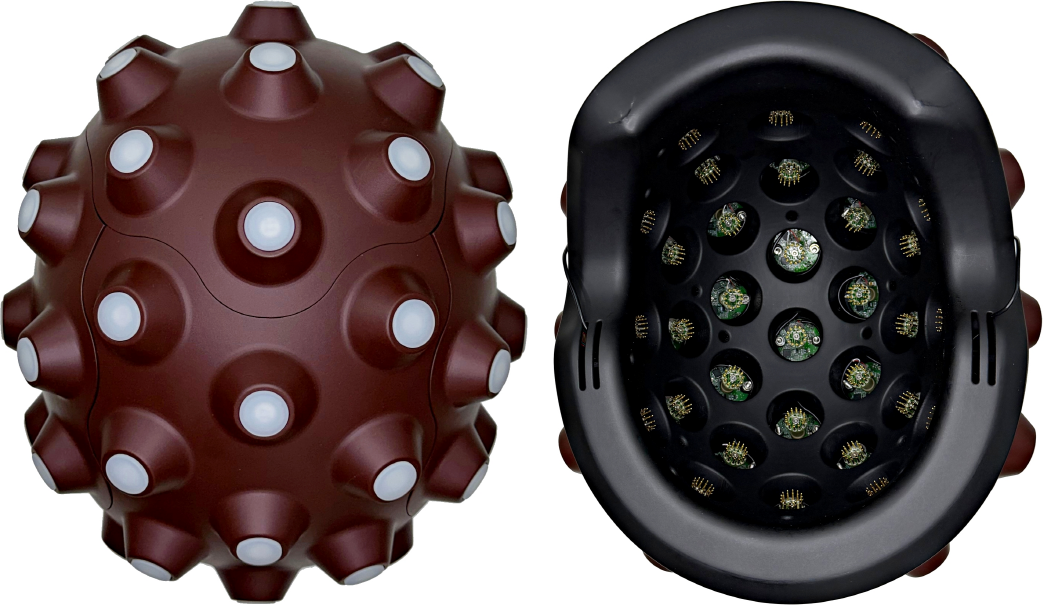
This allows the helmet to reduce measurement variability caused by differences in head shape and hair condition, securing stable brainwave signals. The system also prevents electrodes from pressing too hard against the scalp, improving wearer comfort.
The helmet can also automatically recalibrate if the user moves during measurement and disrupts electrode contact. The research team said this reduces the burden on specialists who would otherwise need to adjust electrodes individually, and improves the reliability of repeated measurements.
The technology's significance lies in its automation of an EEG measurement process that has until now depended heavily on skilled practitioners.
Once performance verification and field trials are complete, the helmet is expected to be applied across a range of areas, including motor rehabilitation training, BCI, virtual reality-based cognitive science research, and analysis of workers' concentration and fatigue levels.
By reducing measurement variability between users and securing consistent EEG data, the technology is also expected to improve the accuracy of AI-based brain activity analysis.
"EEG has high application value in medicine, healthcare and cognitive science, but it has faced limitations in that the process of achieving proper electrode contact is complex and signal quality can vary depending on the user," Lee said. "This technology establishes a foundation for obtaining easier and more consistent EEG data even in environments requiring repeated measurements, by assessing electrode contact in real time and applying automatic corrections."
nbgkoo@heraldcorp.com