South Korea's mergers and acquisitions market is on edge as debate over a mandatory tender offer regime enters a new phase. Industry participants broadly agree with the policy's stated goal — letting ordinary shareholders share in control premiums — but warn that a tightly drawn rule could chill dealmaking in the listed-company space altogether.
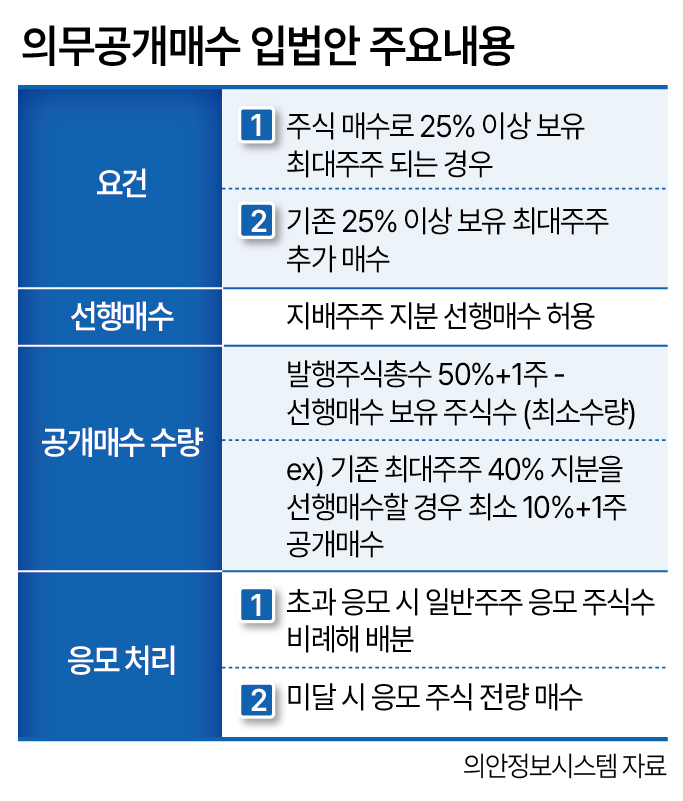
Investment banking sources said Thursday that the market is closely watching whether the Capital Markets Act amendment mandating tender offers will be revised, after its passage at a National Assembly plenary session fell through last month. Ruling and opposition parties had earlier agreed on a bill that would require any acquirer taking a stake of 25 percent or more in a listed company — thereby becoming a controlling shareholder — to launch a tender offer covering 50 percent plus one share of total issued shares. Under that framework, the acquirer would first buy out the existing largest shareholder's stake and then conduct a tender offer for the remaining shares needed from ordinary shareholders.
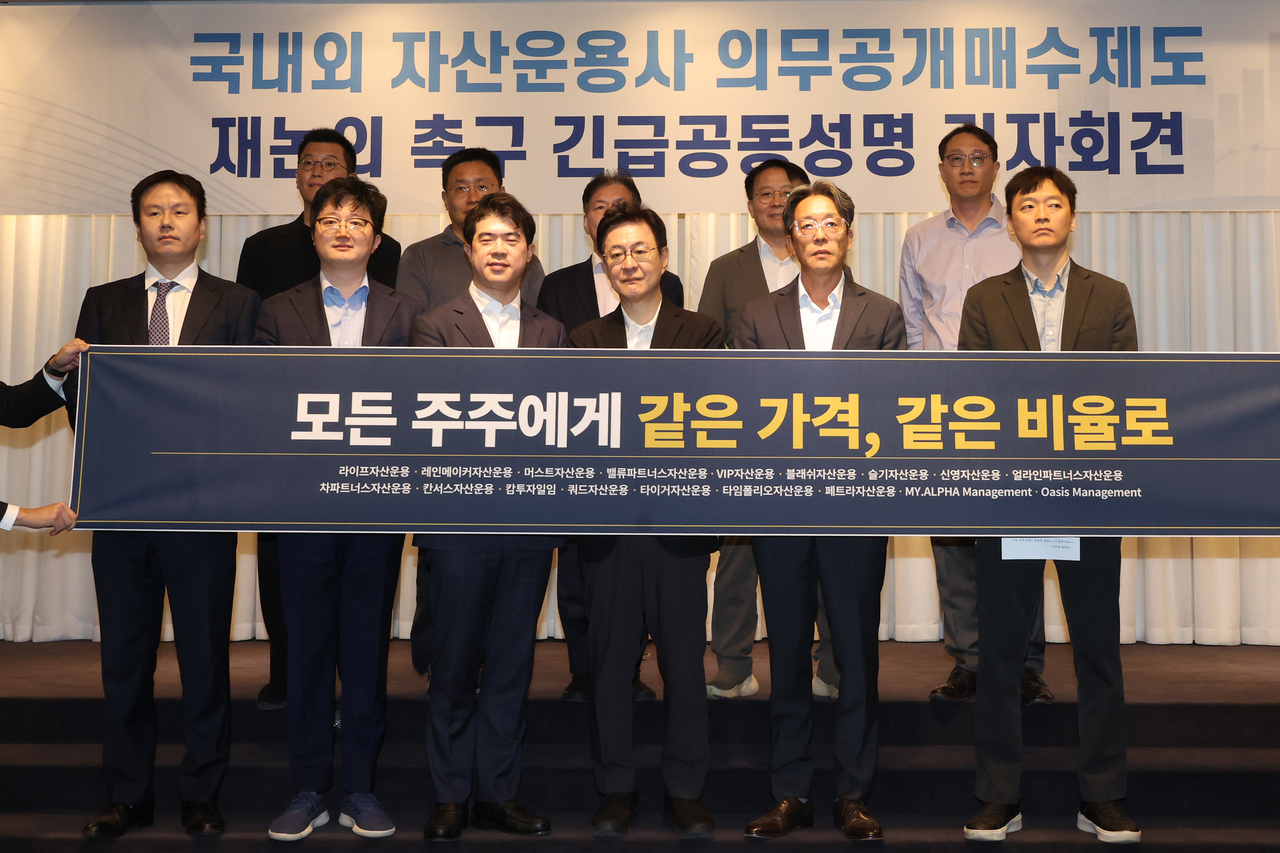
The bill's passage was derailed, however, after domestic and foreign asset managers — including Align Partners and VIP Asset Management — publicly issued statements of opposition ahead of the plenary vote. The asset management industry argued that allowing an acquirer to purchase the largest shareholder's stake first, before launching a tender offer, amounted to discriminatory treatment of ordinary shareholders. Concerns were also raised within the ruling party that passing the amendment as written could signal to domestic and foreign investors that the government and ruling party's commitment to capital market reform had weakened.
A newly proposed proportional approach carries burdens for both sellers and buyers. The central question is whether the existing largest shareholder can fully exit by selling the entire stake. The asset management industry argues that allowing the largest shareholder's stake to be purchased first is unreasonable: the largest shareholder can sell the entire holding at a price that reflects the control premium, while ordinary shareholders can only sell a portion. Their position is that prior purchases by the largest shareholder should be excluded, and that a proportional tender offer should guarantee all shareholders an equal opportunity to sell.
Under the current amendment, if an acquirer is buying a listed company where the largest shareholder holds 40 percent and ordinary shareholders hold 60 percent, the acquirer would purchase the largest shareholder's 40 percent stake and then conduct a tender offer for only an additional 10 percent plus one share. Under the proportional approach, by contrast, the acquirer would conduct a tender offer covering all shareholders, acquiring 20 percent from the largest shareholder and 30 percent from ordinary shareholders respectively. The existing largest shareholder would retain a 20 percent stake even after ceding control.
The M&A industry fears the proportional approach would dampen dealmaking. From a seller's perspective, the incentive to sell control weakens considerably. When a founder retires or chooses to sell rather than pass the business to family, the goal is typically to dispose of the entire stake and step away from management entirely. Under the proportional approach, however, a significant portion of the stake would remain after control changes hands, making additional transaction structures to dispose of that residual holding unavoidable.
"The essence of M&A is changing who is in control, but the proportional approach blurs that fundamental purpose," one IB industry official said. "Allowing a prior purchase and then conducting a tender offer for 50 percent plus one share is a compromise that balances the M&A market with the protection of ordinary shareholders."
The burden falls on acquirers as well. Even after securing a majority stake, if the original founder retains a substantial holding, conflicts of interest could arise in future business restructuring or key decision-making. "A residual stake held by the former largest shareholder is a potential source of control disputes," one private equity fund industry official said.
The bar for M&A involving listed companies has been rising even before the mandatory tender offer regime was introduced. Amendments to the Commercial Act last year extended directors' duty of loyalty to shareholders, prompting a wave of shareholder challenges over the fairness of tender offer prices.
A prominent example is Bain Capital's acquisition of Echomarketing. When Bain Capital took control of Echomarketing — the operator of athleisure brand Andar — this year, it launched a tender offer at 16,000 won ($12) per share, the same price paid for the largest shareholder's stake. Ordinary shareholders pushed back hard, arguing the price was far too low, and the tender offer ran into serious difficulty. Only after three rounds of tender offers and additional open-market purchases did Bain Capital secure more than 95 percent of shares.
Macquarie Asset Management Group's acquisition of Gabia also ran into turbulence over tender offer pricing. Macquarie launched a tender offer for Gabia at 48,000 won per share starting in July, but the subscription rate was too low and the offer fell through. After negotiations with major shareholders including Align Partners, it agreed last month to raise the tender offer price to 53,000 won per share. At the same time, it announced plans to launch a tender offer for KINX, a key listed subsidiary of Gabia, at 190,000 won per share.
"M&A activity needs to be robust for minority shareholders to share in control premiums," one IB industry official said. "The mandatory tender offer regime must be designed with its market-dampening effects in mind." The concern is that pushing to increase the share of control premiums flowing to ordinary shareholders in individual deals could end up causing a sharp drop in M&A activity overall.
park.jiyeong@heraldcorp.com