What to watch when claiming expenses on rental housing income
Only costs tied to the rental property count as deductible expenses
Interest exceeding rent is still treated as a separate expense item
A smaller reported loss raises the tax base and can trigger a penalty surcharge

"I'm paying more in interest than I collect in rent — and I still owe more tax?"
Kim Woori runs a restaurant in Seoul and lives in an apartment in Seocho-gu while renting out a separate apartment in Seongdong-gu. The Seongdong-gu unit is leased with a deposit of 150 million won ($112,000) and monthly rent of 2.5 million won, generating annual rental income of 30 million won. Against that, Kim pays 36 million won a year in interest on the Seongdong-gu property alone — already 6 million won more than the rent collected.
Concluding that the rental property was running at a loss, Kim filed a comprehensive income tax return for the 2025 tax year. Every item of rental income and actual outlay — loan interest, taxes and other costs — was entered line by line in a ledger, and the loss from the rental property was then deducted from the 100 million won in business income earned from the restaurant.
After filing, however, Kim received an unexpected notice from the tax office flagging a problem with some of the expenses claimed against rental income. Having kept a full ledger, Kim struggled to understand what had gone wrong and sought answers at a tax advisory service.
Q. I recorded every item of rental income and actual expense in a ledger before filing. Is the method itself wrong?
A. No. Filing on the basis of a ledger is perfectly fine.
In simple terms, the bookkeeping method records how much rent was received and how much was actually spent running the rental property, then calculates taxable income from the difference. Collecting 30 million won in rent does not mean the entire 30 million won is taxed; the idea is to subtract the costs genuinely incurred in operating the rental unit and treat only what remains as income.
Filing under comprehensive taxation with a ledger allows actual expenditures to be recognized as necessary expenses. Taxpayers who do not keep a ledger may instead apply an expense ratio set by tax law to estimate their costs.
The issue here is not the bookkeeping method itself but which expenses were entered in the ledger. A review of the filing showed that costs with no direct connection to the rental property had been included as necessary expenses.
Q. Which expenses were entered incorrectly?
A. The comprehensive real estate holding tax assessed on the Seocho-gu apartment — the one you actually live in — was included as a deductible expense against rental housing income.
When calculating rental housing income, only costs directly related to the property being rented out qualify as necessary expenses. Typical examples include property tax and the comprehensive real estate holding tax levied on the rental unit, interest on the loan taken out to acquire that property, and depreciation on the building.
Costs tied to a property the taxpayer personally occupies cannot be treated as expenditures incurred to earn rental income. The comprehensive real estate holding tax or interest costs on a residence therefore cannot be claimed as necessary expenses against the rental property. That is precisely why the tax office sent the notice.
Q. The comprehensive real estate holding tax is assessed on all my properties combined. How do I separate out the rental property's share?
A. The tax can be apportioned according to the ratio of each property's publicly assessed price.
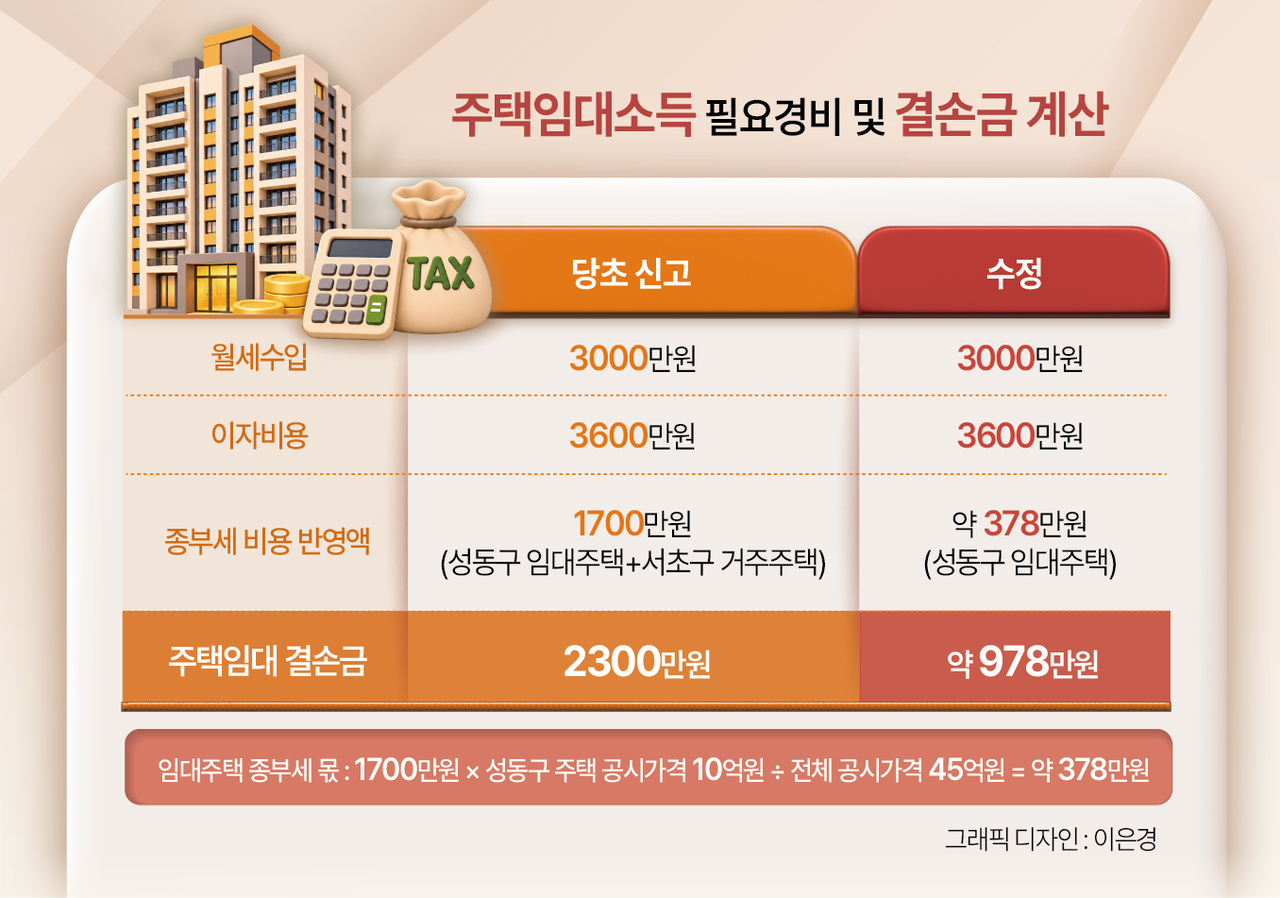
In this case, the total comprehensive real estate holding tax paid was 17 million won. Dividing it by the publicly assessed prices — 3.5 billion won for the Seocho-gu residence and 1 billion won for the Seongdong-gu rental unit — gives an attributable share of about 13.22 million won for the Seocho-gu property and about 3.78 million won for the Seongdong-gu rental unit.
The full 17 million won in comprehensive real estate holding tax therefore cannot be deducted from rental housing income; only the roughly 3.78 million won attributable to the rental property may be recognized as a necessary expense.
Q. Even so, if annual rent is 30 million won and interest alone is 36 million won, isn't the property still running at a loss?
A. Yes. Even after correcting the expense claims, the rental property is still in the red. The loss is simply smaller than what was originally reported.
As originally filed, Kim subtracted the full 17 million won in comprehensive real estate holding tax and 36 million won in interest from the 30 million won in rental income, producing a reported net loss of 23 million won on the rental property.
Once only the roughly 3.78 million won attributable to the rental unit is recognized as a deductible expense, the numbers change. Subtracting 36 million won in interest and about 3.78 million won in comprehensive real estate holding tax from 30 million won in rental income puts the actual rental housing deficit at about 9.78 million won.
In other words, the property is still in the red, but the reported loss must be revised down by about 13.22 million won from the original filing.
Q. Can the rental housing loss be deducted from the income I earn running the restaurant?
A. Yes. That part of the filing was done correctly.
As a general rule, a net loss from a real estate rental business cannot be directly offset against other categories of income. Rental housing losses, however, are an exception and may be consolidated with other income.
Deducting the rental housing deficit from the 100 million won in restaurant business income to arrive at total comprehensive income is therefore permissible. The problem is not the deduction itself but the size of the deficit applied — 23 million won instead of the correct figure of about 9.78 million won.
Q. How much additional tax is owed in the end?
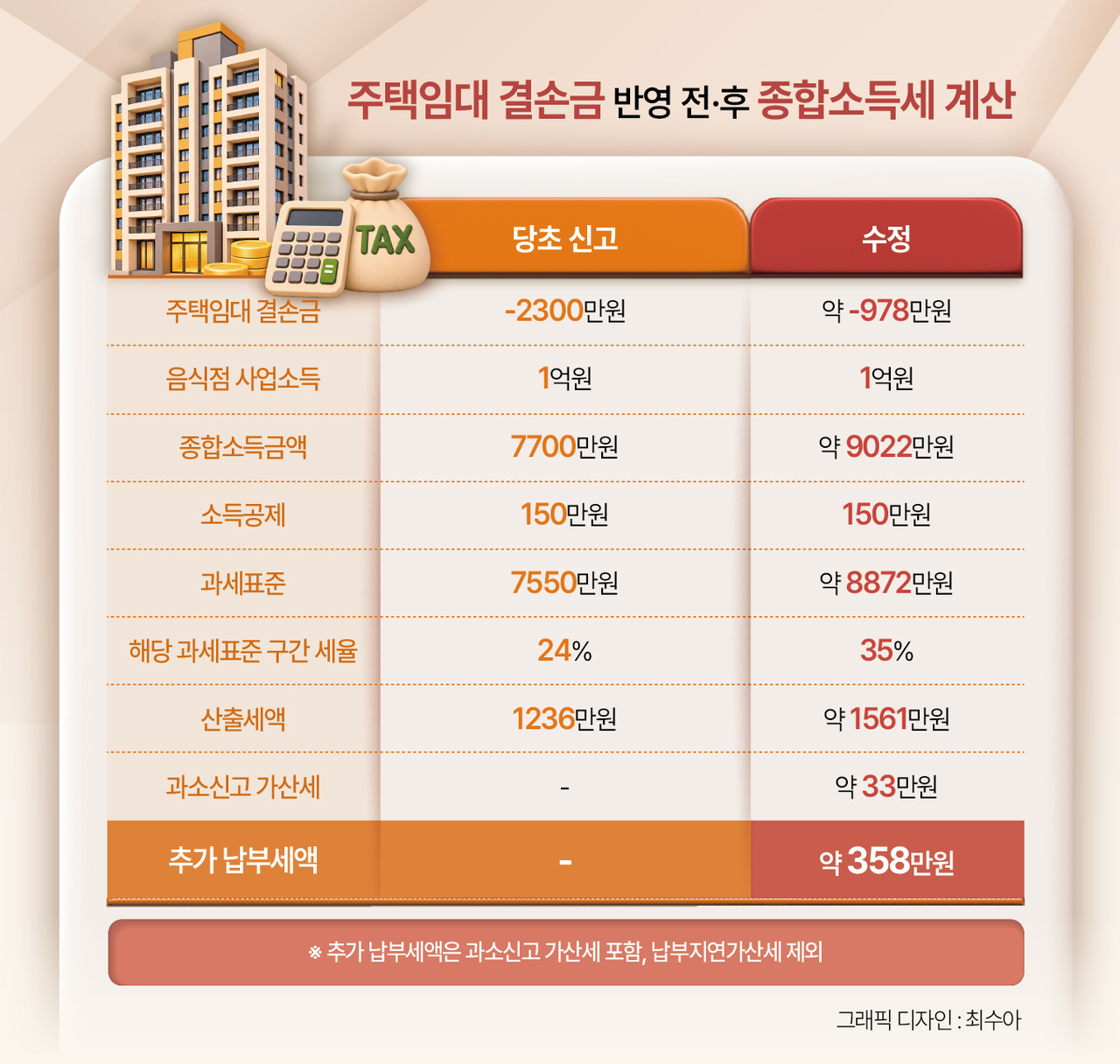
A. Revising the rental housing deficit from 23 million won down to about 9.78 million won reduces the amount that can be deducted from restaurant business income by the same margin.
As a result, total comprehensive income rises from the originally reported 77 million won to about 90.22 million won, and the taxable base increases from 75.5 million won to about 88.72 million won.
The calculated tax liability grows from 12.36 million won to about 15.61 million won, an increase of about 3.25 million won. Adding the 10 percent underreporting penalty surcharge of about 326,000 won brings the total additional tax due to about 3.58 million won.
Note that this figure does not include the late-payment penalty surcharge, which accrues based on how long the tax remained unpaid. The actual amount owed could be higher.
Q. Does paying the extra 3.58 million won settle the matter? What if the same approach was used in previous years?
A. If the same expense error was made in prior years, correcting only this year's return may not be enough.
If the comprehensive real estate holding tax on the residence was repeatedly claimed as a deductible expense against the rental property in earlier filings, those years' rental housing income and comprehensive income tax figures will need to be recalculated. If any of those underreported years fall within the statute of limitations for reassessment, amended returns may be required.
Any additional tax liability from those years would attract not only the underreporting penalty surcharge but also a late-payment surcharge for the period the tax went unpaid. Anyone who has received a notice from the tax office should therefore check not just the current year's return but also whether the same expense treatment was applied in previous filings.
Q. What is the safest approach to claiming expenses when reporting rental housing income?
A. The key question is not simply whether money was spent, but whether it was spent because of the rental property.
Taxpayers who own multiple properties must apportion taxes such as property tax and the comprehensive real estate holding tax — which are assessed across all properties — and include only the share attributable to the rental unit as a necessary expense.
Claiming as much depreciation as possible is not always advantageous. Recognizing depreciation as an expense now reduces rental housing income and lowers the current year's comprehensive income tax. When the property is eventually sold, however, the accumulated depreciation reduces the acquisition cost, which enlarges the capital gain and the capital gains tax owed.
It is therefore worth comparing the immediate reduction in comprehensive income tax against the potential increase in capital gains tax at the time of sale before deciding whether to claim depreciation as an expense.

rim@heraldcorp.com