South Korean semiconductor stocks showed limited damage Friday after Nvidia CEO Jensen Huang resigned abruptly over an extramarital affair scandal. Samsung Electronics and SK hynix both surged in early trading, with analysts saying the market is separating Nvidia's management uncertainty from the AI industry's underlying growth potential.
Concerns remain that the fallout could widen depending on how events unfold. Nvidia has driven a so-called circular trading structure — investing in major AI companies that in turn use the proceeds to buy Nvidia chips — and Huang's departure could reduce financial support for the AI ecosystem or shift the company's medium- to long-term strategy in ways that ripple through South Korea's semiconductor sector.
As of 9:11 a.m. Friday, Samsung Electronics was trading at 214,750 won ($161), up 3.25 percent from the previous session, according to Korea Exchange. SK hynix rose 4.55 percent to 1,311,000 won at the same time.
Huang's resignation cleared some of the uncertainty that had been weighing on the market. The growing perception that the episode represents a company-specific governance risk at Nvidia rather than a broader pullback in AI demand appears to be drawing buyers into large-cap South Korean semiconductor stocks.
Foreign and institutional investors both turned net buyers. On the main KOSPI market at the same time, foreign investors net purchased 208.6 billion won ($157 million) worth of shares and institutions net purchased 8.4 billion won, while retail investors were net sellers of 231.8 billion won.
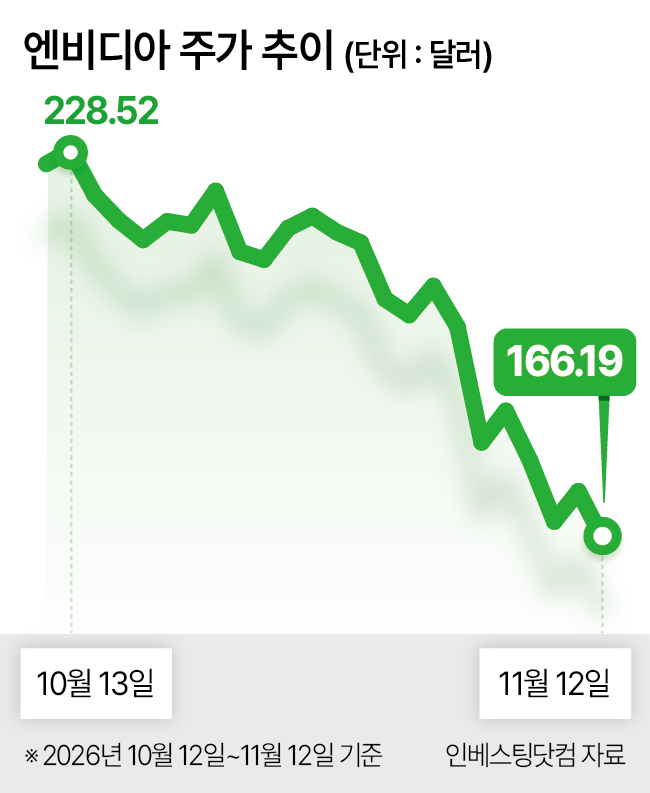
Analysts broadly believe that Nvidia's management uncertainty is unlikely to immediately translate into a slowdown in AI chip demand. Major tech companies have maintained their AI infrastructure investment plans, and no new evidence has emerged to undermine the semiconductor industry's fundamentals.
"There is a need to distinguish between Nvidia's management uncertainty and the semiconductor industry cycle itself," said Lee Jae-won, an analyst at Yuanta Securities Korea. "CoreWeave's large order backlog and financing plan announced this week, along with strong semiconductor export figures in early November, remain intact."
Lee added that it has yet to be confirmed whether the CEO's departure will affect actual AI chip shipments or customers' investment plans. "There is also no new evidence yet to undermine the earnings outlook for semiconductors," he said.
The impact on South Korean memory chip makers is also seen as relatively contained. A leadership change at Nvidia is not considered likely to immediately trigger a reduction in AI data center investment or a slowdown in HBM demand.
Many analysts caution, however, that it is too early to conclude that the uncertainty stemming from Huang's exit has been fully resolved. Nvidia has played a role well beyond that of a chip supplier — it has been a key source of funding and investment across the broader AI ecosystem.
Markets are paying particular attention to the sustainability of the circular trading structure Nvidia has built. The model works by having Nvidia invest directly in AI companies or help them raise capital, with those companies then using the funds to purchase Nvidia GPUs.
This structure has helped expand the investment capacity of AI companies and stimulate semiconductor demand throughout the industry's growth phase. At the same time, it carries the risk that if Nvidia's financial support shrinks or its investment returns run into trouble, AI companies' capital expenditure and GPU purchases could contract simultaneously.
"Nvidia has led the development of the AI ecosystem not only through GPU sales but also through nurturing neo-cloud companies and making equity investments," said Kim Young-geon, an analyst at Mirae Asset Securities.
Kim said that in August, Nvidia moved to raise more than $500 billion in infrastructure financing with six financial institutions, offering residual value guarantees of up to 25 percent per transaction. "These were decisions that would have been difficult without the founder's conviction," he said. "It will be necessary to confirm whether the pace and scope of ecosystem support are maintained under the new leadership."
Given that Huang played a central role in driving Nvidia's technology development and AI ecosystem expansion, whether incoming management will sustain the company's aggressive investment and financial support policies has emerged as a key variable.
"Huang's resignation does not have an immediate impact on industry conditions, but it has introduced fresh uncertainty about the new management and Nvidia's medium- to long-term strategic direction," said Nam Dae-jong, an analyst at Daol Investment & Securities. He identified the key concerns as the medium- to long-term product roadmap, the continuity of financial support for the AI ecosystem, supply chain dynamics and the rise of competing products.
Warnings are also emerging that Nvidia's management uncertainty could affect the company's earnings and investment strategy going forward. Moon Jun-ho, an analyst at Samsung Securities, described the situation as "a risk that is difficult to quantify."
"Huang's dismissal may not have a significant immediate impact on the company's earnings," Moon said, "but investigations into Huang personally are being accompanied by allegations of violations of export controls on China, which represents a risk factor for Nvidia's fundamentals as well."
Even if the near-term earnings impact is limited, the medium- to long-term business outlook could shift depending on the outcome of US regulatory investigations and whether restrictions on semiconductor exports to China are tightened further.
Lee of Yuanta Securities Korea said he had not personally anticipated that uncertainty surrounding Huang would grow to this scale. "Given the weight Nvidia carries in the AI industry, semiconductor stocks will have no choice but to react sensitively to related news for the time being," he said.

th5@heraldcorp.com