4,765 employees cast online votes; teams used operational data to propose on-site improvements
Top prize goes to 'Intelligent Technology' team, which analyzed 2.3 million records to predict station-level safety risks
Proposals range from platform screen door fault response to adjusting train dwell times
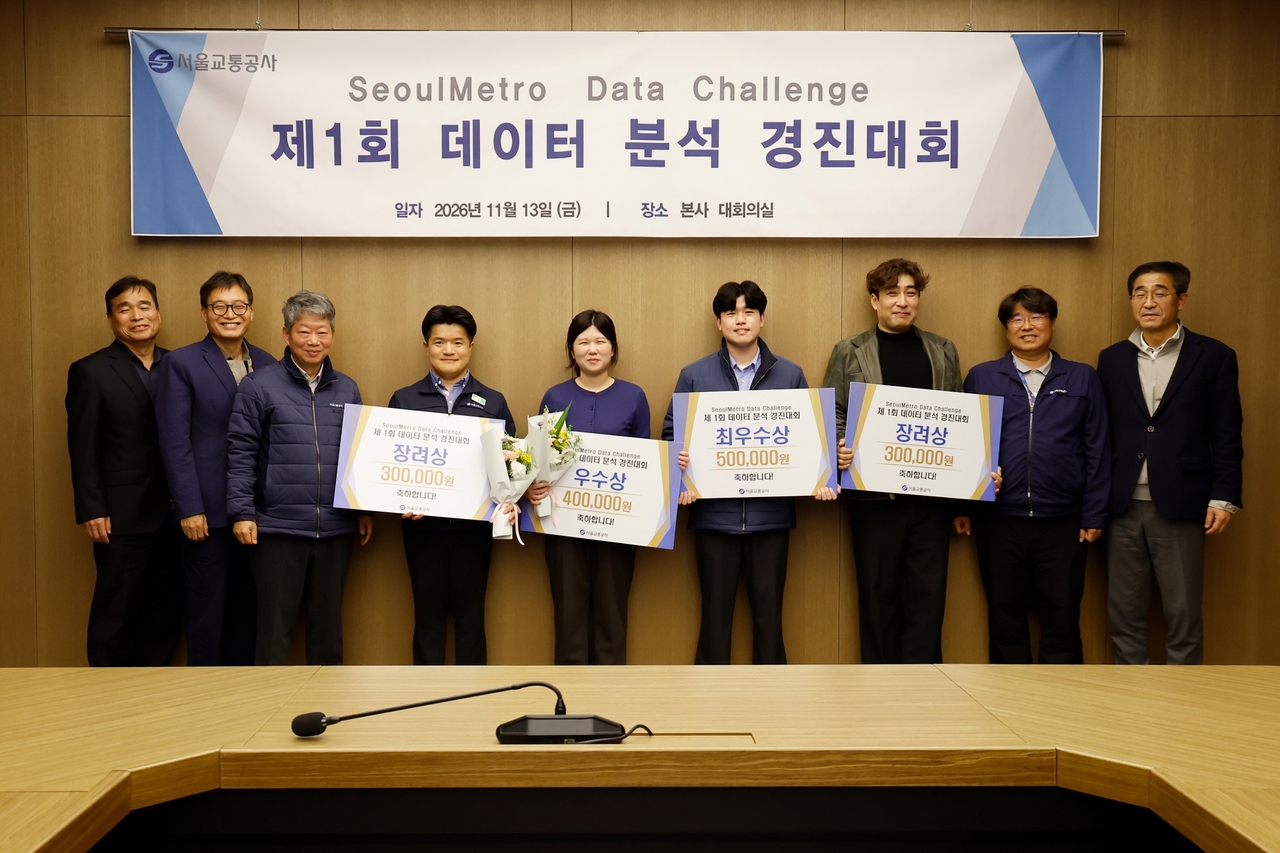
Seoul Metro held its first in-house data analysis competition, in which employees analyzed subway operational data to identify on-site improvements.
Practical solutions were proposed to enhance passenger safety and operational efficiency, covering areas such as safety personnel deployment, platform screen door fault response and train dwell time adjustments.
Seoul Metro announced Tuesday that it held the final round and awards ceremony of its inaugural data analysis competition on Friday.
The competition asked employees to identify problems encountered in their day-to-day work, analyze them using the company's operational data and propose improvements. It was designed to translate the data analysis skills employees had built through workshops and hands-on training into tangible workplace improvements.
Four teams advanced to the final round. Seoul Metro evaluated each entry through two rounds of written review, assessing the validity of the analytical methods and their feasibility for real-world application. An online vote held from Nov. 5 to Wednesday drew participation from 4,765 employees. Final rankings combined the employee vote, which counted for 20 percent, with a panel presentation assessment, which counted for 80 percent.
The top prize went to the "Intelligent Technology" team, which analyzed 2.3 million records of alarm, boarding and alighting, weather and accident data accumulated over three years, under the theme of building a smart station-based safety prediction model.
The team proposed a model that quantifies safety levels at individual stations and predicts risk one to six hours ahead. The system would allow central control to identify high-risk stations in advance and prioritize the deployment of safety personnel accordingly.
The excellence award went to the "Moduui-gil" team, which combined data on accidents, equipment failures and complaints involving passengers with reduced mobility with population data to develop a "mobility safety index" for each station. Based on the index, the team identified 27 stations as priority candidates for deploying support staff, including senior elevator safety teams.
Two teams received encouragement awards. The "Zero-how" team proposed a platform screen door fault response system using an AI chatbot on the company's internal network. The core idea is to help maintenance staff quickly retrieve equipment diagrams and restart procedure videos for the relevant station when a fault occurs, cutting on-site response time.
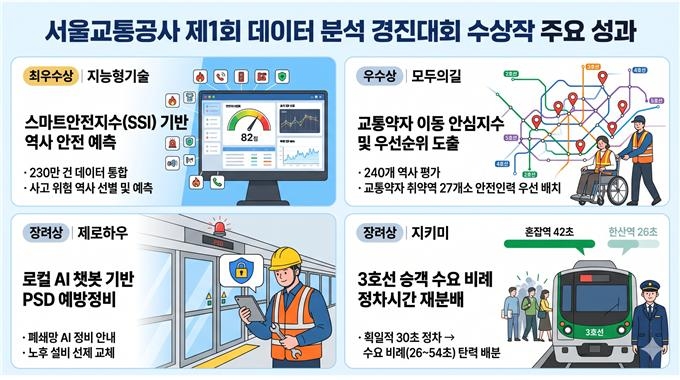
The "Jikimi" team developed a tool to support Line 3 train operators with roll call and supervisory ride duties. The team also analyzed boarding and alighting figures by station and proposed adjusting train dwell times — currently a uniform 30 seconds — to between 26 and 54 seconds depending on each station's characteristics.
Seoul Metro said it plans to incorporate the improvement proposals identified through the competition into the operations of its commercial, crew and technical divisions, as well as into management policy. Award-winning projects will be compiled into a best-practice collection and shared across all departments, and a data analysis best-practice sharing event is planned for 2027.
Jeong Jong-yeop, head of Seoul Metro's management support division, said the data analysis projects developed by frontline employees demonstrated practical solutions capable of significantly improving passenger safety and operational efficiency. "We will continue to actively integrate data and AI technology across all areas of our work to create a smarter subway environment where citizens can ride with greater peace of mind," Jeong said.
seouldream01@heraldcorp.com