Seoul fire department experiment finds fire risk rises with charge level; batteries sold at 80-90% charge with no regulations in place
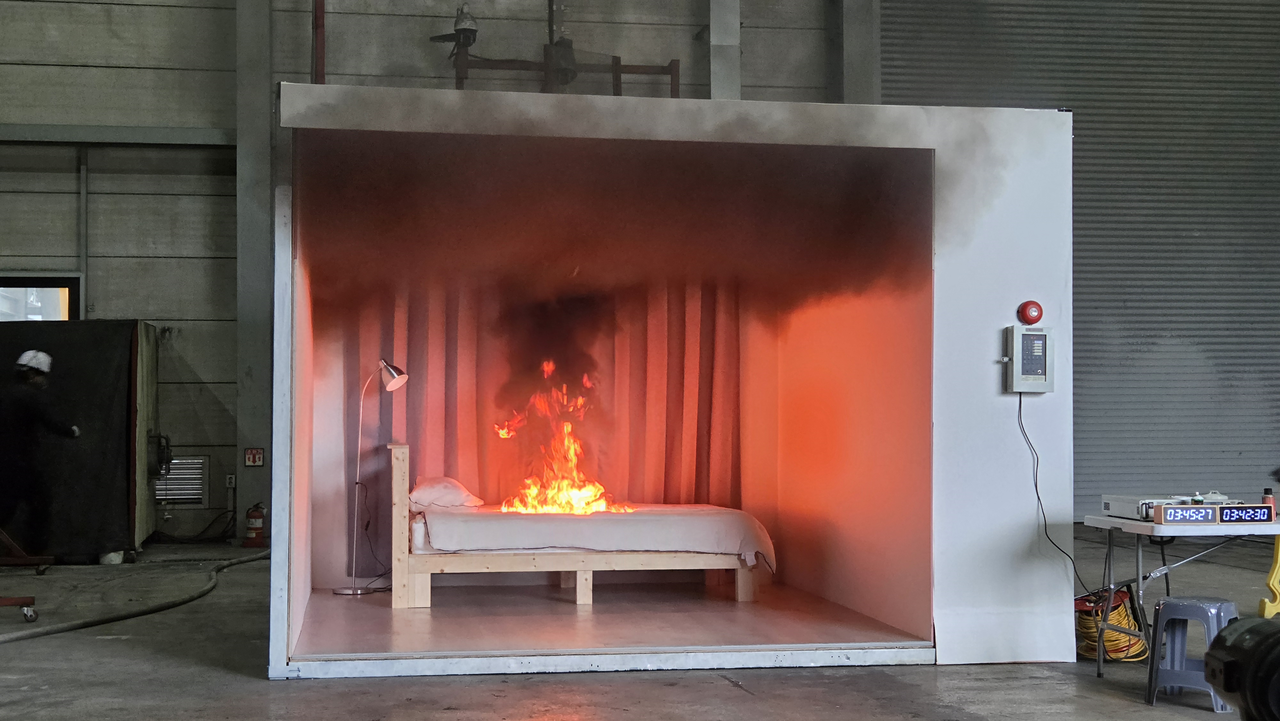
The Seoul Metropolitan Government's Fire and Disaster Headquarters said Tuesday that lithium-ion batteries charged to full capacity are significantly more likely to undergo thermal runaway and catch fire when subjected to external pressure, based on results from a series of controlled experiments.
Lithium-ion batteries are widely used in portable chargers. The findings come after three separate portable battery ignition incidents at major domestic airports and aboard aircraft over four days from Oct. 22 to Oct. 25 put the aviation industry on high alert.
The experiments tested two types of commercially available batteries — cylindrical and pouch-type — set to charge levels of 30, 50, 70 and 100 percent. A pneumatic press applied consistent pressure to the center of each battery to observe how they responded to physical impact.
With five tests conducted at each charge level, batteries at 100 percent charge produced thermal runaway and ignition in four out of five trials for both the cylindrical and pouch-type models.
At 70 percent charge, both battery types exhibited venting — the release of internal gases — while the cylindrical type also showed thermal runaway and the pouch type produced weak sparks. At 50 and 30 percent charge, neither thermal runaway nor ignition was observed.
Despite the clear link between higher charge levels and fire risk, no regulations currently govern the charge level of batteries sold on the market, the headquarters said, meaning batteries charged to 80 to 90 percent are commonly available with no restrictions.
By contrast, the aviation sector applies an international standard requiring certain types of lithium-ion batteries to be transported at no more than 30 percent charge to reduce fire risk.
The headquarters and the National Fire Agency plan to continue discussions with relevant government ministries on establishing safety standards for managing battery charge levels during retail distribution and storage, drawing on the experiment's findings.
"The experiment confirmed that a battery's state of charge can affect fire risk," said Hong Yeong-geun, head of the headquarters. "We will continue to identify fire risk factors through scientific testing and analysis, and build the evidence base needed to establish effective safety management standards for battery distribution and storage."
ken@heraldcorp.com