Raemian Trinione 84㎡ listings diverge by up to 1 billion won
Price gap hinges on who bears reconstruction excess-profit levy
Per-member charge seen reaching up to 700 million won
Agents say unclear liability is paralyzing deals
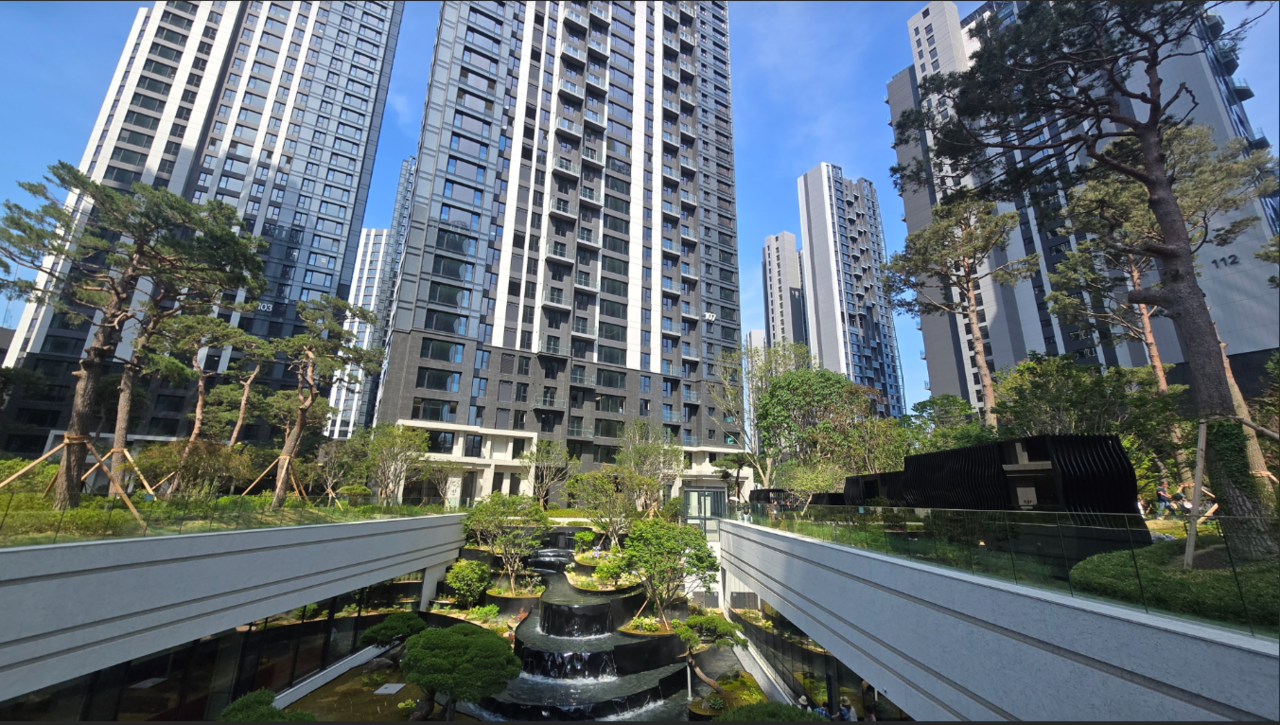
A "dual pricing" phenomenon is emerging at reconstruction complexes in Seoul's Seocho-gu, where identical apartments in the same complex are listed at sharply different prices depending on who is responsible for paying the reconstruction excess-profit recapture levy. Even though the final levy amount and collection date have yet to be determined, asking prices for units of the same size in the same complex are diverging by nearly 1 billion won ($747,000).
According to real estate industry sources Wednesday, listings for 112-square-meter units at Raemian Trinione in Banpo-dong, Seocho-gu, are simultaneously on the market at 6 billion won and 7 billion won. The two listings — comparable in view and floor area — differ only in who bears the reconstruction levy: the 6 billion won listing requires the buyer to pay it, while the seller absorbs it in the 7 billion won listing. A similar split has appeared for 84-square-meter units, where one listing was repriced from 5.7 billion won down to 5 billion won on the condition that the buyer takes on the levy obligation.
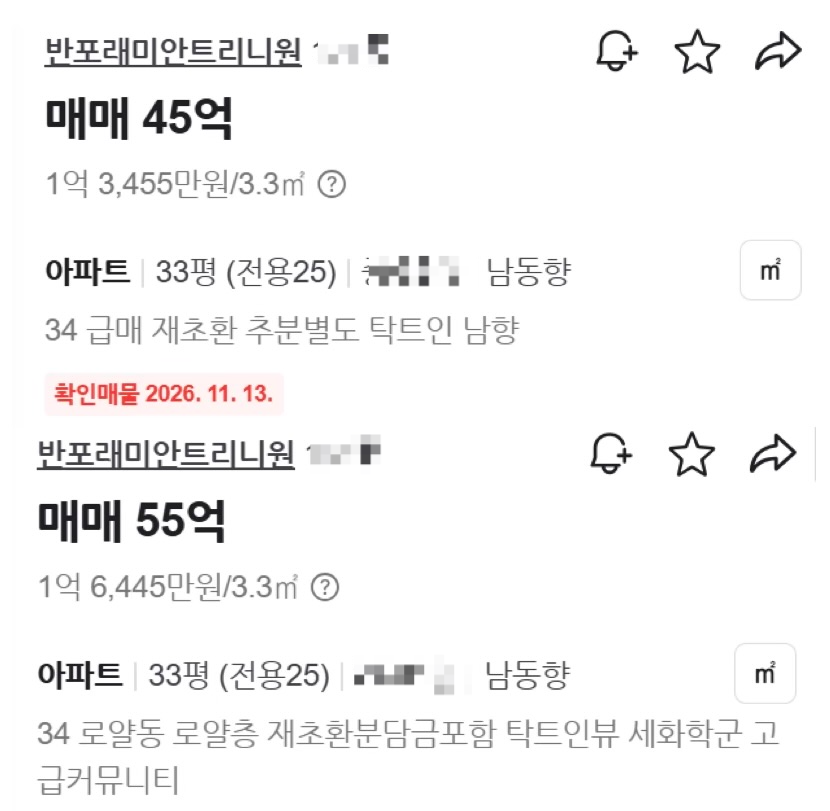
Among other 84-square-meter listings, units with similar views and floor levels are listed at 5.5 billion won when the seller covers the levy and at 4.5 billion won when the buyer must pay it.
Raemian Trinione, which opened to residents five months ago, is a complex where the reconstruction excess-profit levy is projected to reach as much as 700 million won per member. Seocho-gu notified the complex's association in 2020 of a preliminary levy of 402 million won per member, but rising construction costs and surging home prices have since pushed the projected per-household figure to 700 million won. With the levy now approaching the price of a mid-range apartment in the greater Seoul area, whether it is included in the sale price has become the single biggest driver of asking-price variation.
The reconstruction excess-profit recapture regime claws back up to 50 percent of any per-member average profit from reconstruction that exceeds a set threshold. A 2024 amendment raised the exemption threshold from 30 million won to 80 million won and widened the levy brackets from 20 million won to 50 million won intervals, but many observers say Gangnam-area complexes — where home values have risen sharply — will still face levies in the hundreds of millions of won. As ownership changes hands before final levy amounts are set, who absorbs the charge has become a pivotal variable in any transaction.
The formal levy assessment process has also begun in earnest. Seocho-gu notified the reconstruction association of the former Banpo Hyundai complex — now Banpo Centreville Asterium — on Nov. 9 of a preliminary total levy of 17.9 billion won, averaging about 220 million won per member. Nationwide, the Ministry of Land, Infrastructure and Transport counts 58 complexes expected to receive reconstruction levy assessments as of end-2024, with an average projected charge of 103 million won per member. The Seoul average stands at 147 million won per member, and analysts expect the actual figures to climb higher given the broad rise in Seoul home prices over the past one to two years.
Licensed real estate agents in the area say the uncertainty is causing significant confusion in their day-to-day work. When a sale contract is signed before the levy is finalized, disputes can arise later over who pays and how much.
Lee Dong-ha, head of Banpo114 Real Estate Agency, said the situation remains opaque because the district office has submitted a petition to the Ministry of Land, Infrastructure and Transport calling for the regime to be abolished, yet preliminary levy notices have already gone out. "If agents proceed without clearly establishing who bears the reconstruction levy, serious problems could arise down the line — it is a real headache for everyone in the business," Lee said.
The head of a nearby real estate agency, who asked not to be identified, described the current state of the market as "virtual chaos." "Those who need to sell are adjusting their asking prices downward to account for the expected levy — they are willing to cut the price just to get a deal done," the agent said.
The rift between local governments and the central government over the levy has not narrowed. Seoul Mayor Oh Se-hoon said Tuesday that the reconstruction excess-profit recapture system "is caught up in a double-taxation controversy alongside capital gains tax," adding that it "could feed into higher home prices" and that salaried workers or retired elderly homeowners "would have no choice but to be driven out of their homes" if hit with the levy. Land Minister Hong Ji-seon struck a cautious note at the National Assembly on Thursday, saying the regime "clearly has a stabilizing effect on the housing market but also infringes on individual property rights," and that it was "not a situation where one can simply say it is right or wrong."
A real estate expert who asked not to be named said the uncertainty over who pays and exactly how much "is being reflected directly in prices." "Without clear standards on the reconstruction levy, even agents and market specialists are very hesitant to advise clients on transactions," the expert said, adding that "the government needs to clarify the levy timeline, the responsible party and other key criteria as soon as possible to reduce market confusion."
hwshin@heraldcorp.com