Three robots handle neck cutting, carcass splitting and washing
Water use per pig drops from 26L to 8L — a 69% reduction
29-step slaughter process completed in about 24 minutes
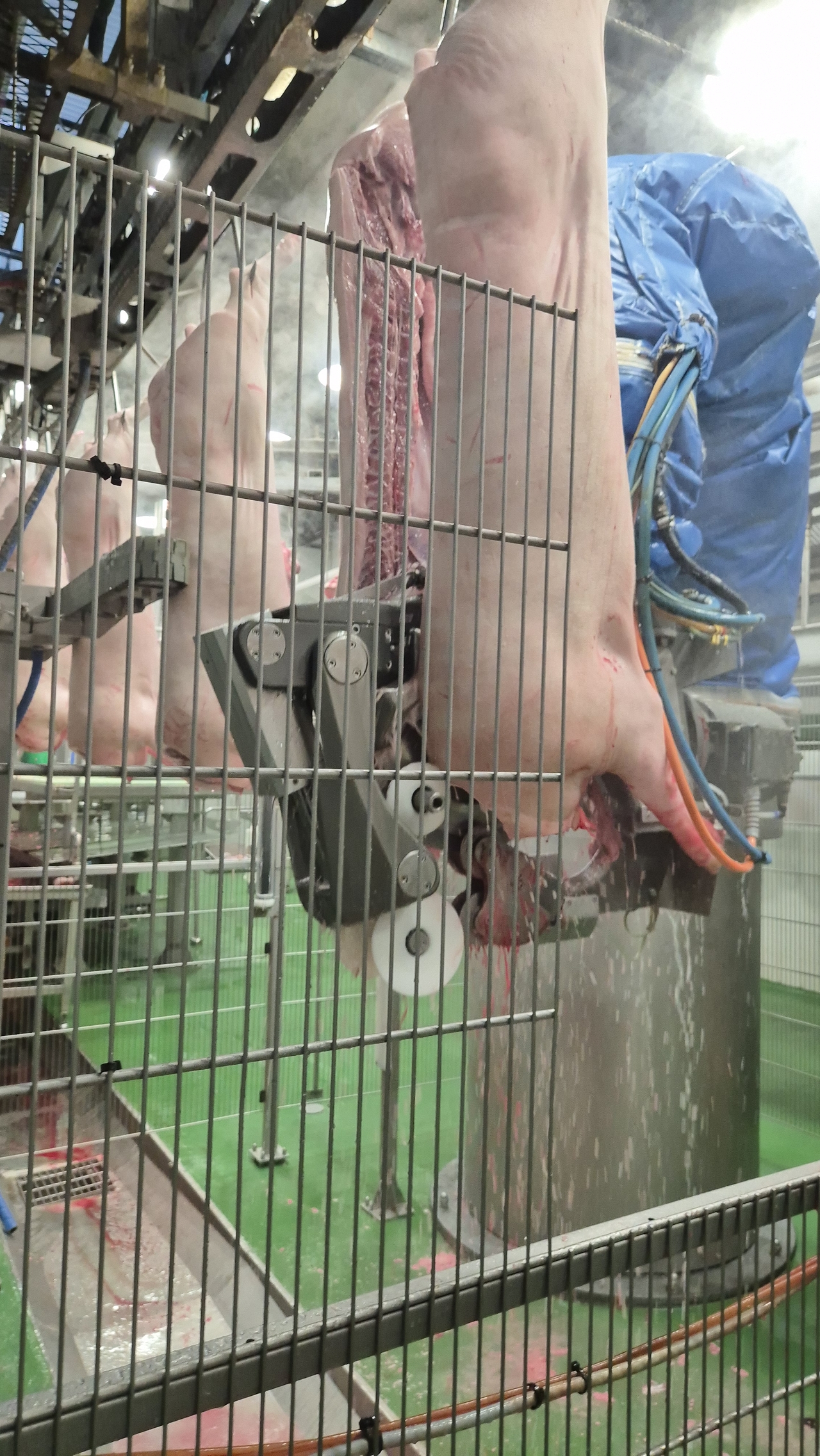
Clean groundwater from deep beneath Jeju Island cascades over pig carcasses as a high-pressure robot tracks each one down the line, blasting away debris and bone fragments. The water comes from the same underground source that feeds Jeju Samdasoo, the island's well-known mineral water brand. Each pig requires just 8 liters for the wash — less than a third of the 26 liters that conventional mechanical systems once consumed.
A visit to the Jeju Swine Farmers Cooperative's livestock distribution center on Wednesday found three robots deployed across the facility's 29-step slaughter process: one for neck cutting, one for splitting the carcass in two, and one for the final wash. A pig entering the line takes about 24 minutes to complete all 29 steps, with one animal advancing to the next stage roughly every 12 seconds.
"We use water drawn from about 300 meters below ground," said Kim Hyeong-jun, director of the center. "Introducing the washing robot has allowed us to cut water consumption while also strengthening hygiene management."
Inside the slaughterhouse, carcasses moved in a continuous line along ceiling-mounted rails. After hair removal and singeing, each pig passed through vertical and horizontal rinses before entering the evisceration room. In the semi-clean zone, workers first sealed the anus to prevent contamination from intestinal contents, then removed the tail.
Next came the neck-cutting robot. Reading the pig's position through a vision camera, it located the precise point on the cervical vertebrae and made the cut. A worker standing nearby completed the head separation, after which the robot sterilized the cut surface with steam — a sequence repeated for every animal on the line.
"In the past, there were frequent disputes between byproduct companies and meat processors over exactly where the head was cut," Kim said. "Since we brought in the robot, the cut position has become consistent and those complaints have almost disappeared."
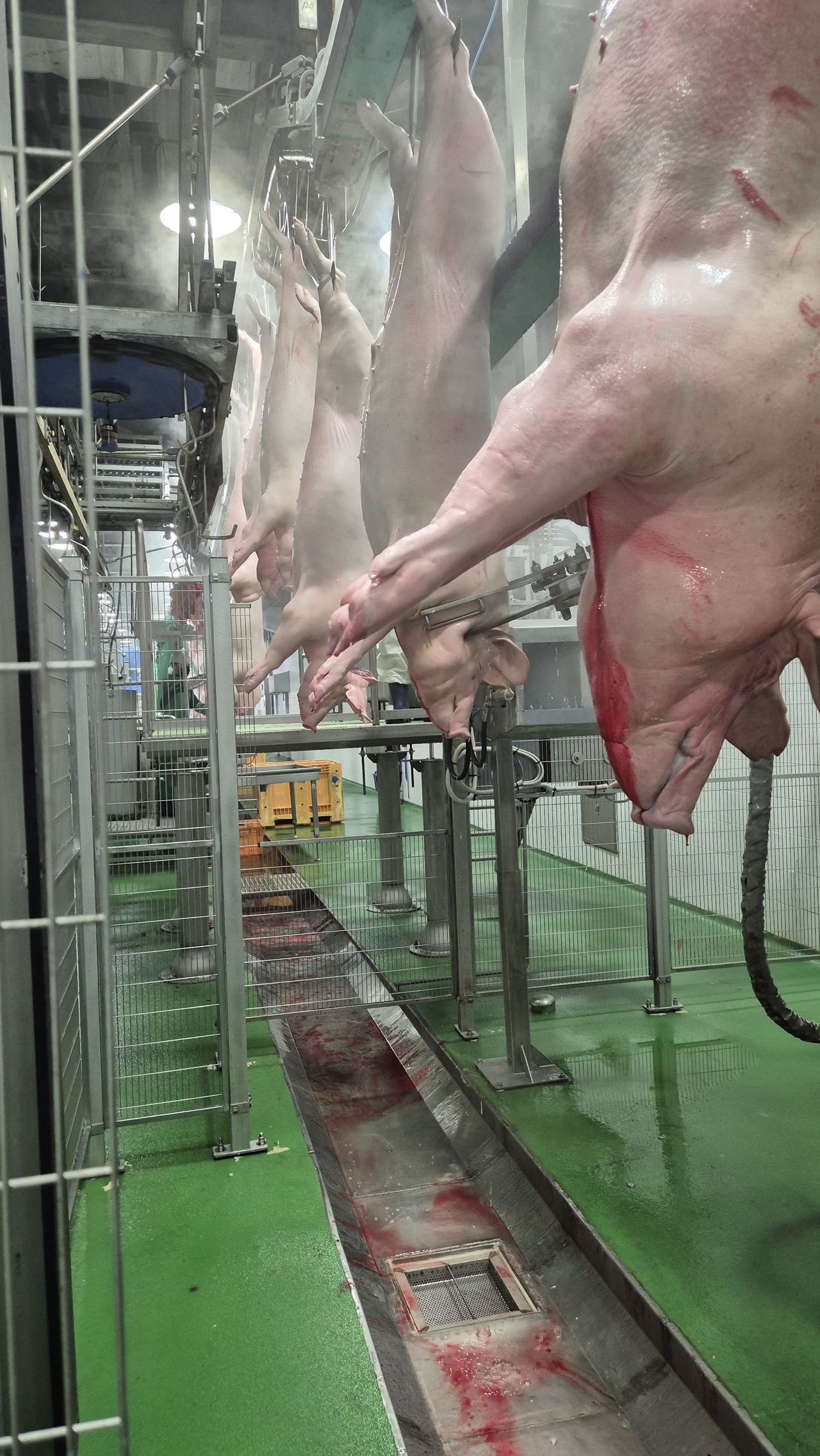
The head goes to byproduct companies while the carcass goes to meat processors. More meat left on the head side benefits the byproduct company but reduces the amount of pork neck and collar cuts available to the processor. By cutting at a fixed point every time, the robot has eased that long-running tension between the two sides.
Sanitation practices have also changed. "When people did the work, sterilization happened after about every five pigs," Kim said. "The robot sterilizes with steam after every single animal."
Further down the line, a carcass-splitting robot divided each pig's body in two along the spine, guided by sensors and cameras that read the vertebrae's position. When the robot determined that a curved spine made a clean cut impossible, it passed the carcass through untouched, leaving the task to a worker with a manual saw standing alongside.
"Pigs, like people, can have curved spines," Kim said. "If the robot decides it cannot cut accurately, it does not force the job — it hands the animal over to a person."
The robots have not eliminated the human role. After splitting, each carcass undergoes inspection. On Wednesday, workers were seen excising specific sections with a knife — removing tissue around injection sites where abscesses or other abnormalities had been found.
The inspectors are civil servants attached to the Jeju Island Animal Disease Laboratory. If a problem is found, the entire production line stops and cannot restart until the inspector has assessed the abnormality and authorized resumption.
Each pig's carcass, head and organs travel together as a linked set so that, if an inspector flags a problem with a particular animal, the dressed carcass and all its byproducts can be condemned together.
"Cooperative members sometimes complain that too much meat has been trimmed from their pigs," Kim said. "But this is food for people to eat — any problem area has to be removed without hesitation."
The clearest numerical proof of the slaughterhouse's automation gains comes at the final washing stage.
As each carcass entered the wash zone, a robot traveled along the rail beside it, firing high-pressure jets from nozzles positioned from top to bottom. Where the old mechanical system simply sprayed water at passing carcasses, this robot moves with each animal, cleaning it from every angle.
According to the center, the old mechanical wash required about 26 liters of water per pig. Manual washing by workers needed about 12 liters, but the robot brings that down to about 8 liters — a reduction of roughly 69.2 percent compared with the mechanical method.
"The more water a slaughterhouse uses, the more wastewater it generates and the higher the treatment costs," Kim said. "With the robot, we can use less water and still reach every corner of the carcass."
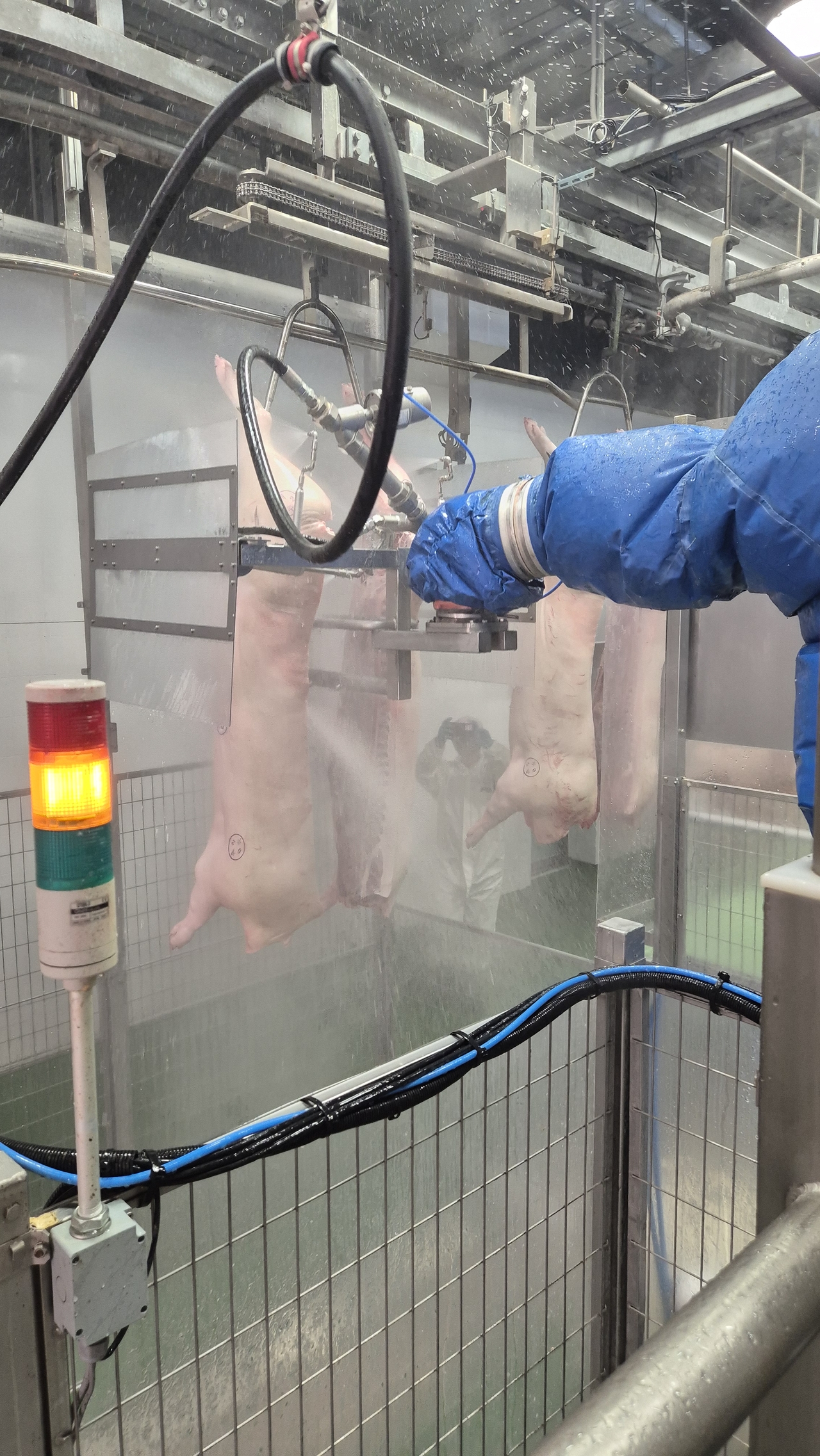
The washing robot was developed jointly with domestic robotics firm Robos and installed at a cost of about 160 million won ($120,000). The center has been expanding automation across its slaughter operations, having earlier installed a European-made carcass-splitting robot as well.
After washing, each carcass passes through an automated grading machine called the VCS 2000, which uses image-analysis technology to measure the lean-meat yield and ratio for individual cuts including samgyeopsal and pork neck. The data are also shared with the farms that supplied the animals.
Slaughter does not mean immediate dispatch. Each carcass spends about 90 minutes in a rapid-chilling room before moving to the next stage, quickly drawing down the residual heat from slaughter to preserve meat quality.
The center slaughtered 461,942 pigs last year, averaging 1,901 animals a day. It was also designated last year as an approved export slaughter facility for Singapore after passing an on-site inspection in Singapore.
Where Jeju's deep groundwater meets robotics, the result is a facility that goes well beyond fast throughput. Tasks requiring human judgment remain in human hands, while repetitive cutting and washing have moved to machines. Across the 24-minute production line that each pig travels, automation and hygiene management now advance together.
adastra@heraldcorp.com