- Nuclear membrane damage in cancer cells and changes in surrounding tissue create a vicious cycle
- Lymph node metastasis increases while immunotherapy efficacy declines

Repeatedly applying physical pressure to cancer cells can accelerate metastasis and reduce the effectiveness of immunotherapy, according to new research.
KAIST announced Sunday that a team led by Professors Kim Jun and Park Jong-eun of its Graduate School of Medical Science and Engineering, along with Professor Park Hyung-soon of the Department of Mechanical Engineering, collaborated with Professor Noh Mi-ryung of Gangnam Severance Hospital at Yonsei University to investigate how repetitive physical pressure affects the metastasis of melanoma — a type of skin cancer — and the efficacy of immunotherapy.
Melanoma is a malignant tumor that originates in the pigment-producing cells of the skin. It can develop in areas subject to repeated weight-bearing pressure, such as the soles of the feet. However, the precise effects of such mechanical stimulation on cancer progression had not been clearly established.
The research team implanted melanoma cells into the footpads of mice and subjected them to repeated pressure. As a result, the nuclear envelope — the protective membrane surrounding the nucleus of cancer cells — was damaged, and changes were observed in nearby fibroblasts, the cells that make up the surrounding tissue.
In healthy tissue, fibroblasts maintain structural integrity and aid in wound healing. In cancerous tissue, however, they can promote the growth and spread of cancer cells.
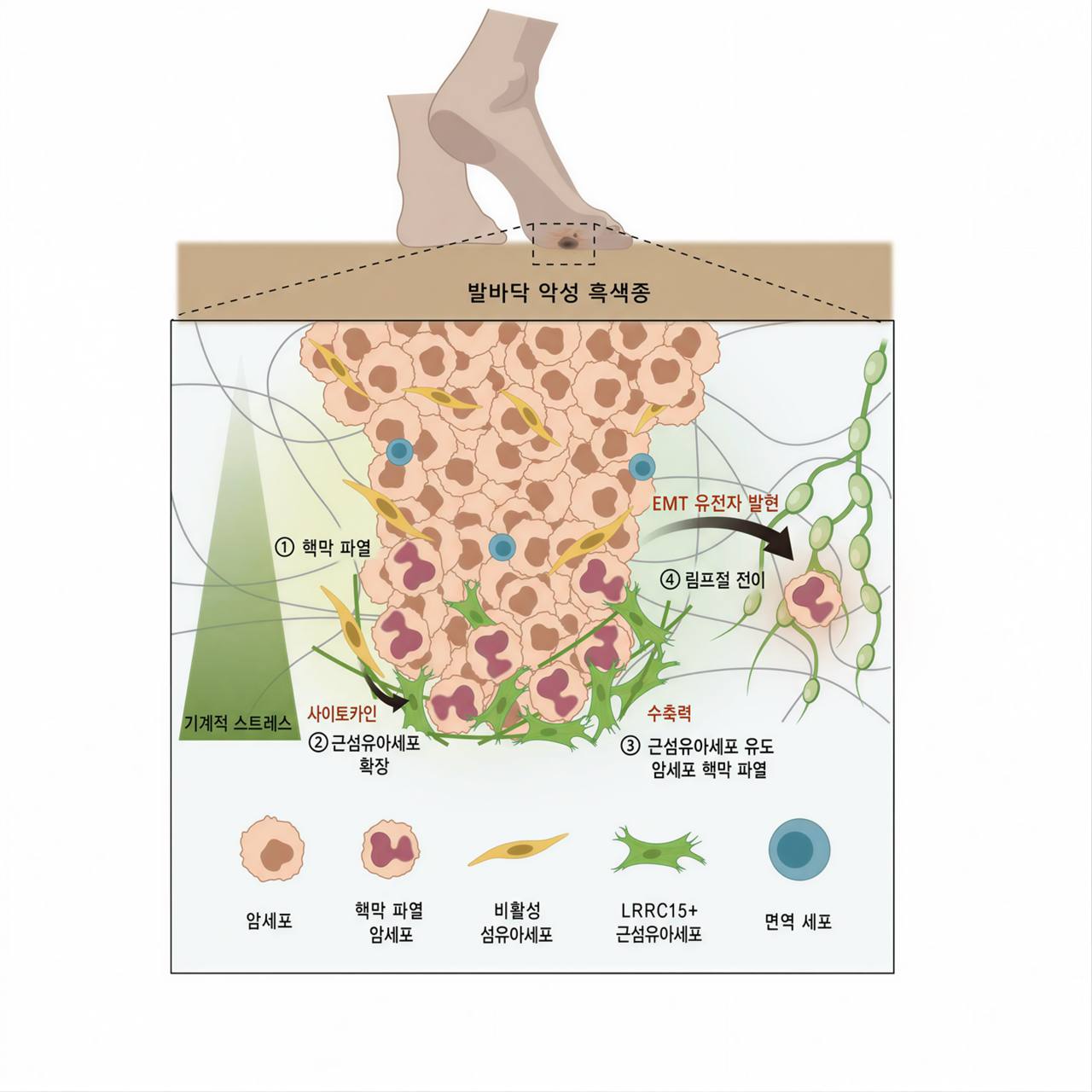
The research team used single-cell analysis and spatial transcriptomics to precisely map gene activity and the locations of cells within cancer tissue.
As a result, myofibroblasts — cells with a contractile, tissue-pulling property — increased in cancer tissue subjected to repeated pressure. Myofibroblasts carrying a marker called LRRC15 were particularly prominent at the tumor margins where pressure was concentrated.
The key finding was that cancer cells and surrounding cells mutually amplify each other's changes.
When the nuclear envelope of a cancer cell is damaged, nearby fibroblasts undergo changes — and those altered cells in turn further damage the nuclear envelopes of cancer cells. This creates a vicious cycle between cancer cells and surrounding tissue that drives disease progression.
These changes had measurable effects on actual metastasis and treatment outcomes.
In mice subjected to repeated pressure, cancer cells spread more extensively to the lymph nodes. At the same time, the effectiveness of immunotherapy — which helps immune cells attack cancer cells — declined.
Similar patterns were observed in tissue samples from actual melanoma patients. Tumors arising in high-pressure areas showed more frequent lymph node metastasis alongside changes in the surrounding tissue.
However, these changes did not show a direct correlation with overall patient survival rates. The findings from patient tissue samples alone are not sufficient to conclude that physical pressure directly causes cancer metastasis.
The study demonstrates that not only the cancer cells themselves, but also the physical environment of the tissue surrounding them, can influence metastasis and treatment response.
The research team said the findings could inform clinical guidelines to minimize repetitive mechanical stress on plantar melanomas and guide the development of new anticancer drugs targeting nuclear envelope damage and changes in surrounding tissue. Further validation will be needed, however, before the approach can be applied to patients.
"We confirmed that repetitive mechanical stimulation does not merely damage the nuclear envelopes of cancer cells, but also alters surrounding normal cells in ways that can affect metastasis and treatment resistance," Professor Kim Jun said. "Understanding the physical interactions between cancer cells and surrounding tissue will be an important clue in developing new cancer treatment strategies."
The findings were published Oct. 20 in the online edition of Cancer Research, an international journal of the American Association for Cancer Research.
nbgkoo@heraldcorp.com