Nexen Tire's vision from Magok
$26.6 million simulator investment
'Evaluating tire feel in the lab, not on the track'
Development time cut by up to 50% — OE competitiveness on the rise
Noise, wear and EV efficiency verified in the lab
![The high dynamic driving simulator installed at Nexen Tire's central research center, The Nexen UniverCITY, in Magok-dong, Gangseo-gu, Seoul, on May 29. Nexen Tire uses the equipment to evaluate vehicle dynamics and tire performance in a virtual environment. [Nexen Tire]](https://wimg.heraldcorp.com/news/cms/2026/05/30/news-p.v1.20260529.67d7d41670374bb2b859fb962750708a_P1.jpg)
Nexen Tire is aiming for a quantum leap in the global tire market by putting AI and virtual driving simulation at the center of its strategy. The company is overhauling its entire research and development approach — shifting to a digitally driven model — to overcome the disadvantages of being a late mover in an industry long defined by heavy capital investment and accumulated experience.
The Nexen UniverCITY, the company's central research center in Magok, western Seoul, visited on May 29, is the nerve center of that transformation. Opened in 2019, the facility serves as a global R&D hub overseeing Nexen Tire's technology research centers in the United States, Germany and China. The building spans 57,171 square meters across two below-ground and eight above-ground floors, and houses roughly 500 researchers and 200 office staff.
The flagship piece of equipment is a high-performance driving simulator introduced in August last year. Working with British firm Ansible Motion, Nexen Tire became the first company in the domestic tire industry to install a high dynamic driving simulator — a system combining high-performance hardware and software to evaluate vehicle dynamics and tire response in real time, indoors.
The cumulative investment in virtual equipment totals 40 billion won (about $26.6 million) and was driven by Vice Chairman Kang Ho-chan. In the domestic market, Nexen Tire holds an oligopoly position alongside Hankook Tire & Technology and Kumho Tire, but globally it ranks outside the top 10 by sales. Overseas, the company must compete against industry leaders such as Michelin, Bridgestone and Goodyear on one side, and fast-rising Chinese and Indian manufacturers on the other.
Closing the scale gap quickly is not realistic, so Nexen Tire is looking for a breakthrough in development efficiency and speed. Vice Chairman Kang is pushing a strategy to apply digital technologies — including AI and virtual reality — across all R&D to shorten development timelines and raise product quality. The plan is to use AI-based performance prediction and virtual driving simulation to lay the groundwork for a push into the global top tier, given the limits of simply trying to catch up through conventional means.
$26.6 million simulator: 'We can evaluate tire feel right here in the lab'
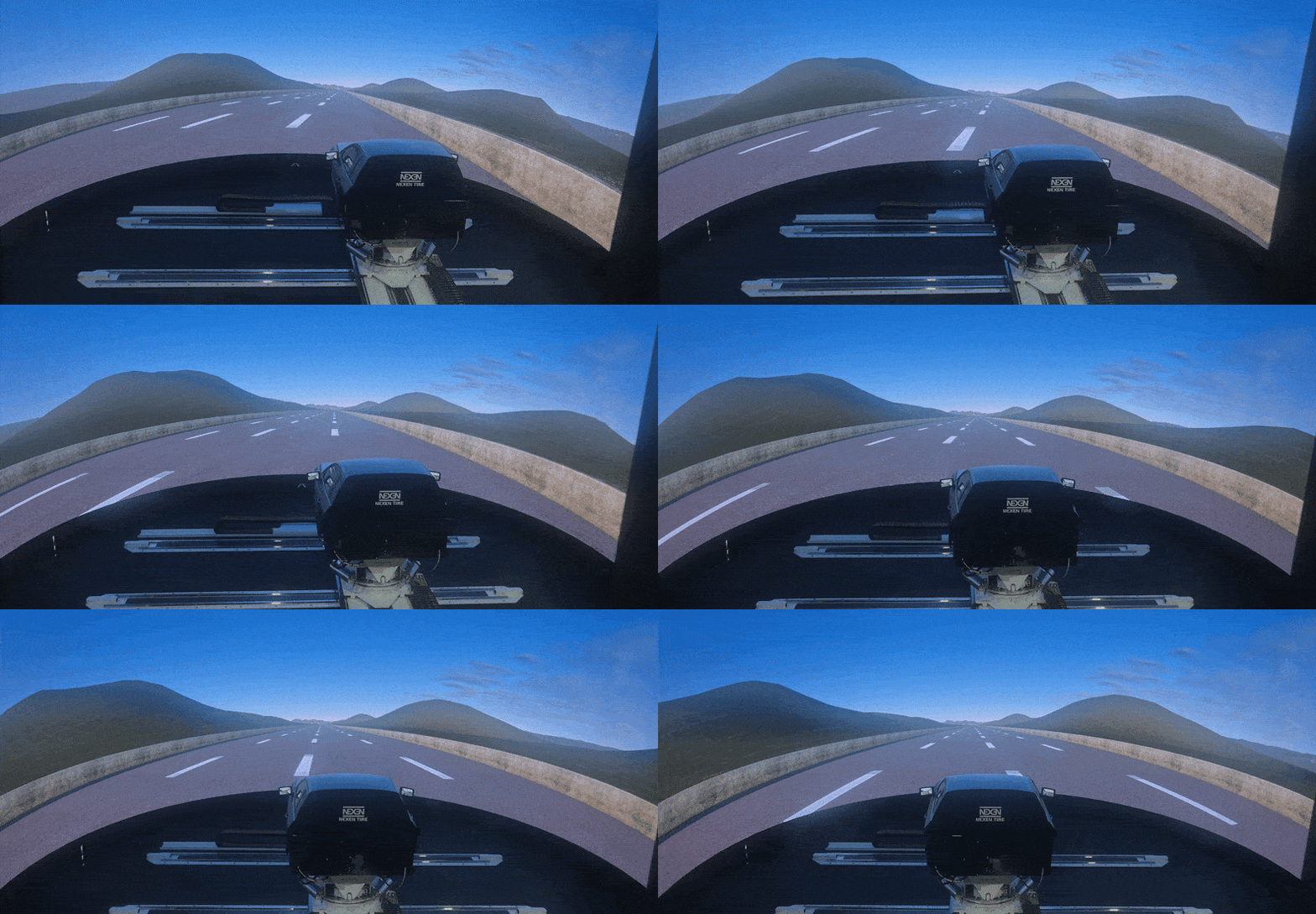
The simulator on display that day was nothing like a gaming rig. A real vehicle cabin sat in front of a curved screen — five meters tall and made up of 432 LED panels — while rails and electric motors on the floor reproduced the physical sensations of acceleration, braking and lane changes.
The test vehicle was an eighth-generation Volkswagen Golf fitted with an OE tire model supplied by Nexen Tire. Changing lanes on a virtual road surface stretching 10 kilometers, the cabin shifted noticeably from side to side. Distinguishing fine differences between individual tire specifications was difficult for a non-professional driver, but the lateral sway and cautious steering feel of a real lane change came through clearly enough.
The simulator's purpose is not to eliminate physical vehicle testing altogether. It is designed to filter out weaker design candidates early in development, reducing the number of physical prototypes that need to be built and the number of track tests that need to be run. Under the old process, engineers had to build a prototype, evaluate it on a track, revise the design and repeat the cycle — all to hit the performance targets set by automakers.
![The dynamic driving simulator at Nexen Tire's central research center, The Nexen UniverCITY, in Magok-dong, Gangseo-gu, Seoul, on May 29. Nexen Tire uses the equipment to evaluate vehicle dynamics and tire performance in a virtual environment. [Nexen Tire]](https://wimg.heraldcorp.com/news/cms/2026/05/30/news-p.v1.20260529.18e8bfff95c0498c94ea01f54e3be248_P1.jpg)
Kwak Jae-ryeon, head of Nexen Tire's vehicle dynamics team, said computer analysis alone cannot capture the subjective feel a driver experiences. "The simulator lets an actual driver get behind the wheel of a virtual tire and feel the handling, stability and cornering response," he said. He added that while it was too early to cite specific cost savings — the system having only recently been introduced — cutting even a single physical development loop would substantially reduce both cost and time.
Development time cut by up to 50% — and a boost to OE competitiveness
Nexen Tire expects the simulator to cut development time and costs by 30 percent in the near term and by as much as 50 percent over the longer term. The capability is also directly tied to its ability to win original equipment supply contracts, particularly as global automakers increasingly adopt virtual testing and development processes.
Nexen Tire currently supplies new-vehicle tires to more than 30 automotive brands worldwide, covering roughly 120 models. Key vehicles in its supply portfolio include the Hyundai Motor Ioniq 6 and Kona EV, Kia's EV lineup, the Porsche Cayenne, Panamera and Macan, the BMW X1, X3, X4 and iX, the Mercedes-Benz E-Class, and the Audi A6.
Electric vehicles present another critical challenge. EVs are heavier and quieter than internal combustion engine vehicles, making tire wear, load capacity, noise and energy efficiency more important than ever. Starting with new products launched last year, Nexen Tire has applied an "EV Route" mark to its lineup and set a strategy to use AI and virtual verification technology to develop tires capable of meeting the demands of EVs, hybrids, hydrogen fuel cell vehicles and conventional combustion-engine cars alike.
![Nexen Tire's central research center, The Nexen UniverCITY, in Magok, Seoul. [Nexen Tire]](https://wimg.heraldcorp.com/news/cms/2026/05/30/news-p.v1.20260506.9f9d9e40e2644c218ac46dace166a8e9_P1.jpg)
Noise, wear and EV efficiency verified in the lab — keeping pace with the EV era
The same direction was evident throughout the research center. A semi-anechoic chamber for full vehicles blocks outside noise so engineers can measure tire noise in isolation, replicating driving conditions up to 250 kilometers per hour and temperatures ranging from minus 5 to 40 degrees Celsius.
In the acoustic analysis room, engineers listen to tire sounds recorded during actual drives and study what customers perceive as pleasant or irritating. Reducing noise is not simply a matter of making it quieter — the standard for what sounds good varies with the character of the vehicle and the preferences of the consumer.
The lab is squarely aimed at the EV era, where tire noise management has become critical. Unlike internal combustion engine vehicles, EVs produce almost no engine sound, which means the noise generated where the tire meets the road travels far more clearly into the cabin. As more consumers prioritize a quiet ride, tire noise has emerged as a key factor shaping not just ride comfort but the overall appeal of an electric vehicle.
The workspace itself also reflects a deliberate break from the conservative manufacturing image. The Nexen UniverCITY is an open-plan complex featuring a research wing, an office wing, a central courtyard and a spiral walkway, designed to encourage natural interaction between researchers and office staff.
![The semi-anechoic chamber at Nexen Tire's central research center, The Nexen UniverCITY, in Magok, Seoul. The facility is used to analyze tire driving noise and conduct research into quietness and ride comfort. [Nexen Tire]](https://wimg.heraldcorp.com/news/cms/2026/05/30/news-p.v1.20260529.8515630cf5d44c60b954c22e9f8b0a48_P1.jpg)
'Conventional development has its limits' — going all-in on fully virtual R&D
In April last year, Nexen Tire unveiled its "Vision 2030: Next Level 5.0" roadmap, setting a target of surpassing 4 trillion won (about $2.66 billion) in sales by 2030 and pushing toward 5 trillion won (about $3.32 billion). The company identified price competitiveness, product portfolio, production capacity, downstream stability and corporate culture as its five core challenges. Among them, the digital transformation of R&D stands as the central pillar for lifting product competitiveness.
For decades, the tire industry has been shaped by equipment, accumulated expertise and repeated physical testing. Nexen Tire is adding AI and simulation as new variables. Closing the gap with global leaders in one stroke will not be easy, but the strategy is to change the path of the chase by raising development speed and precision. The simulator at the Magok research center showed that the shift has already begun.
![The acoustic analysis room at Nexen Tire's central research center, The Nexen UniverCITY, in Magok-dong, Gangseo-gu, Seoul, on May 29. The room is used to analyze tire driving noise and conduct research into quietness and ride comfort. [Nexen Tire]](https://wimg.heraldcorp.com/news/cms/2026/05/30/news-p.v1.20260529.85feb0ce94fe418490b1e97b7e104b3d_P1.jpg)
Kim Jong-myung, Nexen Tire's chief technology officer and executive vice president, said there is no such thing as a universally good or bad tire — what matters is how well a tire pairs with a specific vehicle. "We believe it is no longer possible to compete by relying solely on the conventional development approach of building and testing a tire three or four times," he said.
He added that completing a fully virtual development process — one that uses AI and simulation to rapidly identify the optimal specification combination, then uses the driving simulator to verify the pairing between vehicle and tire — would be the core of future tire technology competitiveness.
kwater@heraldcorp.com