Results covering 555 patients across 14 countries presented at SITC 2026 in Phoenix; primary endpoint met
Secondary endpoints including progression-free survival show comparable data; zero neutralizing antibodies detected
Regulatory filings completed in South Korea and US as company races to commercialize biosimilar of world's top-selling drug
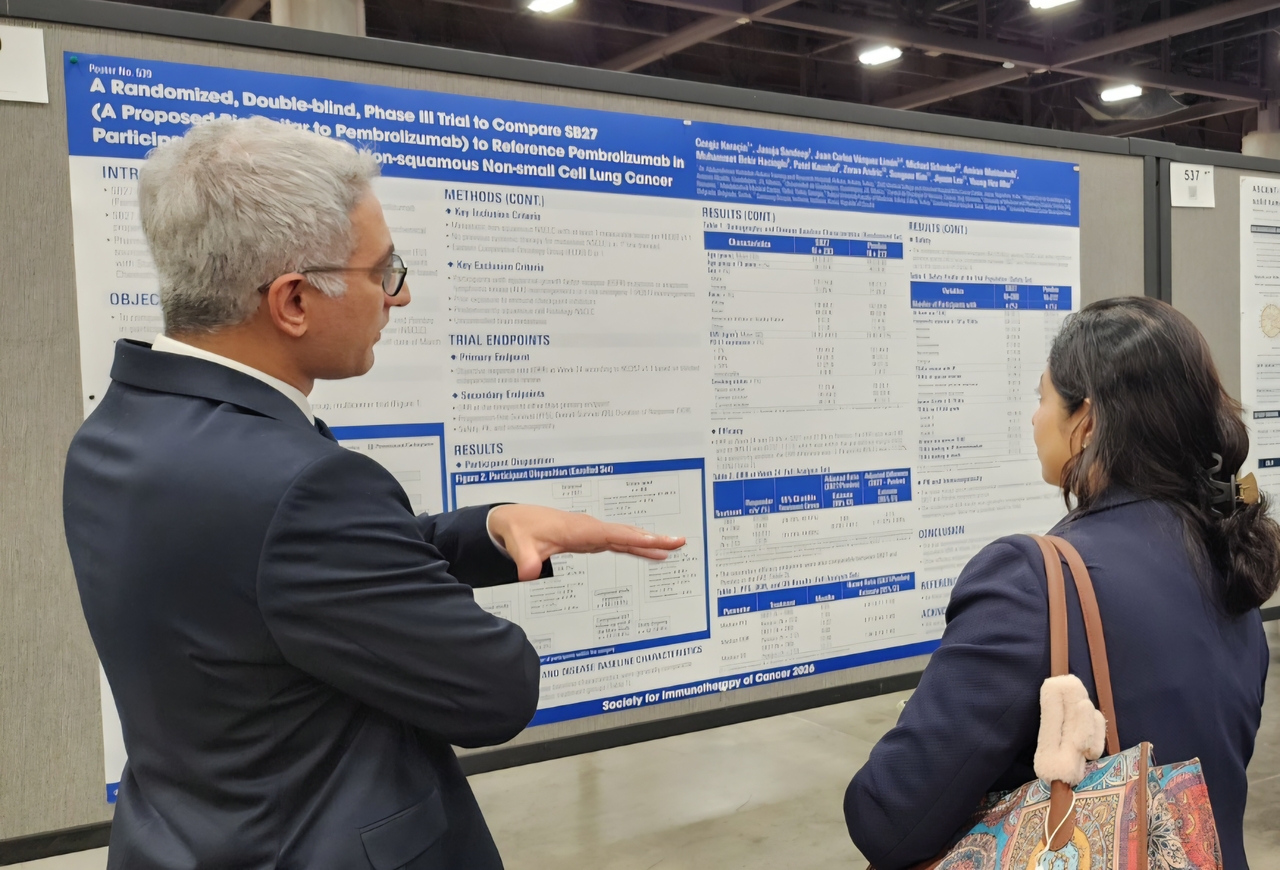
Samsung Bioepis has demonstrated equivalence and safety against the original drug in a global Phase 3 trial of a biosimilar for Keytruda, the world's top-selling anticancer drug by revenue.
Samsung Bioepis announced Monday that it presented results from the global Phase 3 trial of SB27 (pembrolizumab), its Keytruda biosimilar candidate, at the Society for Immunotherapy of Cancer (SITC 2026) annual meeting in Phoenix, Arizona, which ran from Wednesday through Sunday.
Keytruda is an immune checkpoint inhibitor developed by US drugmaker MSD that binds to the PD-1 receptor to help the immune system attack cancer cells. It is the world's best-selling single pharmaceutical product, with global sales of approximately 46 trillion won ($34.3 billion) last year.
Since 2024, Samsung Bioepis has conducted the Phase 3 trial across 14 countries, enrolling 555 patients with metastatic non-squamous non-small cell lung cancer and comparing SB27 against the original drug in combination with standard chemotherapy.
The analysis showed that SB27 met the pre-specified equivalence margin set by regulators on the primary efficacy endpoint — the objective response rate at 24 weeks.
Secondary efficacy endpoints, including progression-free survival, duration of response and overall survival, also produced data comparable to the original drug. On safety, the rates of treatment-emergent adverse events and serious adverse events were similar to those of the original, and no neutralizing antibodies — which can render a drug ineffective — were detected.
Samsung Bioepis filed for domestic approval of SB27 with South Korea's Ministry of Food and Drug Safety in August, becoming the first company to do so in the country, and completed its application to the US Food and Drug Administration in October. The company plans to move swiftly through the regulatory approval process in each market to bring the product to global markets on schedule.
"We successfully demonstrated the primary endpoint in a large-scale global Phase 3 trial, confirming SB27's clinical equivalence and consistent safety profile," said Shin Dong-hoon, executive vice president and head of clinical medicine at Samsung Bioepis. "We will focus our development capabilities on improving patient access to high-quality oncology biopharmaceuticals."
The results carry significant weight as Samsung Bioepis has moved faster than any rival in securing Phase 3 data and completing regulatory filings in both South Korea and the United States ahead of Keytruda's patent expiration — cementing its position as a global first mover in what is the largest single-product pharmaceutical market, with annual sales of 46 trillion won.
silverpaper@heraldcorp.com