Teenagers to plan and propose wetland conservation activities; applications open June 1 through June 15
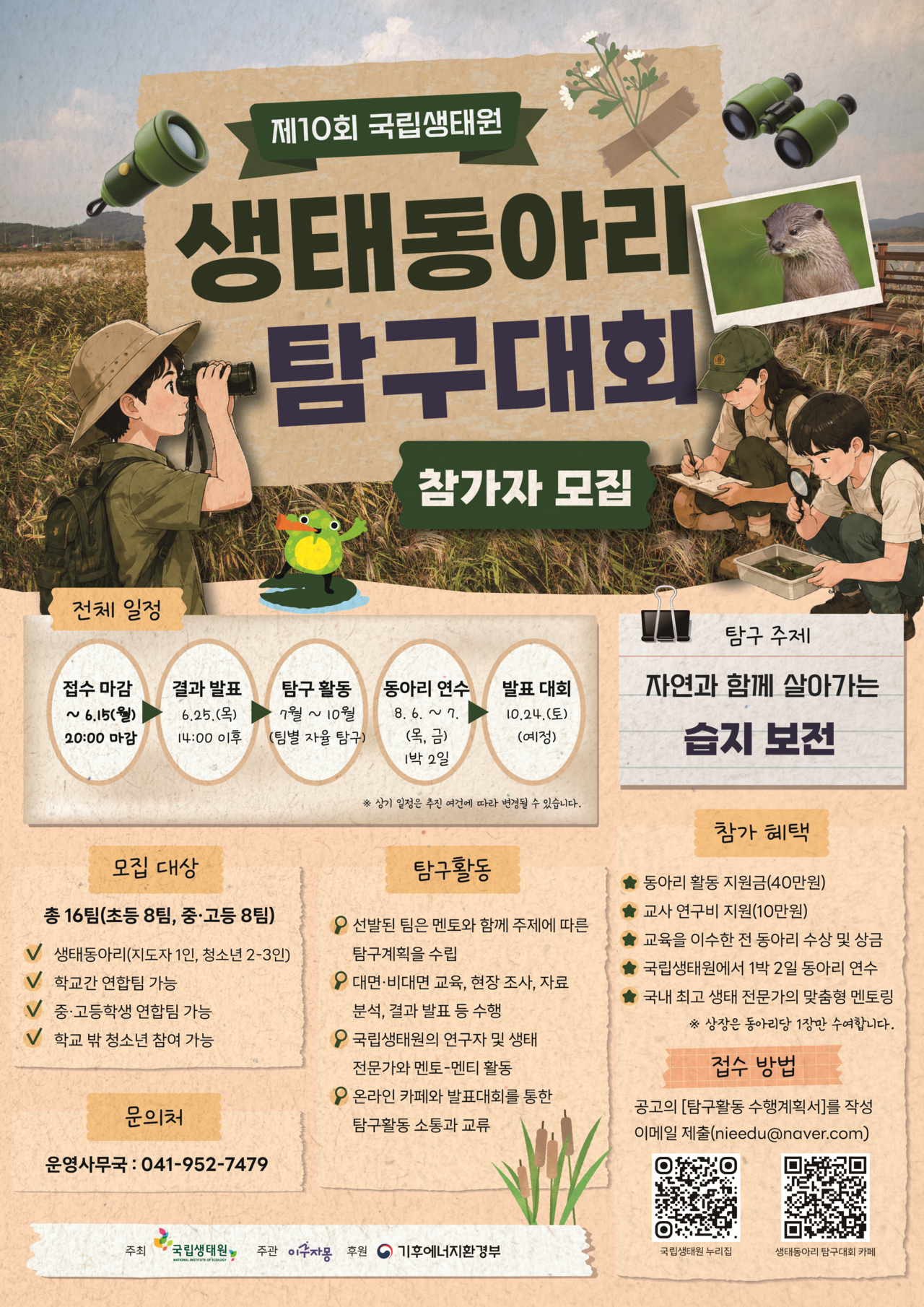
The National Institute of Ecology, under the Ministry of Climate, Environment and Energy, announced Sunday it will hold the 10th National Institute of Ecology Eco Club Research Competition to cultivate young ecological talent and raise awareness of conservation.
The competition pairs teenage students with a supervising teacher to plan and carry out ecological research activities, with education at the core of the program.
It is designed to help young participants sharpen their creative problem-solving skills by exploring local ecosystems firsthand, while giving them access to collaborative research experiences linked to the institute's research and education resources.
This year's theme is wetland conservation.
Teams are open to teenagers nationwide — groups of two to three upper elementary, middle or high school students — accompanied by one adult supervisor.
Applicants can download a research activity plan from the institute's website and submit it by email to the organizing office between June 1 and June 15.
Submitted plans will be reviewed by experts, and 16 teams will be selected in total — eight from elementary school and eight from middle and high school. Selected teams will take part in a series of activities to build ecological thinking and problem-solving skills, including in-person and online training sessions in July and August, expert mentoring from July through October, and a presentation competition with awards in October.
Each selected team will receive an activity grant of 500,000 won (about $333), which includes a research stipend for the supervising teacher.
Entries will be judged on originality, scientific validity and community impact. Four Ministry of Climate, Environment and Energy minister's awards will be given — two to student clubs and two to supervising teachers — along with 14 National Institute of Ecology director's awards for student clubs. Total prize money is expected to reach approximately 4 million won (about $2,660).
"This competition is living education in itself — a process through which young people think through environmental problems and find solutions on their own, and a precious opportunity to raise awareness of wetland biodiversity and wetland ecosystems," institute director Lee Chang-seok said. "Through education alongside ecological experts, we will nurture the next generation of ecological talent and further expand the foundation for sustainable ecological education."
thlee@heraldcorp.com