Procurement reform highlights include innovation procurement expansion, AI industry support and regional balance — agency vows to make changes 'more tangible for citizens and businesses'
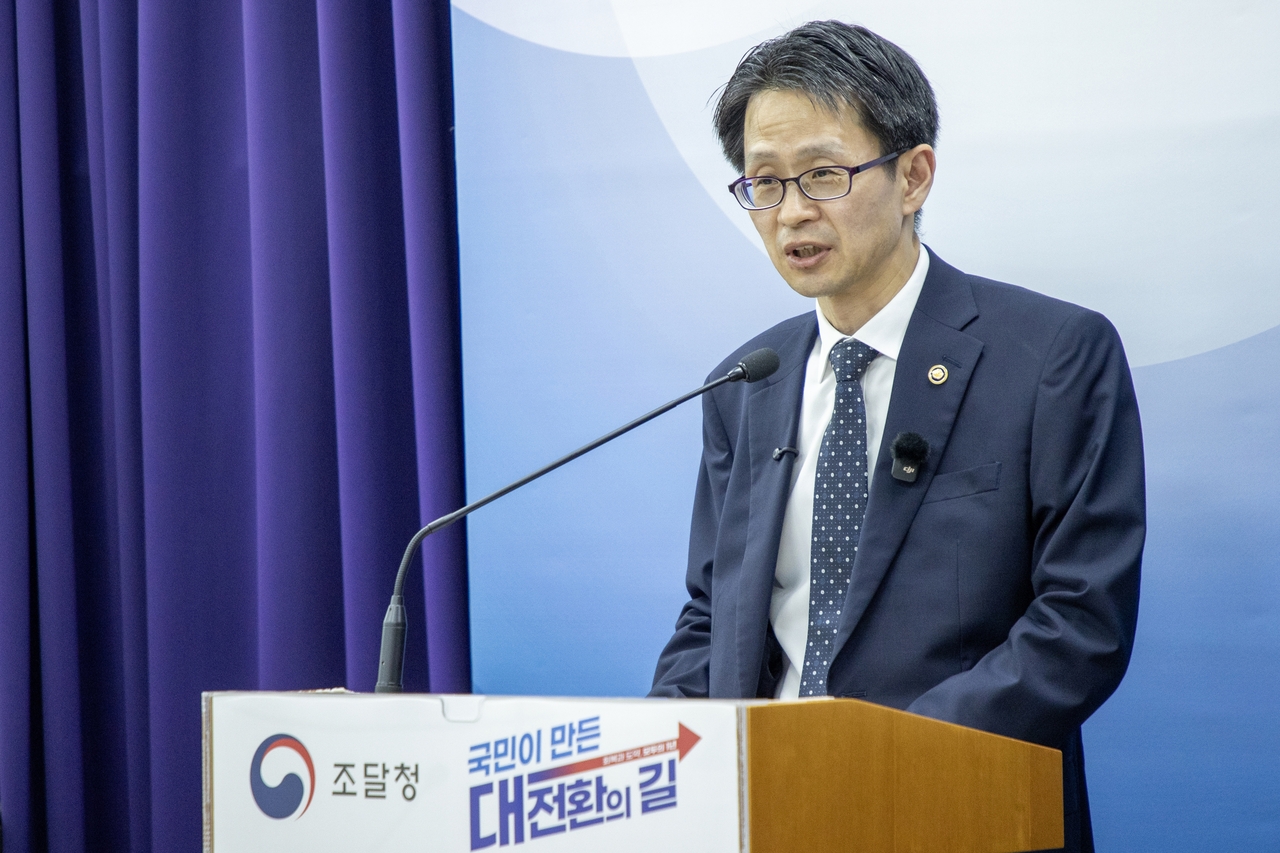
The Public Procurement Service announced 10 key achievements on Sunday to mark the first anniversary of the People's Sovereignty Government.
Commissioner Baek Seung-bo held a press briefing at the Government Daejeon Complex, presenting results across three pillars: technology-led growth, balanced regional growth and fair growth.
The first achievement was strengthening innovation procurement — a model in which the government acts as the first buyer of private-sector innovations to help innovative companies grow. Over the past year, the agency worked with local governments and the private sector to identify promising products, resulting in a 24 percent increase in designated innovation products and an 11 percent rise in public purchases. Designations of products in advanced strategic industries — including AI, robotics and climate technology — surged 44 percent compared with the same period a year earlier. Overseas demonstration programs also expanded sharply, with the number of target countries tripling and demonstration products more than quadrupling, securing export references primarily across the Global South.
One example: a rehabilitation robotics company used 150 million won (about $99,800) in overseas demonstration support in a Central Asian country, which opened the door to roughly 900 million won in export orders from neighboring countries — about six times the initial investment.
The second achievement was nurturing the AI industry through public purchasing power. The agency overhauled procurement procedures from entry to contract to lower barriers for AI companies, including exemptions from delivery performance requirements, preferential bidding treatment, dedicated AI evaluation panels and streamlined contracting. Over the past year, AI product designations among excellent and innovative products rose 90 percent, and unit-price contracts for AI software and services expanded. The agency also drew up a public procurement AI transformation roadmap and began building more than 20 procurement AI agents covering tasks such as drafting estimated prices for goods, calculating construction costs, comparing prices and preparing request-for-proposal documents.
The third achievement was reducing the burden on small and medium-sized enterprises entering the procurement market and expanding their growth opportunities. Following the completion of 105 regulatory improvement tasks through a "Regulatory Reset" initiative last year, the agency is now fast-tracking 118 tasks under a "Regulatory Reboot" program this year, reviewing the entire procurement system with a focus on autonomy and competition. The minimum award rate — the floor below which bids cannot be accepted — was also raised by 2 percentage points across goods, facilities and services procurement to prevent excessively low-price awards, marking a significant shift aimed at expanding growth opportunities for small and medium-sized enterprises.
The fourth achievement was procurement autonomy that broadens local governments' choices. A pilot program was launched allowing local governments in Gyeonggi Province and North Jeolla Province to opt out of mandatory purchases under the agency's unit-price contracts and instead choose procurement methods suited to local conditions. Supporting infrastructure put in place includes unit-price contract guidelines, training programs and a dedicated online shopping portal for local governments. The program is set to expand to all local governments in 2027 following performance reviews and refinements.
At the same time, the Electronic Procurement Act was amended to allow oversight of regulatory violations in self-contracted purchases. Approximately 28,000 such contracts have been reviewed since the amendment took effect, resulting in 1,208 corrective orders.
The fifth achievement was preferential treatment for non-metropolitan companies to support locally led growth. In April, the agency unveiled a plan to expand non-metropolitan companies' participation in the procurement market. Key measures include regional preference points in bid evaluations, priority purchasing when conditions are equal, higher spending thresholds for shopping-mall purchases that can be made without competitive bidding, and additional benefits for companies in areas experiencing population decline.
The agency also cited five further achievements: eliminating indiscriminate bidding by shell companies; establishing a fair procurement market order through strong action against unfair procurement practices; strengthening safety and quality management throughout the procurement process; securing public procurement supply chain stability through swift and pre-emptive crisis response; and building a foundation for training specialist procurement professionals.
The agency said it also plans to tighten qualification standards for evaluators involved in procurement project assessments, citing growing dissatisfaction among procurement companies over some evaluators' lack of qualifications.
Measures under consideration to improve fairness include a three-strikes-and-out system for evaluators, appointing qualified evaluators by field, and partially reinstating public officials with strong practical experience as evaluators.
"The past year was a starting point for procurement reform — one in which we responded to a rapidly changing economic and industrial environment, redefined the role of public procurement in areas such as nurturing the AI industry and supporting locally led balanced growth, while more firmly grounding ourselves in the principles of fairness and safety," Commissioner Baek said.
"Going forward, it will be important to translate the foundation built over the past year into tangible results on the ground," he added. "We will do our utmost to strengthen public procurement's role as a core policy instrument supporting the great leap forward of the People's Sovereignty Government, and to ensure that citizens and businesses can feel the changes in public procurement more clearly."
kwonhl@heraldcorp.com