Content exports, inbound tourism and leisure satisfaction all hit record highs, cementing K-culture industries as a core pillar of South Korea's services trade
![A night view of Geunjeongjeon at Gyeongbokgung Palace [Korea Tourism Organization]](https://wimg.heraldcorp.com/news/cms/2026/06/02/news-p.v1.20260602.39d03e28d5fb40c590ee6e7b0c384349_P1.jpg)
South Korea's K-content exports and inbound tourism both hit all-time highs last year, sharply elevating the economic standing of the country's culture and tourism industries. The two sectors have firmly established themselves as major foreign-currency earners and national strategic industries.
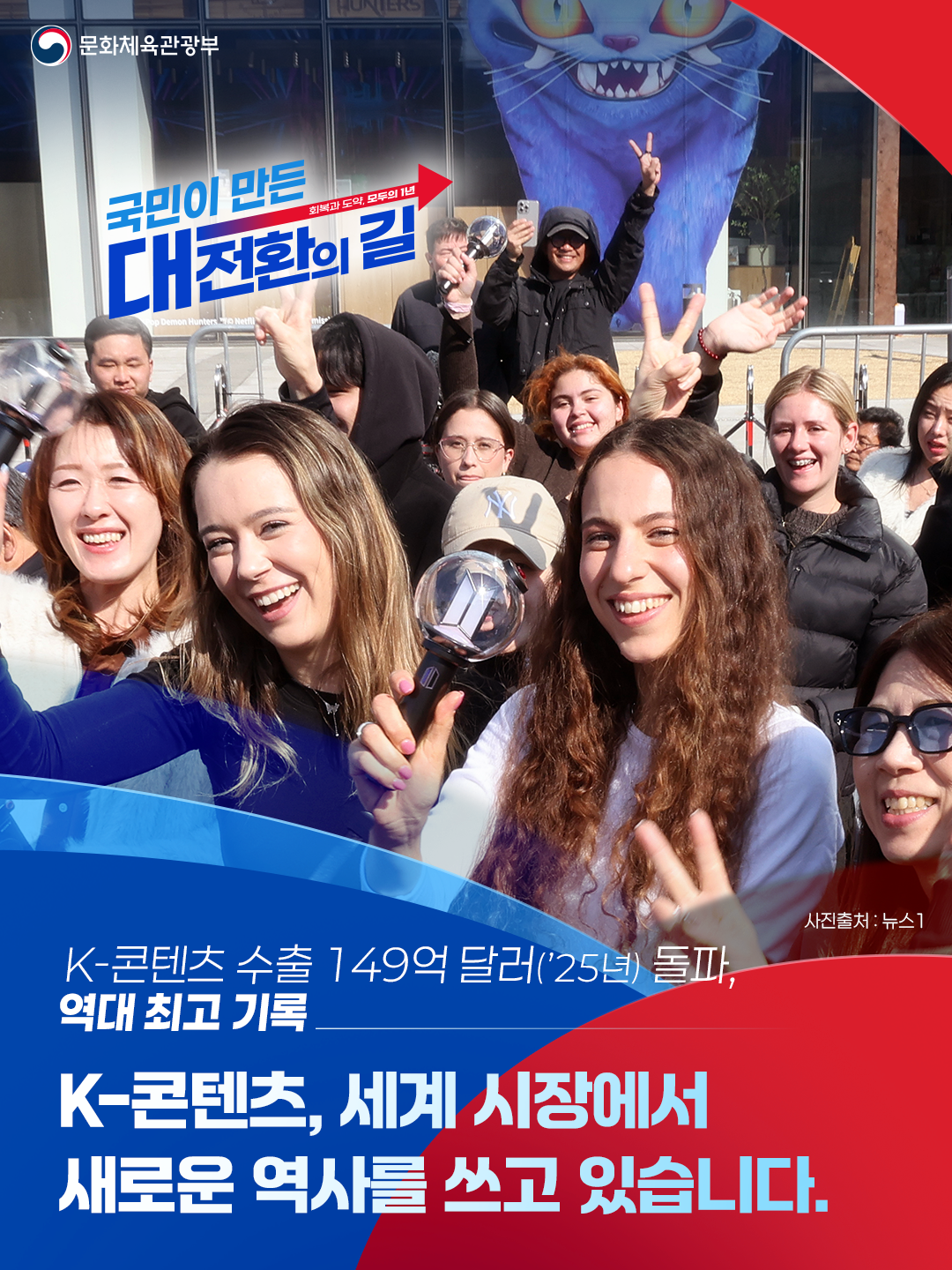
The Ministry of Culture, Sports and Tourism released a summary of major accomplishments in culture, content and tourism Monday to mark the first anniversary of the People's Sovereignty Government. Both content exports and tourism receipts broke all-time records, with K-culture-based industries now serving as a central pillar of South Korea's services exports.
Last year's K-content exports reached a preliminary $14.9 billion, an all-time high. Tourism receipts also set a record, rising 10.6 percent year-on-year to a preliminary $27.2 billion. Combined, content and tourism exports totaled $42.1 billion.

The number of foreign tourists visiting South Korea reached 18.94 million, also a record. Foreign visitors' domestic card spending hit an all-time high of $14.1 billion, according to the Bank of Korea, contributing to the revitalization of local economies.
The growth has accelerated since the new government took office. Inbound tourist arrivals in the second half of 2025 rose 17 percent from the same period a year earlier. The cumulative number of visitors through April this year reached 6.77 million, up 21 percent from 5.58 million in the same period last year.
Improvements to entry procedures contributed to the increase. The government introduced a temporary visa-free policy for Chinese group tourists in September last year. From March this year, it expanded multiple-entry visa issuance to nationals of China and 12 Southeast Asian countries who have previously visited South Korea.
Tourism policy initiatives also moved into full gear. Two National Tourism Strategy Council meetings held since the new government took office focused on streamlining immigration procedures and building an integrated support framework for the accommodation industry. In April, an amendment to the Framework Act on Tourism elevated the National Tourism Strategy Council to a presidential body.
Regional airports also posted strong gains. Arrivals at regional airports in the first quarter of this year rose 49 percent year-on-year. To diversify tourism entry points beyond the capital region, a new domestic route between Incheon and Jeju launched in May, and the Incheon–Gimhae route was expanded from 35 to 39 weekly flights.

The film industry, which had been struggling, showed signs of recovery following emergency government support. Box office sales and admissions in the first quarter of this year reached 318 billion won (approximately $210 million) and 31.9 million, respectively — up 58.7 percent and 53.2 percent from the same period a year earlier. The Ministry of Culture, Sports and Tourism expanded its film production support budget from 10 billion won last year to 46 billion won this year, while stepping up assistance for independent and art-house films as well as advanced production technologies.

Cultural infrastructure and consumption also expanded. The National Museum of Korea drew 6.5 million visitors last year, ranking third in the world behind the Louvre and the Vatican Museums. Total visitors across all national museums reached 18.09 million, up 36 percent from the previous year. Sales of the museum's cultural merchandise brand "Muds" surged 94 percent to 41.3 billion won.
Indicators of public cultural engagement also improved. Leisure satisfaction stood at 64 percent, the highest since the survey began in 2016. The monthly "Culture Day" program was expanded into a weekly "Culture Wednesday," significantly increasing the number of participating facilities and programs. The recreational sports participation rate reached 62.9 percent, and professional sports attendance hit 17.83 million — both recent highs.
Reforms to arts sector governance were also pursued. The ministry reaffirmed its principle of "support without interference" and operates a 90-member Cultural Arts Policy Advisory Committee drawn from field experts. A dedicated unit for protecting artists' rights was established, and a presidential committee on popular culture exchange has been tasked with identifying new policy priorities.
Policy financing support is also being strengthened. The ministry is setting up its 2026 mother fund culture and film account at a record 731.8 billion won, and is preparing a 150 billion won Global League Fund. A new tax credit for webtoon production costs was introduced, and the tax credit for video content production costs was extended through 2028.

To expand specialized policy financing, the Ministry of Culture, Sports and Tourism is building its 2026 mother fund culture and film account to a record 731.8 billion won and establishing a 150 billion won Global League Fund. In January, the ministry introduced a new tax credit for webtoon production costs and extended the sunset deadline for the video content production cost tax credit to 2028.
Separately, amendments to the Copyright Act, the Performance Act and the National Sports Promotion Act passed the National Assembly on Jan. 29, enabling a system to block access to illegal content that took effect May 11. A punitive damages scheme, a 50-times surcharge to deter ticket scalping, and a whistleblower reward program are set to take effect in August.
Culture Minister Choi Hwi-young said the ministry had spent the first year of the People's Sovereignty Government focused on communicating directly with the field, laying the groundwork for South Korea to become a cultural powerhouse, turning K-culture into a future growth engine, and expanding everyday cultural access for citizens. "We will diligently prepare for the government's second year so that people can feel the impact of our policies with real momentum," he said.
terry@heraldcorp.com