Sales up but operating profit seen falling
Fire, recalls and Middle East risks weigh on results
Ulsan lines expand weekend overtime
HMGMA utilization rate normalization remains key challenge
Attention is turning to whether Hyundai Motor Co can stage a second-half recovery after a profitability slump that stretched through the first two quarters of this year. U.S. tariff pressures, production disruptions and recall costs combined to push first-half operating profit below year-earlier levels, but the automaker is betting on new models — including a facelifted Grandeur and the Genesis GV90, the brand's first flagship electric SUV — to lift factory utilization rates at home and abroad.
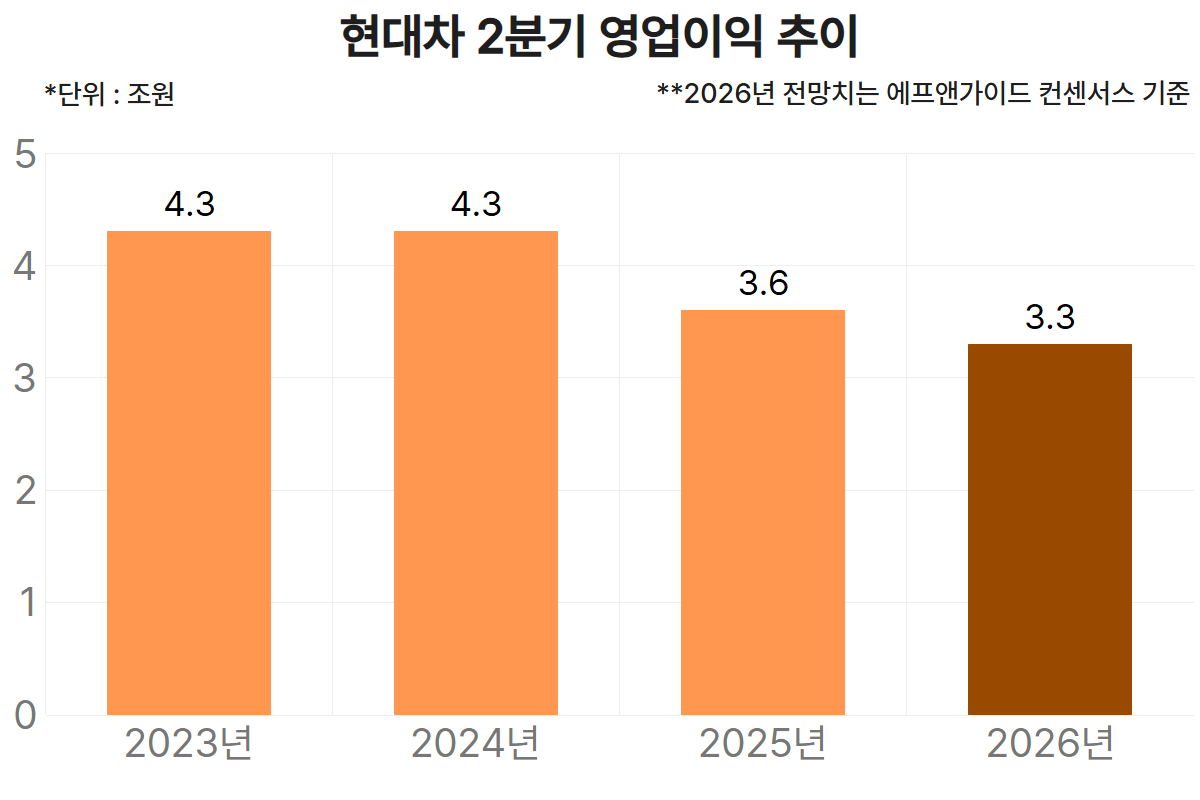
According to a consensus compiled by financial data provider FnGuide on Monday, Hyundai Motor's second-quarter sales are forecast to rise 3.7 percent year-on-year to 50.066 trillion won ($33.1 billion). Operating profit, however, is expected to fall 8.4 percent over the same period to 3.3 trillion won — down 22.8 percent from the second quarter of 2024.
On the surface, the pace of decline is easing compared with the first quarter's 30.8 percent drop in operating profit. Analysts caution, however, that a base effect is at work. The United States began imposing tariffs on automobiles in April last year, meaning those costs were not reflected in first-quarter 2025 figures but hit Hyundai Motor's books in full from the first quarter of this year — estimated at around 860 billion won. If the first-quarter earnings hit was largely a tariff-timing shock, the second quarter is where the company's underlying production and sales strength will begin to show through.
Hyundai Motor faced a string of headwinds simultaneously in the first half. A fire at parts supplier Anjeong Gongup disrupted component supply, instability in the Middle East added logistics costs, and a Palisade recall weighed on second-quarter results. Production shortfalls translated directly into weaker domestic sales, making the home-market slump particularly pronounced.
Hyundai Motor sold a total of 325,473 vehicles worldwide in May — 45,364 in South Korea and 280,109 overseas — a 7.7 percent decline from the same month a year earlier. Domestic sales fell 23.1 percent and overseas sales dropped 4.6 percent. On a cumulative January-through-May basis, domestic sales were down 11.7 percent and overseas sales fell 3.2 percent.
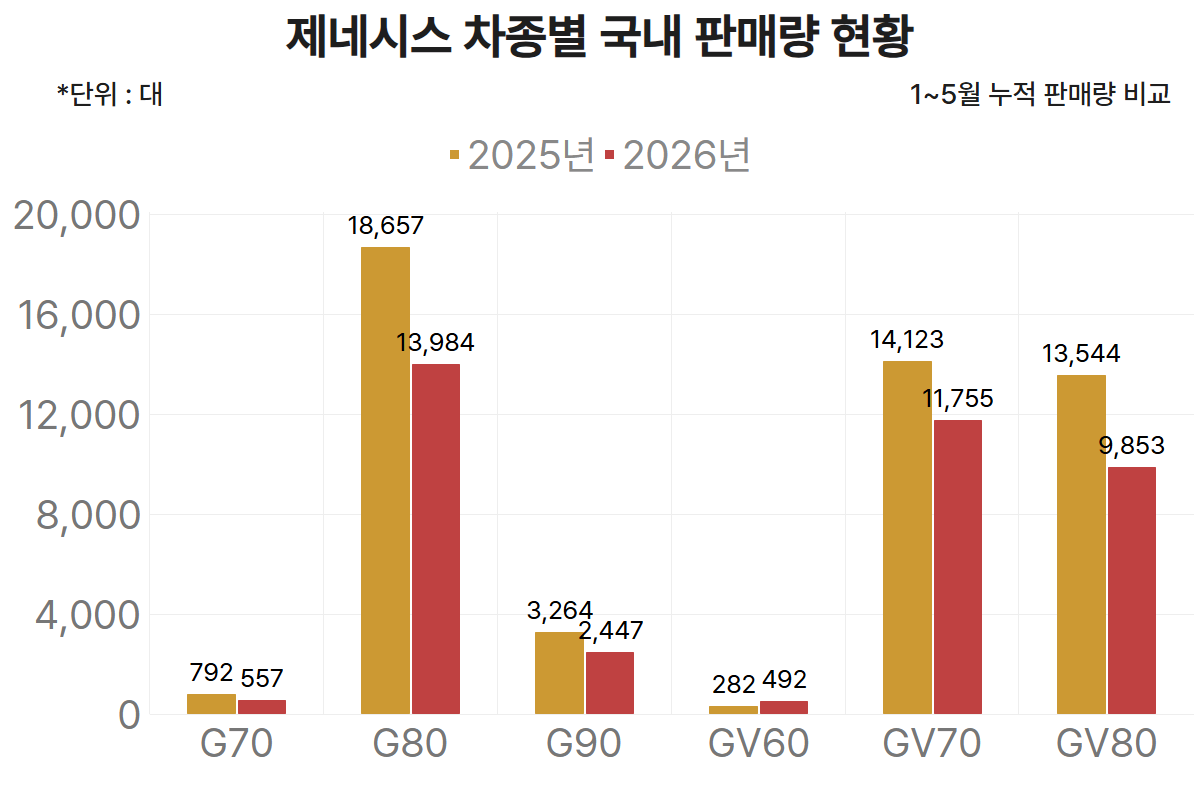
The component supply disruption hit domestic recreational vehicle sales especially hard. RV sales in May came to 15,799 units, down 32.0 percent year-on-year. The Palisade sold 1,825 units, down 76.2 percent, while the Santa Fe moved 2,862 units, down 42.4 percent. Tucson sales were limited to 2,183 units, a 46.6 percent decline. Genesis also slipped, with 6,161 units sold — a 35.3 percent drop — as key models including the G80, GV70 and GV80 all posted year-on-year declines.
Hyundai Motor's domestic factory output in the first quarter fell by roughly 15,000 units from a year earlier. In the second half, the company plans to lead a domestic sales recovery with popular models such as the Grandeur. Once the dedicated electric vehicle factory at the Ulsan plant moves into full operation, the domestic production system is expected to shift further toward electrification.
Hyundai Motor appears to be returning to normal operations this month after roughly two months of production disruptions, with a sizable backlog of orders to work through. Pending orders for the Santa Fe and Palisade stand at around 10,000 units combined. To make up for the weak first half, some lines at the Ulsan plant have expanded weekend overtime to as many as four or five shifts this month.
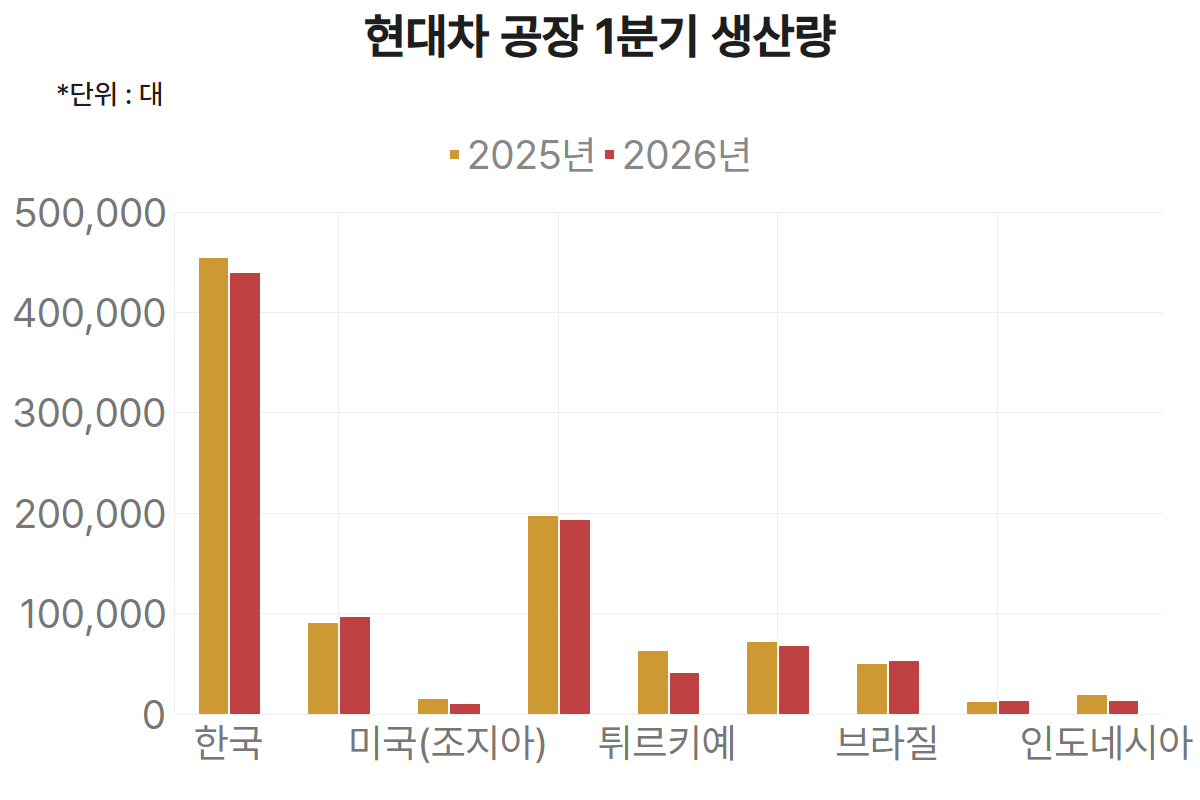
Restoring utilization rates at overseas plants is equally critical. In the first quarter, output fell year-on-year at several of Hyundai Motor's major international facilities — down 3,550 units in India, 21,400 in Turkey, 4,540 in the Czech Republic and 5,610 in Indonesia. The steepest decline came at Hyundai Motor Group Metaplant America, the new Georgia plant, where output dropped 4,276 units from a year earlier. HMGMA's first-quarter utilization rate was limited to 38.2 percent, below the 54.7 percent recorded in the first quarter of last year.
The low utilization rate could weigh on Hyundai Motor's consolidated earnings. "If HMGMA's utilization rate stays below 50 percent, an annual operating loss of around 300 billion won could be reflected in the books," said Shin Yun-cheol, an analyst at Kiwoom Securities. With Kia Sportage hybrid mass production beginning at the plant this month, however, analysts say a return to normal utilization in the second half could substantially ease the fixed-cost burden.
![An Ioniq 5 production line at Hyundai Motor's Ulsan plant [Hyundai Motor Co]](https://wimg.heraldcorp.com/news/cms/2026/06/02/news-p.v1.20260527.4b02c322b71341549f64e78d963831ad_P1.jpg)
Expanding the hybrid lineup is another key variable. In the U.S. market, demand for hybrids has remained solid while electric vehicle sales have required incentives of $10,000 to $15,000 per unit. Hybrids, by contrast, continue to see excess demand and face relatively little pressure to offer incentives. Hyundai Motor plans to launch the fully redesigned Tucson — in both internal combustion and hybrid variants — in South Korea in the third quarter before rolling it out sequentially to major markets including Europe and North America.
"First-half operating profit will likely be limited to 5.8 trillion won, down 19.9 percent year-on-year, but the second half could see a 43.4 percent increase to 6.1 trillion won, making a profitability recovery highly plausible," said Park Gwang-rae, a research fellow at Shinhan Investment. "The key short-term variable is HMGMA's utilization rate. Once hybrid model production ramps up in the second half, fixed-cost pressure will ease, and HMGMA will be reappraised as a strategic asset offering tariff protection, logistics savings and a U.S. localization premium."
kwater@heraldcorp.com