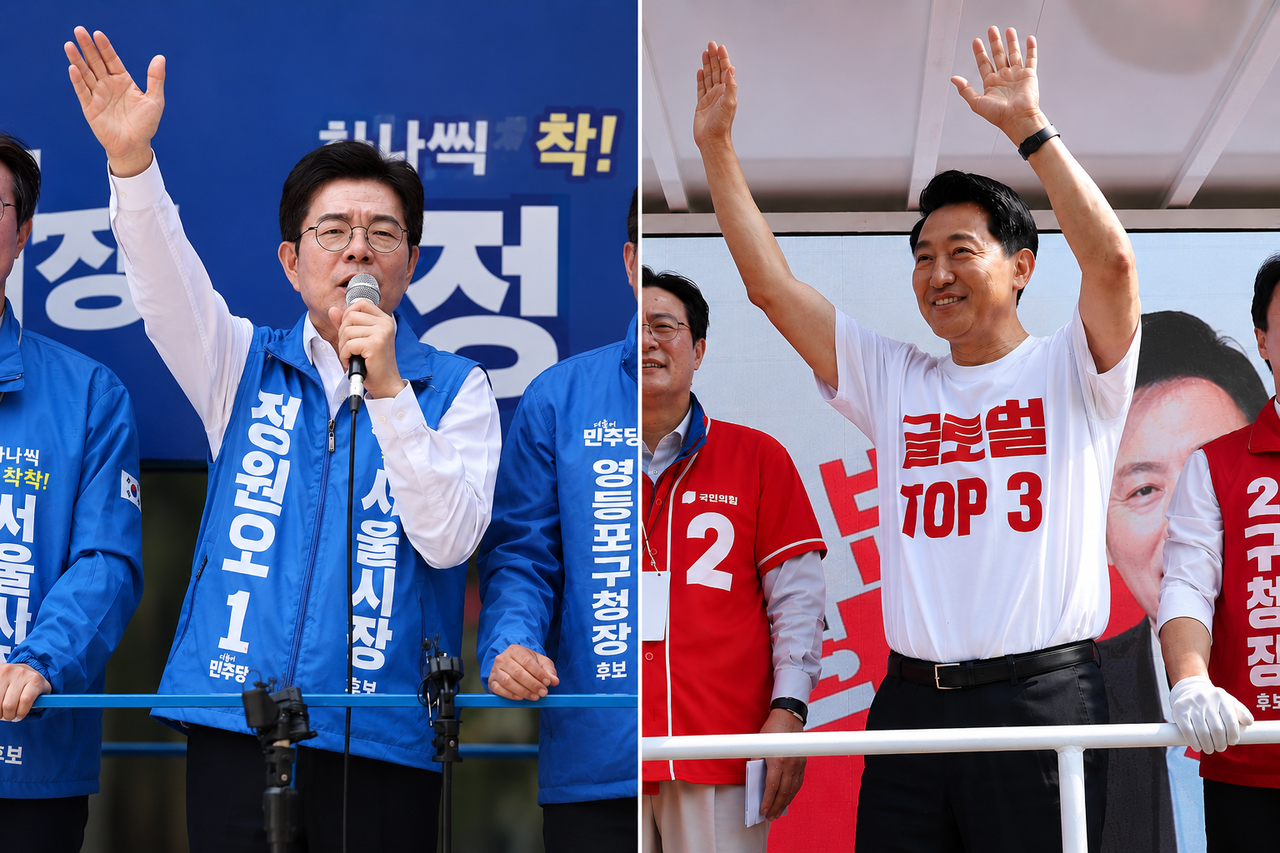
Democratic Party's Jeong Won-oh and People Power Party's Oh Se-hoon mount final pushes ahead of Wednesday's vote
With Election Day one day away, Seoul voters head to the polls Wednesday to choose their next mayor.
Early voting enthusiasm ran higher than expected, with Seoul's early voting turnout reaching 23.84 percent — a figure that points to strong overall participation when the main vote opens Wednesday.
Against that backdrop, the stakes of the Seoul mayoral race come into sharp relief when the numbers are laid out plainly.
Seoul has a population of roughly 9.4 million, with about 8.3 million eligible voters. The city is operating on a budget of more than 51 trillion won ($34.8 billion) this year, meaning the total budget over the incoming mayor's four-year term would easily exceed 200 trillion won ($136.8 billion). Divided across the electorate, each vote in the Seoul mayoral race carries a value of roughly 24 million won ($16,400) — or more than 6 million won ($4,100) even on an annual budget basis.
The arithmetic is simple — total budget divided by number of voters — but it underscores the weight of authority and responsibility that comes with the office.
As South Korea's capital and its political, economic and cultural center, Seoul is led by a mayor who oversees more than 50 trillion won in annual spending and the lives of 9 million residents — in effect making the position the most influential local government post in the country.
Four candidates are on the ballot: Jeong Won-oh of the Democratic Party, Oh Se-hoon of the People Power Party, Kim Jeong-cheol of the Reform Party and Kwon Young-guk of the Justice Party. The race has played out in practice as a two-way contest between Jeong and Oh.
Jeong, a three-term Seongdong-gu district mayor, has campaigned on his record in local administration. Oh, a former Seoul mayor, has emphasized strengthening the city's global competitiveness and driving urban innovation, drawing on his experience in the role.
All four candidates clashed over policy, campaign pledges and governing competence at the sole televised joint debate, held May 28. Many observers noted, however, that a single debate was not enough to fully scrutinize the candidates' platforms and qualifications.
Voters have had to weigh the candidates' capabilities, integrity and policy visions through a combination of debates, official campaign materials, news coverage and campaign events.
Now the decision rests with the citizens. The vote each Seoul resident casts Wednesday will set the direction of the city for the next four years.
Polling has consistently shown an extremely tight race, making a decisive victory for either side difficult to predict. Ultimately, the key variable will be which campaign succeeds in turning out its base.
"By the day before an election, most voters have likely already made up their minds," a senior official at one of Seoul's autonomous districts said. "We won't know which candidate will lead Seoul for the next four years until the ballot boxes are opened."
Mayoral candidates and the candidates for district mayor across all 25 of Seoul's autonomous districts are expected to mount a final all-out push through midnight, when campaigning officially ends.
The vote each Seoul citizen casts will determine the city's future for the next four years. At roughly 24 million won a ballot, no single vote is a small thing.
seouldream01@heraldcorp.com