
Analysis of MMDA balances at five major banks shows firms hoarding liquidity amid uncertainty, boosting bank profitability but raising volatility concerns
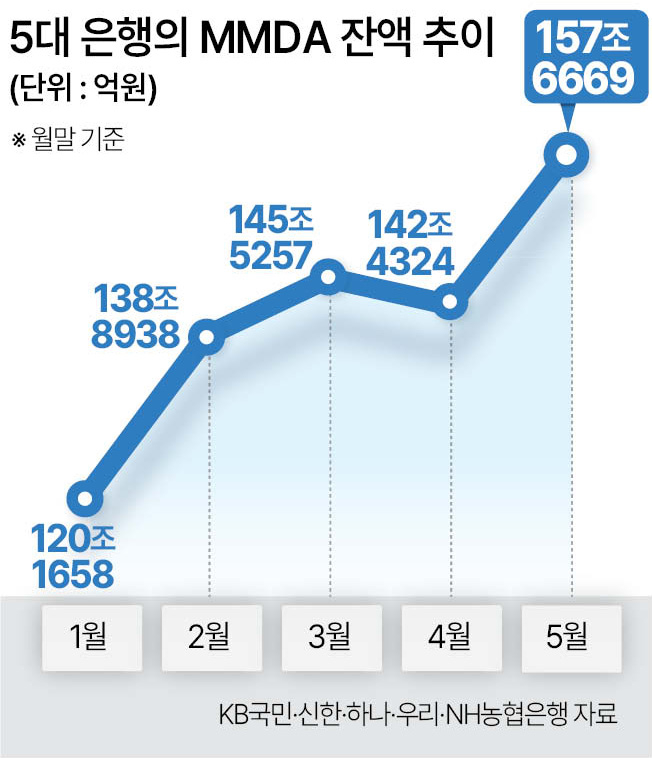
Balances in money market deposit accounts at South Korea's five major banks surged more than 15 trillion won (approximately $9.93 billion) in May alone.
Banks attribute the jump largely to corporations parking short-term cash in the accounts — a trend that stands in sharp contrast to individual investors, who have been moving money out of banks and into capital markets.
Combined MMDA balances at KB Kookmin, Shinhan, Hana, Woori and NH NongHyup Bank stood at 157.67 trillion won at the end of May, up 15.23 trillion won from 142.43 trillion won at the end of April, according to financial industry data released Monday. Compared with the end of last year, when balances totaled 127.34 trillion won, the figure has risen by 30.33 trillion won.
It marks the first time MMDA balances have exceeded 150 trillion won, putting the 160 trillion won threshold within reach. Balances briefly climbed to 161.22 trillion won on May 28 before edging back down, apparently as companies made end-of-month payments.
MMDAs are interest-bearing savings accounts that allow free deposits and withdrawals, with interest accruing from the first day.
Because they offer higher interest rates than ordinary checking accounts, companies use them primarily to manage short-term funds — earning the nickname "corporate parking accounts."
Banks say the rapid buildup reflects a strategy by companies to park cash in short-term accounts as a hedge against market volatility.
A boom in some industries, including semiconductors, has improved cash flow at large conglomerates, but heightened domestic and external uncertainty has pushed firms to prioritize liquidity over investment.
"Most of the recent increase in MMDA balances reflects an inflow of corporate funds," a commercial bank official said. "The growing cash reserves of large conglomerates appear to be a major factor."
Individual funds, by contrast, continue to flow out of banks toward securities firms and other investment channels, according to a shared assessment across the banking sector.
The Kospi's surge past the 8,000 mark and the introduction of integrated management accounts — which guarantee principal — have lowered the barrier to investing, reducing the incentive to keep money sitting in bank accounts.
Some standby funds do flow back into banks when markets swing, but officials said the pace of outflows is equally swift.
The influx of corporate standby funds is seen as a positive for bank profitability.
Banks can raise large sums at relatively low interest rates compared with financial bonds or fixed-term deposits, easing their funding costs. The inflows also help shore up overall deposit bases.
Concerns about stability have been raised, however, given the nature of the funds. Corporate standby cash is highly sensitive to market conditions and interest rate changes, meaning it could exit en masse if investment conditions improve.
"While liquid funds such as MMDAs are flowing in, deposits and savings products are declining, which has increased volatility in the deposit structure," another commercial bank official said. "Because a significant portion of the funds has come from large conglomerates, inflow and outflow swings could widen depending on market conditions."
ehkim@heraldcorp.com





