
Half of self-employed borrowers hold loans from both banks and secondary lenders; nearly half carry debt from three or more institutions; a 0.25 percentage point rate increase would add 550,000 won per borrower annually; experts call for writing off delinquent debt under inclusive finance principles
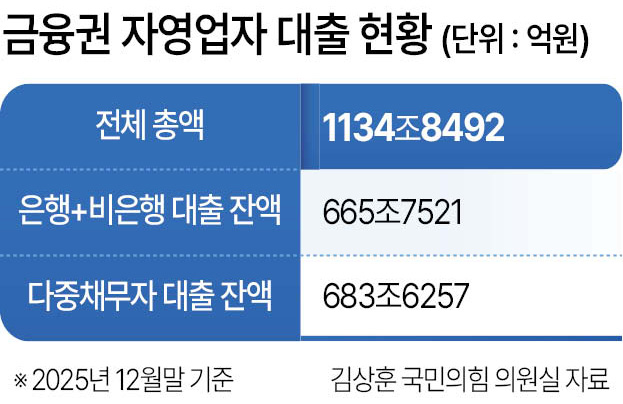
With the Bank of Korea officially signaling a benchmark interest rate hike in the second half of the year, loans to self-employed borrowers — totaling roughly 1,100 trillion won — are emerging as the single biggest risk in the financial sector heading into a rate-rising cycle.
More than half of all self-employed borrowers carry debt from three or more financial institutions, and a significant share hold loans from secondary lenders charging annual rates above 10 percent. Analysts warn that a sustained rise in interest rates could trigger large-scale defaults across the sector.
Economic experts say financial institutions must go beyond the legally required level of loan-loss provisions and actively build additional capital to strengthen their capacity to absorb losses.
Data obtained by the office of People Power Party lawmaker Kim Sang-hoon of the National Assembly's Political Affairs Committee from the Financial Supervisory Service show that total loans to self-employed borrowers across all financial sectors stood at about 1,134.8 trillion won at the end of last year, up roughly 3.6 trillion won from about 1,131.3 trillion won a year earlier.
A defining feature of self-employed lending is its spread across the entire financial system rather than concentration in any single sector. Self-employed borrowers typically take out loans from banks first, then seek additional funding from secondary lenders such as savings banks and credit card companies to cover operating costs. As of the end of last year, 1,717,244 — or 51.2 percent — of the 3,348,279 self-employed borrowers held loans simultaneously from both banks and secondary lenders, representing about 665.8 trillion won, or 58 percent of the total by value.
Another characteristic is that many borrowers take on additional debt to stay afloat during economic downturns and deteriorating business conditions. Of all borrowers, 1,675,682 — nearly half — were multiple debtors with loans from three or more financial institutions. Those indebted to five or more institutions numbered 612,446.
Financial industry officials say large-scale defaults among self-employed borrowers could materialize if the Bank of Korea raises its benchmark rate in the second half of the year. Shin Yong-sang, a senior research fellow at the Korea Institute of Finance, said a Bank of Korea rate hike "will deal an extremely severe blow to marginal borrowers such as the self-employed."
Data the Bank of Korea submitted to the office of People Power Party lawmaker Park Sung-hoon show that a 0.25 percentage point increase in lending rates would add 1.8 trillion won to the interest burden on self-employed borrowers as of the end of last year — an average of 550,000 won per person annually. Markets have raised the possibility that the Bank of Korea could raise its benchmark rate up to three times this year in 0.25 percentage point increments, which by simple calculation could add as much as 1.65 million won per borrower annually in interest costs.
Early warning signs are already appearing. The non-performing loan ratio for self-employed borrowers at domestic banks reached 0.66 percent at the end of March, up 0.09 percentage points quarter-on-quarter and the highest level in five years, according to the Financial Supervisory Service.
Financial sector experts say banks and other financial institutions must not only set aside sufficient loan-loss provisions but also actively build capital to strengthen their loss-absorption capacity. While accounting standards impose certain limits on the size of provisions, there is no separate ceiling on capital accumulation.
Some analysts argue that financial holding companies, which have been aggressively increasing dividends as part of shareholder return policies, should now scale back payouts to shore up their financial strength. The common equity tier 1 ratio at bank holding companies stood at 13.41 percent at the end of March, down 0.09 percentage points from the end of the previous year.
Financial authorities are currently activating various policy finance programs, including the New Leap Fund, to help vulnerable borrowers such as the self-employed make a soft landing. In line with the recent inclusive finance push, financial institutions have also been writing off delinquent debt to ease the burden on self-employed borrowers.
Experts agree that symptomatic relief measures to reduce the interest burden must be accompanied by structural adjustment. They say support should be provided to help self-employed borrowers establish new livelihoods — including assistance with business closure procedures and pathways to wage employment — before they sink into delinquency.
A 2025 survey on business closures among firms that used regional credit guarantee foundations, published by the Korea Federation of Credit Guarantee Foundations, found that 34.2 percent of 2,111 self-employed borrowers who had closed their businesses said they needed financial support for closure costs. Only 42.5 percent had found employment or were actively seeking work after shutting down.
Kim Sang-bong, a professor of economics at Hansung University, said writing off delinquent debt alone cannot resolve the underlying problems. "Structural adjustment is needed that supports the reintegration of self-employed people into society — through measures such as subsidizing closure costs and linking them to re-employment opportunities," he said.
"Financial institutions must also secure sufficient loss-absorption capacity to prepare for shocks that may arise in the future," he added.
By Seo Sang-hyeok
hyuk@heraldcorp.com





